.... A few weeks ago, with the tacit blessing of her husband, Shakespeare scholar Michael Goldman, [Eleanor] Bergstein and I went dancing at a Toronto nightclub. ... A week or so later, I met Bergstein again, to hear the story of her incredible journey with the [Dirty Dancing stage show] show.Michael Posner is the author of several plays and five books.
Bruce Springsteen's legion of fans will be surprised, I expect, to learn this, but it turns out the Boss is the guy who inspired Bergstein to adapt the movie for the stage. Producers had wooed her for years for just such a project, but she had always declined.
But one year after the attacks of 9/11 [i.e. in 2002], she attended a Springsteen concert at Shea Stadium in New York. It was a cold rainy night and, Bergstein recalls, "we were all feeling pretty awful. He was very tiny -- we were sitting far away from the stage -- but his energy just filled the place with an ecstatic presentness. It was very moving and emotional. And at the end, when the musicians were packing up, he came back on stage to play more and many of us were just weeping, like a community. And I knew at the moment exactly what I wanted to do -- to create a live theatre experience as intimate as a movie, to make it a community experience with all the lines of ecstasy and sorrow."
Bergstein has been in Toronto for the past month [October-November 2007], overseeing the fourth installation of a show that has shattered box office records in all its previous incarnations: Sydney, Hamburg and London. The Toronto advance sale is now more than $17-million ...
A few weeks ago, as it happened, Bruce Springsteen was playing Toronto's Air Canada Centre and Bergstein arranged tickets for about 12 members of the cast. "And I saw again everything that had made me want to do this."
Showing posts with label Eleanor Bergstein. Show all posts
Showing posts with label Eleanor Bergstein. Show all posts
Thursday, September 12, 2019
Eleanor Bergstein's Decision to Develop the Stage Musical
Excerpts from an article written by Michael Posner and published by The Globe and Mail website in 2007.


Monday, January 15, 2018
My Review of the Stage Musical -- Romance
This post is the third in a series, following:
1) My Review of the Stage Musical -- General
2) My Review of the Stage Musical -- Race
=======
In this post I will write about a series of romantic relationships, in which the movie and stage musical differ.
1) Billy Kostecki and Elizabeth
2) Jake and Marjorie Houseman
3) Neil Kellerman and Baby Houseman
4) Johnny Castle and Baby Houseman
Other relationships -- involving Lisa Houseman, Penny Johnson, Robbie Gould, Lisa Houseman and Vivian Pressman -- are essentially similar in the movie and musical.
======
Billy Kostecki and Elizabeth
In my previous article about the musical's race aspect, I pointed out that Billy frequently sings with a Negro female co-worker. I perceived that he looks at her longingly, but I did not notice his saying anything romantic to her. According to the musical's program, the character is called Elizabeth.
In an earlier post titled The Resort Hotel's Employees, I reported -- based on Eleanor Bergstein's commentary in a DVD -- that the an early draft of the movie's story was supposed to include a scene showing that Negroes were allowed to use the resort's swimming pool along with Caucasians.
(In 1963 the polite words were Caucasian and Negro, and so I use them here.)
If there was some relationship between Billy and Elizabeth, then perhaps Elizabeth was involved somehow in Billy helping Penny getting an abortion. Below is my list of speculations.
Years later, when Bergstein had the opportunity to retell her story as a musical, she restored Elizabeth into the story. Elizabeth sings with Billy, and he seems to be attracted to her, but their relationship is not elaborated further in the musical.
=======
Jake and Marjorie Houseman
Marjorie Houseman is much more prominent in the musical than in the movie.
They have a long conversation while they are playing golf. Unfortunately, I did not grasp that conversation's essence. I perceived that there was some tension between them. They seemed to be making biting remarks at each other.
(I did not take notes or record sound while I was watching the musical. I do not have access to the musical's script. Although the musical's sound system was superb, my hearing is becoming worse, and I could not understand every word. My account of the dialogue is based only on my memory and might be mistaken in some details.)
My perception might be based on the ABC original movie, in which they are approaching a divorce.
After Penny recovers from her abortion in the musical, she is so grateful to the entire Houseman family that she takes the initiative to give private dance lessons to Marjorie. During such a lesson, Penny mentions that Jake had treated her after her an abortion. Penny assumes that Marjorie knew about this, but Marjorie knew nothing until Penny mentioned it.
Marjorie is angry that Jake has kept this secret from her, and so she goes and confronts Jake about it.
Afterwards Marjorie confronts Baby. This scene in the musical is similar to a scene that was filmed for the movie but was deleted (8:17 to 9:02 in the following video).
In both the movie and the musical, Marjorie insinuates that Baby's actions have been wrecking the Houseman family. This insinuation makes much more sense when we understand that Marjorie fears that her marriage might be breaking apart.
Since all the marriage problems have been removed from the movie, Marjorie's insinuation is puzzling. How exactly has Baby been "wrecking everyone else's lives"? As far as the movie audience can see, Baby has only disappointed her father by lying to him about the borrowed money. Even in regard to Jake, Baby has not wrecked anything.
In the musical, however, Baby has caused a serious argument between Marjorie and Baby, because Penny unwittingly revealed to Marjorie the secret of Jake's involvement in the abortion. Since Marjorie and Jake have been having marriage problems, this revelation might be the straw that breaks the camel's back of the marriage. In that regard, Baby might have wrecked her parents' marriage.
The scene deleted from the movie was a superb, and it was acted superbly by the actress Kelly Bishop, who played the character Marjorie. Since the marriage problems had been eliminated from the movie, however, Marjorie's insinuation that Baby was wrecking everyone else's lives no longer made sense. That might be why this superb scene was deleted.
The marriage trouble between Jake and Marjorie was removed from the movie but later was restored to the stage musical and to the ABC original movie.
=======
Neil Kellerman and Baby Houseman
During last September and October I wrote a series of articles called Baby Houseman's Inner Conflict about Femininity. In that series' sixth part, I re-evaluated the relationship between Baby and Neil:
During this conversation, they talk about politics. Baby admires Neil for his political activism, for his intention to travel to Mississippi to help promote civil rights for Negroes. Johnny scoffs, saying that he himself never has voted even once in his life. Baby is appalled by Johnny's lack of even interest.
Then, however, Neil reveals that he will not travel to Mississippi after all, because he as a manager should not be gone from the hotel for a couple of weeks. Now Baby is somewhat disappointed with Neil for subordinating his political activism to his professional career.
This conversation is important in the story, because it gives Baby a reason to shift her romantic affection from Neil completely to Johnny. Although Johnny is not interested in politics, Neil's interest is more talk than action.
In general, I perceived throughout the musical scattered indications that Baby was affectionate and respectful toward Neil. These indications are related to the scattered mentions that Neil intends to travel to Mississippi.
In contrast, the movie mentions Neil's intention only once, when Neil and Baby are dancing in the ballroom during her first night at the resort. In that single context, the mention seems to be merely an empty boast to impress idealistic Baby.
The musical's continuing mentions of Neil's intended Mississippi trip support Baby's affection and admiration toward Neil during the story. Her disappointment in him occurs near the story's end and occurs suddenly.
======
Johnny Castle and Baby Houseman
In the stage musical that I saw, Baby dances more poorly and improves more slowly than in the movie.
The musical's program reports that the actress, Kaleigh Courts, has attended the Houston Ballet Academy and has performed as a member of the Houston Ballet, so the actress can dance superbly. She purposely dances poorly in the musical.
She continues to dance poorly through the "Hungry Eyes" and "Hey, Baby" scenes. Only when she accomplishes the lift move in the lake does she seem to show improvement. Her dancing at the Sheldrake is likewise worse in the musical than in the movie. Her dancing during and after the "Love Is Strange" scene is about the same in the musical as in the movie.
Johnny's apparent affection for Baby corresponds to her dancing skill. In other words, his affection develops slower in the musical than in the movie. I didn't notice this difference in any dialogue. Rather, his coolness -- his iciness -- toward her is indicated by his body movements and voice tone.
Maybe other actors playing Johnny and Baby in other companies play their relationship differently. Maybe other actresses playing Baby dance better and maybe other actors playing Johnny speak more warmly. For the purpose of my article here, I must assume that the performance that I happened to see is the Baby-Johnny relationship that the stage musical is supposed to portray.
In the musical, the relationship develops more slowly, and so their decision to becomes sexual is more sudden and seems to be prompted by their mutual experience of seeing Penny in mortal danger after her abortion.
In the movie, they became gradually more affectionate while they are practicing for their Sheldrake performance. In the musical, they become suddenly more affection after they have become sexual, which they have done because they were upset about Penny.
Even after Baby has become sexual with Johnny, she still feels affectionate towards Neil. Only after Neil reveals that he will not travel to Mississippi after all, does Baby shift all her romantic attention to Johnny.
======
I think that the musical's portrayal of the relationship among Baby, Neil and Johnny is closer to Bergstein's original concept than the movie is.
In the movie, Neil seems to be merely a tiresome creep, and so it is obvious that Baby should disdain him and prefer the exciting artist Johnny. Furthermore, the movie's Jewish subtext suggests that Baby feels pressured by her family to marry a Jewish man, like Neil.
In the musical, Baby continually admires Neil because of his political activism, which is symbolized continually by his intention to travel to Mississippi. In contrast, Baby is appalled that Johnny is so politically uninterested that he has never even voted. Therefore, Baby's dilemma about whether to select Neil or Johnny as her ultimate romantic interest is more conflicted. Her dilemma is resolved only when Neil reveals that he will not travel to Mississippi after all.
The removal of most of the racial aspect from the movie prevented the movie audience from understanding why Baby might admire Neil. The movie audience perceived Neil to be merely a tiresome creep.
The character Neil was played brilliantly as a tiresome creep by the actor Lonny Price, who furthermore is a rather short man. Perhaps the character Neil turned out to be more despised by the movie audience than Bergstein intended because of the decision to cast Price in the role and because of Price's brilliant performance of the role.
If my speculation that the musical's portrayal of the Baby-Neil-Johnny triangle is closer than the movie to Bergstein's original concept, then I judge her original concept to be the better story. In the musical, Baby is more conflicted about whether she should pursue a romantic relationship with a man like Neil or a man like Johnny.
=======
Most people love the movie Dirty Dancing so much that they reject reflexively other presentations of the story. This rejection happened especially in regard to the ABC original movie. (I have published two posts praising the ABC version and intend to publish two more.)
However, the movie is somewhat different from Bergstein's original story. The movie was addressed to an audience in the 1980s and had to be kept to a standard length and had to kept rather simple. Therefore, much of Bergstein's story was not included in the movie.
The other presentations -- the stage musical and the ABC original movie -- were for audiences in the 21st century. Those audiences are already very familiar with the movie's story and they live in a more multi-ethnic society. The story can be told more briskly, making time for the racial aspect and the Housemans' marriage trouble to be restored into Bergstein's story. The later presentations are closer than the movie to Bergstein's original concept of the story.
The stage musical has provided new insights into the roles of Billy, Jake, Marjorie, Neil and Johnny -- and therefore into the role of Baby.
=======
This series will continue:
4) My Review of the Stage Musical -- Comparison of Songs
1) My Review of the Stage Musical -- General
2) My Review of the Stage Musical -- Race
=======
In this post I will write about a series of romantic relationships, in which the movie and stage musical differ.
1) Billy Kostecki and Elizabeth
2) Jake and Marjorie Houseman
3) Neil Kellerman and Baby Houseman
4) Johnny Castle and Baby Houseman
Other relationships -- involving Lisa Houseman, Penny Johnson, Robbie Gould, Lisa Houseman and Vivian Pressman -- are essentially similar in the movie and musical.
======
Billy Kostecki and Elizabeth
In my previous article about the musical's race aspect, I pointed out that Billy frequently sings with a Negro female co-worker. I perceived that he looks at her longingly, but I did not notice his saying anything romantic to her. According to the musical's program, the character is called Elizabeth.
In an earlier post titled The Resort Hotel's Employees, I reported -- based on Eleanor Bergstein's commentary in a DVD -- that the an early draft of the movie's story was supposed to include a scene showing that Negroes were allowed to use the resort's swimming pool along with Caucasians.
When the producers were selecting a resort as a location for the movie, they looked for a resort with a swimming pool, because the movie was supposed to show that the swimming pool was racially integrated. The author Eleanor Bergstein in her running commentary mentioned that the Jewish-owned resorts racially integrated their swimming pools before the other resorts did so, so apparently her original script included a reference to that fact.Based on the stage musical, I now speculate further that the swimming pool scene was supposed to introduce a subplot about a romantic relationship between Caucasian Billy and Negro Elizabeth.
However, the producers could not find an available resort with a swimming pool (we do see guests swimming in a lake). Therefore none of the movie’s dialogue refers to the racial integration of the swimming pool, although the dialogue refers several times to the Civil Rights movement that was developing in the South in the early 1960s. We can suppose that the African-Americans in the planned swimming-pool scene would have been the orchestra members, who were idle during the days.
(In 1963 the polite words were Caucasian and Negro, and so I use them here.)
If there was some relationship between Billy and Elizabeth, then perhaps Elizabeth was involved somehow in Billy helping Penny getting an abortion. Below is my list of speculations.
* Elizabeth told Billy about the abortionist in New Paltz.The Billy-Elizabeth subplot was eliminated, however, as clutter around the time that the producers failed to find a resort with a swimming pool.
* Elizabeth herself or a close relative or friend had had an abortion.
* Elizabeth remarked that Negroes were disadvantaged in getting legal abortions.
* Elizabeth helped cover for Billy or Penny while they were gone from work for an entire day.
Years later, when Bergstein had the opportunity to retell her story as a musical, she restored Elizabeth into the story. Elizabeth sings with Billy, and he seems to be attracted to her, but their relationship is not elaborated further in the musical.
=======
Jake and Marjorie Houseman
Marjorie Houseman is much more prominent in the musical than in the movie.
They have a long conversation while they are playing golf. Unfortunately, I did not grasp that conversation's essence. I perceived that there was some tension between them. They seemed to be making biting remarks at each other.
(I did not take notes or record sound while I was watching the musical. I do not have access to the musical's script. Although the musical's sound system was superb, my hearing is becoming worse, and I could not understand every word. My account of the dialogue is based only on my memory and might be mistaken in some details.)
My perception might be based on the ABC original movie, in which they are approaching a divorce.
After Penny recovers from her abortion in the musical, she is so grateful to the entire Houseman family that she takes the initiative to give private dance lessons to Marjorie. During such a lesson, Penny mentions that Jake had treated her after her an abortion. Penny assumes that Marjorie knew about this, but Marjorie knew nothing until Penny mentioned it.
Marjorie is angry that Jake has kept this secret from her, and so she goes and confronts Jake about it.
Afterwards Marjorie confronts Baby. This scene in the musical is similar to a scene that was filmed for the movie but was deleted (8:17 to 9:02 in the following video).
In both the movie and the musical, Marjorie insinuates that Baby's actions have been wrecking the Houseman family. This insinuation makes much more sense when we understand that Marjorie fears that her marriage might be breaking apart.
Since all the marriage problems have been removed from the movie, Marjorie's insinuation is puzzling. How exactly has Baby been "wrecking everyone else's lives"? As far as the movie audience can see, Baby has only disappointed her father by lying to him about the borrowed money. Even in regard to Jake, Baby has not wrecked anything.
In the musical, however, Baby has caused a serious argument between Marjorie and Baby, because Penny unwittingly revealed to Marjorie the secret of Jake's involvement in the abortion. Since Marjorie and Jake have been having marriage problems, this revelation might be the straw that breaks the camel's back of the marriage. In that regard, Baby might have wrecked her parents' marriage.
The scene deleted from the movie was a superb, and it was acted superbly by the actress Kelly Bishop, who played the character Marjorie. Since the marriage problems had been eliminated from the movie, however, Marjorie's insinuation that Baby was wrecking everyone else's lives no longer made sense. That might be why this superb scene was deleted.
The marriage trouble between Jake and Marjorie was removed from the movie but later was restored to the stage musical and to the ABC original movie.
=======
Neil Kellerman and Baby Houseman
During last September and October I wrote a series of articles called Baby Houseman's Inner Conflict about Femininity. In that series' sixth part, I re-evaluated the relationship between Baby and Neil:
In the first part of Dirty Dancing, the relationship between Baby Houseman and Neil Kellerman is friendly, even affectionate.That interpretation of mine has been confirmed by my watching the stage musical. In particular, the musical includes an important conversation among Baby, Neil and Johnny in the scene right after the "Love Is Strange" dance. Neil enters the dance room and begins talking about the talent show, the pechanga, and so forth.
In the movie's last part, Neil becomes a rather negative character. Therefore, people who have watched the entire movie develop a false memory that he was a negative character in the first part too. People persist in this mistake even as they watch the movie many times.
Early in the movie, Baby and Neil dance and chat together in the ballroom. A couple days ago, I re-watched that scene three times, looking for indications that Baby felt uncomfortable with Neil. I was surprised to find that she obviously is enjoying her time with him in the ballroom. This realization has caused me to reconsider Baby's and Neil's relationship.
Now I recognize that Baby was using Neil as her practice boyfriend, also known as a starter boyfriend, without his knowing his status.
[....]
Baby decided to use Neil as a practice boyfriend because she is not sure how to be feminine naturally. She wants to see how an interested man talks and acts with her, and she wants to experiment with her responses. For her, this is fun, and she is happy to remain in an elementary flirting stage for a long time.
She strings Neil along slowly. As the week passes, she gradually allows him more freedom to kiss and embrace her. Eventually she even allows him to touch a breast briefly through her clothes during a night's final embrace.
Baby likes Neil as a friend. He has many admirable qualities. After Neil and Johnny argue about the pachanga dance, she advises Johnny to discuss the issue with Neil again. She knows that Neil is a reasonable and accommodating person.
Baby thinks that Neil learned useful lessons about female-male interactions from herself too. She expects that he eventually will become a good husband for some other woman.
During this conversation, they talk about politics. Baby admires Neil for his political activism, for his intention to travel to Mississippi to help promote civil rights for Negroes. Johnny scoffs, saying that he himself never has voted even once in his life. Baby is appalled by Johnny's lack of even interest.
Then, however, Neil reveals that he will not travel to Mississippi after all, because he as a manager should not be gone from the hotel for a couple of weeks. Now Baby is somewhat disappointed with Neil for subordinating his political activism to his professional career.
This conversation is important in the story, because it gives Baby a reason to shift her romantic affection from Neil completely to Johnny. Although Johnny is not interested in politics, Neil's interest is more talk than action.
In general, I perceived throughout the musical scattered indications that Baby was affectionate and respectful toward Neil. These indications are related to the scattered mentions that Neil intends to travel to Mississippi.
In contrast, the movie mentions Neil's intention only once, when Neil and Baby are dancing in the ballroom during her first night at the resort. In that single context, the mention seems to be merely an empty boast to impress idealistic Baby.
The musical's continuing mentions of Neil's intended Mississippi trip support Baby's affection and admiration toward Neil during the story. Her disappointment in him occurs near the story's end and occurs suddenly.
======
Johnny Castle and Baby Houseman
In the stage musical that I saw, Baby dances more poorly and improves more slowly than in the movie.
The musical's program reports that the actress, Kaleigh Courts, has attended the Houston Ballet Academy and has performed as a member of the Houston Ballet, so the actress can dance superbly. She purposely dances poorly in the musical.
She continues to dance poorly through the "Hungry Eyes" and "Hey, Baby" scenes. Only when she accomplishes the lift move in the lake does she seem to show improvement. Her dancing at the Sheldrake is likewise worse in the musical than in the movie. Her dancing during and after the "Love Is Strange" scene is about the same in the musical as in the movie.
Johnny's apparent affection for Baby corresponds to her dancing skill. In other words, his affection develops slower in the musical than in the movie. I didn't notice this difference in any dialogue. Rather, his coolness -- his iciness -- toward her is indicated by his body movements and voice tone.
Maybe other actors playing Johnny and Baby in other companies play their relationship differently. Maybe other actresses playing Baby dance better and maybe other actors playing Johnny speak more warmly. For the purpose of my article here, I must assume that the performance that I happened to see is the Baby-Johnny relationship that the stage musical is supposed to portray.
In the movie, they became gradually more affectionate while they are practicing for their Sheldrake performance. In the musical, they become suddenly more affection after they have become sexual, which they have done because they were upset about Penny.
Even after Baby has become sexual with Johnny, she still feels affectionate towards Neil. Only after Neil reveals that he will not travel to Mississippi after all, does Baby shift all her romantic attention to Johnny.
======
I think that the musical's portrayal of the relationship among Baby, Neil and Johnny is closer to Bergstein's original concept than the movie is.
In the movie, Neil seems to be merely a tiresome creep, and so it is obvious that Baby should disdain him and prefer the exciting artist Johnny. Furthermore, the movie's Jewish subtext suggests that Baby feels pressured by her family to marry a Jewish man, like Neil.
In the musical, Baby continually admires Neil because of his political activism, which is symbolized continually by his intention to travel to Mississippi. In contrast, Baby is appalled that Johnny is so politically uninterested that he has never even voted. Therefore, Baby's dilemma about whether to select Neil or Johnny as her ultimate romantic interest is more conflicted. Her dilemma is resolved only when Neil reveals that he will not travel to Mississippi after all.
The removal of most of the racial aspect from the movie prevented the movie audience from understanding why Baby might admire Neil. The movie audience perceived Neil to be merely a tiresome creep.
The character Neil was played brilliantly as a tiresome creep by the actor Lonny Price, who furthermore is a rather short man. Perhaps the character Neil turned out to be more despised by the movie audience than Bergstein intended because of the decision to cast Price in the role and because of Price's brilliant performance of the role.
If my speculation that the musical's portrayal of the Baby-Neil-Johnny triangle is closer than the movie to Bergstein's original concept, then I judge her original concept to be the better story. In the musical, Baby is more conflicted about whether she should pursue a romantic relationship with a man like Neil or a man like Johnny.
=======
Most people love the movie Dirty Dancing so much that they reject reflexively other presentations of the story. This rejection happened especially in regard to the ABC original movie. (I have published two posts praising the ABC version and intend to publish two more.)
However, the movie is somewhat different from Bergstein's original story. The movie was addressed to an audience in the 1980s and had to be kept to a standard length and had to kept rather simple. Therefore, much of Bergstein's story was not included in the movie.
The other presentations -- the stage musical and the ABC original movie -- were for audiences in the 21st century. Those audiences are already very familiar with the movie's story and they live in a more multi-ethnic society. The story can be told more briskly, making time for the racial aspect and the Housemans' marriage trouble to be restored into Bergstein's story. The later presentations are closer than the movie to Bergstein's original concept of the story.
The stage musical has provided new insights into the roles of Billy, Jake, Marjorie, Neil and Johnny -- and therefore into the role of Baby.
=======
This series will continue:
4) My Review of the Stage Musical -- Comparison of Songs
Wednesday, November 15, 2017
I think she gets it from me!
While Marjorie and Jake Houseman are watching Baby Houseman and Johnny Castle doing their final dance, Marjorie remarks to Jake:
Marjorie seems to imply that Baby inherited her apparent dancing talent from Marjorie. The movie audience has not seen, however, any evidence that Marjorie herself has any dancing talent. Marjorie has been seen in four dancing situations:
-----
1) Marjorie is participating in a class for beginning dancers conducted by Penny Johnson.
-----
2) During their first evening at the resort, Marjorie and Jake are dancing to orchestra music. Marjorie's dancing is not remarkable.
-----
3) During a later evening, some guests are dancing in the gazebo. Marjorie and Jake are not dancing, because they are waiting for an "a waltz" -- a simple and slow dance.
-----
4) On the last evening, after Baby and Johnny have performed their dance, Marjorie is seen dancing with Neil Kellerman. Marjorie's dancing is a simple boogie -- not remarkable.
======
Marjorie's remark makes a bad impression that she is ditzy and vain. At that point she has seen Baby performing her dance for only one minute, but that short time has sufficed to see that Baby is performing rather well. Marjorie's apparent conclusion that Baby's performance is due to Marjorie herself seems absurd.
It's possible that Eleanor Bergstein intended to make Marjorie look ditzy and vain. The Houseman family seems to comprise two contrasting groups:
======
Important context for Marjorie's remark was deleted from the movie. A few hours before the talent show, Marjorie and Baby had a serious conversation in which Marjorie compared herself to Baby. The conversation was filmed, but the scene was deleted when the film was edited. In the following video, the deleted conversation can be seen between 8:17 and 9:02.
Marjorie's remark she she didn't wreck everyone else's lives either is ambiguous. This remark might mean
Marjorie is helping Baby to understand her crisis with a proper perspective.
=====
My key point here is that in this deleted scene Marjorie compared herself to Baby. Although the scene has been deleted, we should use it as important context for Marjorie's remark, just a few hours later, that I think she gets it from me!
In that sentence, Marjorie's word it does not refer mainly to Baby's dance skill, but rather to Baby's emotional strength.
Marjorie and Jake both are aware that Baby is suffering from her breakup with Johnny. Although Johnny has disrupted the talent show and has taken Baby up onto the stage, the breakup continues.
Johnny's speech gives Marjorie and Jake a new perspective on Baby's recent actions. Baby has not been "wrecking everyone else's lives". Rather, Baby has been standing up for other people and has been teaching Johnny to be a better person.
Then, despite the emotional pain that Baby has suffered -- and still is suffering -- from her breakup, Baby focuses on dancing well and keeps a smile on her face. Baby makes the whole Houseman family proud of her.
Baby privately has stood up for and taught other people, and now she publicly is displaying grit and courage. In that regard, Marjorie sees her own young self in Baby and feels proud that she has raised Baby to become such an admirable young adult.
That is why Marjorie -- a mother proud of her daughter -- exclaims I think she gets it from me!
I think she gets it from me!In the following video clip, Marjorie's remark occurs at 1:20.
Marjorie seems to imply that Baby inherited her apparent dancing talent from Marjorie. The movie audience has not seen, however, any evidence that Marjorie herself has any dancing talent. Marjorie has been seen in four dancing situations:
-----
1) Marjorie is participating in a class for beginning dancers conducted by Penny Johnson.
 |
| The Houseman family taking a class for beginning dancers. |
2) During their first evening at the resort, Marjorie and Jake are dancing to orchestra music. Marjorie's dancing is not remarkable.
 |
| Marjorie's unremarkable dancing with Jake in the ballroom |
3) During a later evening, some guests are dancing in the gazebo. Marjorie and Jake are not dancing, because they are waiting for an "a waltz" -- a simple and slow dance.
 |
| Marjorie: "We're waiting for a waltz" |
4) On the last evening, after Baby and Johnny have performed their dance, Marjorie is seen dancing with Neil Kellerman. Marjorie's dancing is a simple boogie -- not remarkable.
 |
| Marjorie boogie-dancing with Neil |
======
Marjorie's remark makes a bad impression that she is ditzy and vain. At that point she has seen Baby performing her dance for only one minute, but that short time has sufficed to see that Baby is performing rather well. Marjorie's apparent conclusion that Baby's performance is due to Marjorie herself seems absurd.
It's possible that Eleanor Bergstein intended to make Marjorie look ditzy and vain. The Houseman family seems to comprise two contrasting groups:
1) Lisa and Marjorie are ditzy and vain.However, Marjorie's remark is said during the movie's happy ending. I think that Bergstein intended the remark to make a better impression about Marjorie, but Bergstein's intention went awry.
2) Baby and Jake are thoughtful and modest.
======
Important context for Marjorie's remark was deleted from the movie. A few hours before the talent show, Marjorie and Baby had a serious conversation in which Marjorie compared herself to Baby. The conversation was filmed, but the scene was deleted when the film was edited. In the following video, the deleted conversation can be seen between 8:17 and 9:02.
Baby HousemanHere, Marjorie compares her own seventeen-year-old self with seventeen-year-old Baby. Marjorie too suffered a painful break-up with a boyfriend.
Ma, please, you don't understand.
Marjorie Houseman
No, Baby, you don't.
I know about this. I really know.
When I was your age, I was in love with someone else before your father. And when it ended, it hurt so bad I thought I'd die of it, but I didn't.
And I didn't wreck everyone else's lives in the process either.
Marjorie's remark she she didn't wreck everyone else's lives either is ambiguous. This remark might mean
* Marjorie did not wreck lives, but Baby is doing so.... or else it might mean ...
* Marjorie did not wreck lives, and Baby likewise is not wrecking lives.I think that the second meaning is the correct interpretation. Marjorie is reassuring Baby that Baby will get through this personal crisis and that the Houseman family too will survive this family crisis. However, Marjorie also is suggesting to Baby that Baby's crisis is affecting -- albeit not wrecking -- the family.
Marjorie is helping Baby to understand her crisis with a proper perspective.
=====
My key point here is that in this deleted scene Marjorie compared herself to Baby. Although the scene has been deleted, we should use it as important context for Marjorie's remark, just a few hours later, that I think she gets it from me!
In that sentence, Marjorie's word it does not refer mainly to Baby's dance skill, but rather to Baby's emotional strength.
Marjorie and Jake both are aware that Baby is suffering from her breakup with Johnny. Although Johnny has disrupted the talent show and has taken Baby up onto the stage, the breakup continues.
Johnny's speech gives Marjorie and Jake a new perspective on Baby's recent actions. Baby has not been "wrecking everyone else's lives". Rather, Baby has been standing up for other people and has been teaching Johnny to be a better person.
Then, despite the emotional pain that Baby has suffered -- and still is suffering -- from her breakup, Baby focuses on dancing well and keeps a smile on her face. Baby makes the whole Houseman family proud of her.
Baby privately has stood up for and taught other people, and now she publicly is displaying grit and courage. In that regard, Marjorie sees her own young self in Baby and feels proud that she has raised Baby to become such an admirable young adult.
That is why Marjorie -- a mother proud of her daughter -- exclaims I think she gets it from me!
Tuesday, November 7, 2017
My Speculations About the Talent Show in the Original Script
In order to convince Patrick Swayze to play the role of Johnny Castle in Dirty Dancing, the producers granted Swayze great authority in changing the script. By 1986, when the movie was filmed, he had played major roles in about a dozen movies. (His first major role was in Skatetown USA in 1979). He also had taken acting lessons for many years and had seriously thought about all of his movies and roles.
Although Patrick's wife Lisa never became a star, she too studied acting, and she helped Patrick analyze all his roles. Patrick and Lisa deserve much more credit than they have received for improving the script of Dirty Dancing.
In his autobiography The Time of My Life, he describes (page 130) the original script as follows:
Swayze's book suggests that Bergstein's original script did include Johnny's statement Nobody puts Baby is the corner. However, I speculate that the statement was added during a last-day argument about the drastic change of the final scene. The argument was settled with a compromise that the scene would include the speech written by Patrick and Lisa during the preceding night on the condition that the scene include also the corner statement that likewise was added during the last-day argument.
=====
The song that originally accompanied Baby's and Johnny's triumphant dance was not The Time of My Life. Rather, the song was an unidentified song composed by Lionel Richie. In a previous article, I argued that the song was Richie's Dancing on the Ceiling.
The fact that the song was changed was revealed in an interview of Frank Previte, who wrote The Time of My Life.
Nobody should think that I am trying to tarnish Bergstein's glory. Rather, I am trying merely to deduce the final scene that had existed before the collaborative improvements to which she agreed.
======
In the above excerpt from Swayze's autobiography, the paragraph saying that Johnny should ultimately end up with Penny is sandwiched between 1) a paragraph saying that the Swayzes rewrote the big speech and 2) a paragraph about the Baby in the corner statement. This context indicates to me that Swayze argued that the final scene should include a revelation that Johnny would end up with Penny.
Swayze's argument about the Johnny-and-Penny ending surely boggles the minds of the movie's fans. However, when Swayze was making that argument, the story's ending was less about Baby's love for Johnny and more about Baby's rivalry with her sister Lisa.
As long as Baby outperformed Lisa in the talent show, Baby should be satisfied to relinquish Johnny to Penny, who was his better match. That was the essence of Swayze's argument, which was reasonable when the story still was mostly about the Baby-Lisa rivalry.
Keep in mind that Bergstein's original script had been rejected by all the major producers. It was rejected not because all the producers were stupid, but rather because the script "seemed fluffy" -- was different from the later, rewritten, final script.
Think about that before you scoff at me for speculating that the original story was mostly about the rivalry between Baby and Lisa. The movie ended with Baby outperforming Lisa in the talent show.
Baby triumphed over Lisa by sexually seducing professional-dancer Johnny so that he would help her organize a spectacular performance in the talent show.
======
Based on my speculation, I hypothesize this story.
The movie begins with the Baby-Lisa rivalry. Baby reads economics textbooks and wants to pursue a career. Lisa reads women's magazines, frets about her personal appearance and wants to marry a medical student.
On the Houseman family's first day at the resort, while they still are unloading their car, Billy Kostecki appears and offers Baby a job. She can earn some money by working secretly as the magician's stooge. Baby agrees. Because she will be a focus of attention during the magic show, she wants to look sexy, so she tightens her bra straps to lift her breasts.
Billy has told Baby to go to the resort's main building at the time when the Entertainment Staff will arrive. There she will meet the magician, who will instruct her how to act as his stooge in his magic tricks. When Baby arrives at the main building's back door, she sees Max Kellerman lecturing his waiters about flattering the guests' teenage daughters, and she sees the Entertainment Staff arrive, led by Johnny.
Baby learns from the magician how to help do the magic tricks, and subsequently she acts as the stooge in the magic show later that evening.
Later, when Baby wanted $250 for Penny's abortion, she perhaps tried to get the money from the magician and/or Neil Kellerman. These conversations might have introduced the idea of Baby participating in a spectacular magic show on the last night. Maybe the show's best performance would win a $250 prize.
While Baby is learning to dance with Johnny for the Sheldrake performance, she starts to think how she could incorporate her new dance skills into the last-night magic show. Baby's dance performance at the talent show will be far better than Lisa's dopey singing of the song I'm So Pretty.
However, Baby foresees that Johnny will have little interest in herself after Penny recovers from her abortion.
Therefore, Baby schemes to seduce Johnny right after the Sheldrake performance. Baby threatens Lisa to prevent Lisa from informing their parents about Baby's absent all night. On the drive to and from the Sheldrake, Baby bares her breasts to Johnny in the car. Finally, Baby does to Johnny's cabin and accomplishes her seduction.
To continue enjoying sex with Baby, Johnny continues to spend time with her and helps her practice and perform her talent-show dance. Together, Baby and Johnny begin to develop the talent-show performance. Scenes of their practice sessions are accompanied partially by Swayze's song "She's Like the Wind", because Baby flies through the air in her fearful, clumsy attempts to master the lift movement.
The planned performance gradually takes shape. Baby will be sawed in half by the magician. Then there will be some magic trick involving the ceiling. Then Johnny will come onto the stage and will rejoin the magician's sawed-in-half box. Then Baby will emerge with her whole body from the box, and she and Johnny will perform their dance.
Baby's and Johnny's practice sessions are shown in the movie. Also shown are Johnny's teaching the hotel staff Cuban-soul dances. There are lots of dance scenes.
However, during the final days before the talent show, Johnny squabbles with Neil and is falsely accused of stealing money from Moe Pressman, and so Johnny is fired. As Johnny says goodbye to Baby, he jokes, Maybe they'll saw you in seven pieces now in order to fill all the time in her truncated talent-show performance.
Baby is disappointed, because all her efforts for the talent show have turned out to be inconsequential. By default, Lisa will shine as the family's star performer with her "I'm So Pretty".
However, instead of driving home to New York City, Johnny drives just 20 minutes to the Sheldrake Hotel, where he gets hired immediately for the next season. Now financially secure, Johnny drives back to Kellerman's just as the talent show is about to end.
The planned magic tricks have been abandoned (the movie audience already has seen the tricks being practiced), so Johnny just grabs Baby from her table and leads her up onto the stage. Tito Suarez's orchestra begins to play Lionel Richie's song "Dancing on the Ceiling", and Baby and Johnny perform their dance. This time Baby leaps up into the lift fearlessly and flawlessly.
After that dance, the movie's denouement happens essentially the same way it happens in the current movie.
=====
Swayze argued that the denouement should include a moment revealing that Johnny would get together with Penny. After all, Baby was going away to college and career, so the movie audience should be happy to see Johnny and Penny get together.
=====
In the current movie, the final scene begins with Billy Kostecki putting a single record onto a record player and playing the song "The Time of My Life". During the denouement, however, the movie audience sees that Tito Suarez is conducting his orchestra, which is playing the song. At that moment, Max Kellerman asks Tito:
Since all the practice for the talent-show dance has been removed from the movie, however, the final scene has to begin with Billy Kostecki putting the record onto the record player. Now the dance seems to be spontaneous, and the orchestra's sheet music is mysterious.
======
This article follows up four previous articles.
1) The Re-Writing of Eleanor Bergstein's Script
2) My Speculations About Eleanor Bergstein's Original Script
3) My Speculations About Script Changes Made by the Swayzes and by Rhodes
4) My Speculation About the Construction of the Story
Although Patrick's wife Lisa never became a star, she too studied acting, and she helped Patrick analyze all his roles. Patrick and Lisa deserve much more credit than they have received for improving the script of Dirty Dancing.
In his autobiography The Time of My Life, he describes (page 130) the original script as follows:
I read the script for Dirty Dancing one evening in our new house. Right away it filled me with emotion -- but not the kind it was supposed to. I didn't like it. It seemed fluffy -- nothing more than a summer-camp movie. Lisa read it, too, and she felt the same way.Further, he tells (pages 136-137) how he rewrote the last scene.
Lisa and I stayed up the entire night before filming the final scene, where Johnny [Castle] grabs the microphone in front of everyone at the resort, so we could rewrite the big speech. Sometimes we'd be working on new dialogue right up to shooting -- and then continue fixing it between takes. We never stopped trying to make it better.The reason why Patrick and Lisa Swayze stay up all night "rewriting" Johnny's speech is that (I speculate) Eleanor Bergstein's original script did not have any such speech at all.
I felt all along that Johnny should ultimately end up with Penny [Johnson], as they were so much alike and a more realistic couple than Johnny and Baby [Houseman]. That change got overruled, which was probably for the best. ...
We [Patrick and Lisa] did a lot of rewriting of the big final scene, but one line that I absolutely hated ended up staying in. I could hardly even bring myself to say, "Nobody puts Baby in a corner" in front of the cameras, it just sounded so corny. But later, seeing the finished film, I had to admit it worked. ...
The more we added and revised, the stronger the characters got.
Swayze's book suggests that Bergstein's original script did include Johnny's statement Nobody puts Baby is the corner. However, I speculate that the statement was added during a last-day argument about the drastic change of the final scene. The argument was settled with a compromise that the scene would include the speech written by Patrick and Lisa during the preceding night on the condition that the scene include also the corner statement that likewise was added during the last-day argument.
=====
The song that originally accompanied Baby's and Johnny's triumphant dance was not The Time of My Life. Rather, the song was an unidentified song composed by Lionel Richie. In a previous article, I argued that the song was Richie's Dancing on the Ceiling.
The fact that the song was changed was revealed in an interview of Frank Previte, who wrote The Time of My Life.
When I [Previte] met Patrick at the Oscars [in 1988], he told me:The above quote indicates to me the following considerations:
"You have no idea what this song ["The Time of My Life"] did for this movie. We filmed the movie out of sequence so the last scene was the first one filmed. We listened to 149 songs and hated them. We rehearsed every day to a Lionel Richie track. Good song but it wasn’t our song. We all felt the ending wasn’t happening and the movie was going to bomb."
"Then your cassette with you and Rachele Cappelli singing 'Time of My Life' came in. We filmed to that, and at the end of the day we all looked at each other and said "Wow, what just happened? This ending is awesome! Let’s go make this movie!"
It changed everything for them for the better. The camaraderie that wasn’t there was now there.
* As written in the screenplay, the final scene caused much dissatisfaction and dissension among top people making the movie.I am sure that Eleanor Bergstein herself agreed happily that the change improved her movie. She deserves praise for going along with her collaborators' constructive criticism. The result is that her movie is brilliant.
* The final filming of that scene was postponed for a considerable time while various decisions and changes were made.
* After the scene was changed, the top people shared a consensus that the scene was dramatically better.
Nobody should think that I am trying to tarnish Bergstein's glory. Rather, I am trying merely to deduce the final scene that had existed before the collaborative improvements to which she agreed.
======
Swayze's argument about the Johnny-and-Penny ending surely boggles the minds of the movie's fans. However, when Swayze was making that argument, the story's ending was less about Baby's love for Johnny and more about Baby's rivalry with her sister Lisa.
As long as Baby outperformed Lisa in the talent show, Baby should be satisfied to relinquish Johnny to Penny, who was his better match. That was the essence of Swayze's argument, which was reasonable when the story still was mostly about the Baby-Lisa rivalry.
Keep in mind that Bergstein's original script had been rejected by all the major producers. It was rejected not because all the producers were stupid, but rather because the script "seemed fluffy" -- was different from the later, rewritten, final script.
Think about that before you scoff at me for speculating that the original story was mostly about the rivalry between Baby and Lisa. The movie ended with Baby outperforming Lisa in the talent show.
Baby triumphed over Lisa by sexually seducing professional-dancer Johnny so that he would help her organize a spectacular performance in the talent show.
======
Based on my speculation, I hypothesize this story.
The movie begins with the Baby-Lisa rivalry. Baby reads economics textbooks and wants to pursue a career. Lisa reads women's magazines, frets about her personal appearance and wants to marry a medical student.
On the Houseman family's first day at the resort, while they still are unloading their car, Billy Kostecki appears and offers Baby a job. She can earn some money by working secretly as the magician's stooge. Baby agrees. Because she will be a focus of attention during the magic show, she wants to look sexy, so she tightens her bra straps to lift her breasts.
Billy has told Baby to go to the resort's main building at the time when the Entertainment Staff will arrive. There she will meet the magician, who will instruct her how to act as his stooge in his magic tricks. When Baby arrives at the main building's back door, she sees Max Kellerman lecturing his waiters about flattering the guests' teenage daughters, and she sees the Entertainment Staff arrive, led by Johnny.
Baby learns from the magician how to help do the magic tricks, and subsequently she acts as the stooge in the magic show later that evening.
Later, when Baby wanted $250 for Penny's abortion, she perhaps tried to get the money from the magician and/or Neil Kellerman. These conversations might have introduced the idea of Baby participating in a spectacular magic show on the last night. Maybe the show's best performance would win a $250 prize.
While Baby is learning to dance with Johnny for the Sheldrake performance, she starts to think how she could incorporate her new dance skills into the last-night magic show. Baby's dance performance at the talent show will be far better than Lisa's dopey singing of the song I'm So Pretty.
However, Baby foresees that Johnny will have little interest in herself after Penny recovers from her abortion.
Therefore, Baby schemes to seduce Johnny right after the Sheldrake performance. Baby threatens Lisa to prevent Lisa from informing their parents about Baby's absent all night. On the drive to and from the Sheldrake, Baby bares her breasts to Johnny in the car. Finally, Baby does to Johnny's cabin and accomplishes her seduction.
To continue enjoying sex with Baby, Johnny continues to spend time with her and helps her practice and perform her talent-show dance. Together, Baby and Johnny begin to develop the talent-show performance. Scenes of their practice sessions are accompanied partially by Swayze's song "She's Like the Wind", because Baby flies through the air in her fearful, clumsy attempts to master the lift movement.
The planned performance gradually takes shape. Baby will be sawed in half by the magician. Then there will be some magic trick involving the ceiling. Then Johnny will come onto the stage and will rejoin the magician's sawed-in-half box. Then Baby will emerge with her whole body from the box, and she and Johnny will perform their dance.
Baby's and Johnny's practice sessions are shown in the movie. Also shown are Johnny's teaching the hotel staff Cuban-soul dances. There are lots of dance scenes.
However, during the final days before the talent show, Johnny squabbles with Neil and is falsely accused of stealing money from Moe Pressman, and so Johnny is fired. As Johnny says goodbye to Baby, he jokes, Maybe they'll saw you in seven pieces now in order to fill all the time in her truncated talent-show performance.
Baby is disappointed, because all her efforts for the talent show have turned out to be inconsequential. By default, Lisa will shine as the family's star performer with her "I'm So Pretty".
However, instead of driving home to New York City, Johnny drives just 20 minutes to the Sheldrake Hotel, where he gets hired immediately for the next season. Now financially secure, Johnny drives back to Kellerman's just as the talent show is about to end.
The planned magic tricks have been abandoned (the movie audience already has seen the tricks being practiced), so Johnny just grabs Baby from her table and leads her up onto the stage. Tito Suarez's orchestra begins to play Lionel Richie's song "Dancing on the Ceiling", and Baby and Johnny perform their dance. This time Baby leaps up into the lift fearlessly and flawlessly.
After that dance, the movie's denouement happens essentially the same way it happens in the current movie.
=====
Swayze argued that the denouement should include a moment revealing that Johnny would get together with Penny. After all, Baby was going away to college and career, so the movie audience should be happy to see Johnny and Penny get together.
=====
In the current movie, the final scene begins with Billy Kostecki putting a single record onto a record player and playing the song "The Time of My Life". During the denouement, however, the movie audience sees that Tito Suarez is conducting his orchestra, which is playing the song. At that moment, Max Kellerman asks Tito:
Do you have sheet music on this stuff?Indeed, in the original story Suarez and his orchestra did have the sheet music, because Baby and Johnny had planned and practiced their performance and so had provided the sheet music to Suarez's orchestra.
Since all the practice for the talent-show dance has been removed from the movie, however, the final scene has to begin with Billy Kostecki putting the record onto the record player. Now the dance seems to be spontaneous, and the orchestra's sheet music is mysterious.
======
This article follows up four previous articles.
1) The Re-Writing of Eleanor Bergstein's Script
2) My Speculations About Eleanor Bergstein's Original Script
3) My Speculations About Script Changes Made by the Swayzes and by Rhodes
4) My Speculation About the Construction of the Story
Sunday, June 18, 2017
Vivian Pressman and Johnny Castle
The actress Kelly Bishop was hired for the role of Vivian Pressman in Dirty Dancing because Bishop danced well. The characters Vivian Pressman and Johnny Castle were supposed to dance together in the movie. Watch this video of Bishop starting at 3:20.
The Wikipedia article about Kelly Bishop describes her dancing and acting experience before the filming of Dirty Dancing in 1986:
Bishop's role as Marjorie Houseman turned out to be a good stepping stone in her acting career. In the following year she went on to a big supporting role in the 1978 movie An Unmarried Woman, which was a commercial success and was nominated for three Academy Awards.
======
In the ABC Dirty Dancing original movie that was broadcast in May 2017, Pressman indeed is a major character who dances rather well. I suppose that the ABC movie's scriptwriters were informed by research and interviews about the 1987 movie's original story. Much of the original story was cut out as the script and film was edited.
In the 2017 ABC movie, Pressman is a former Miss Rhode Island beauty contestant who married a wealthy man. After her divorce, she herself remains quite wealthy. Although she is much older than Johnny Castle, she has been involved in a sexual affair with him rather openly for quite a while. She performs songs and dances in the Kellerman ballroom, whee she also dances with him as the orchestra plays.
Unfortunately, I could not find any YouTube videos showing the Pressman character in the ABC 2017 movie. (I have been writing a long article about the ABC movie, which I will publish soon.)
I suppose that the 2017 ABC movie's Pressman is largely similar to the intended Pressman in the 1987 movie. By the time Bishop arrived for filming in 1986, however, the Pressman role had been reduced drastically. Because of Bishop's professional stature, she was compensated with the role of Marjorie Houseman.
======
In the 1987 movie, Castle's relationship with Pressman is rather secret, but in the 2017 ABC the relationship is quite public.
In the 1987 movie, Castle and Pressman are close in age. Castle was played by the actor Patrick Swayze, who was 35 years old, and Pressman was played by the actress Miranda Garrison, who was 37 years old. However, Pressman was supposed to be played by Bishop, who was 42 years old.
In the 2017 ABC movie, Castle was played by the actor Colt Prattes, who was 31 years old, and Pressman was played by Katay Sagal, who was 63 years old.
So, in the 1987 movie, the age difference between Castle (35) and Pressman (Garrison, 37) is only two years, whereas in the 2017 ABC movie the difference between Castle (31) and Pressman (63 is 32 years.
In the 1987 movie, the relationship is rather secret. In the 2017 ABC movie, the relationship is rather public.
I think that the Castle-Pressman relationship in the 2017 ABC movie is closer to the original story in Bergstein's mind as she was writing her screenplay.
======
I speculate also that the original Castle-Pressman relationship was based in the Arthur Murray Dance Studio where Castle had learned to dance and worked in past years. In my previous blog article, titled Working as an Instructor at Arthur Murray, That article reported that rich female clients sometimes provided money for dance-studio owners and instructors to stay in business and open new studios. The Castle character perhaps viewed the Pressman character as a wealthy source of funding for a future dance studio..
======
I speculate further that Bergstein's originally conceived her third movie Let It Be Me as a sequel to Dirty Dancing. However, by the time Let It Be Me was filmed in 1994 (eight years after Dirty Dancing had been filmed in 1986), the story and main characters were differentiated greatly from those of Dirty Dancing.
In the movie Let It Be Me, male dancer, named Bud, is struggling to make his dance studio into a successful business. A young woman, named Emily, enrolls in dance lessons at the studio in order to practice dancing with her fiance for her upcoming wedding. It turns out that Bud and Emily know each other but have not had any contact with each other since they had ended a sexual relationship 12 years previously, when Emily had been 17 years old. In this regard, Let It Be Me seems to have been conceived as a Dirty Dancing sequel that would have brought Johnny Castle and Baby Houseman back together briefly in the year (1963 + 12 =) 1975.
If so, then Vivian Pressman might have been included as a continuing investor in the dance studio. Such a character is not included in Let It Be Me, but one character is rich, elderly woman who takes dance lessons at the studio and eventually marries one of the dance instructors, who is about her age. The falling-in-love relationship of these two elderly characters is quite charming and heart-warming.
If Let It Be Me had become a real sequel to Dirty Dancing and if Pressman had been included as a character, then Let It Be Me might have ended with Pressman's happy marriage to a dance instructor who was about her own age.
In general, Let It Be Me provides much insight into the difficulties of managing a dance-studio business. Pressman as a wealthy female investor pressuring the male owner to make the business profitable could have been inserted into the story easily.
If Let It Be Me had become a successful sequel, then Bergstien well might have made a prequel about how Castle and Pressman had met at an Arthur Murray Dance Studio before 1963.
Through the three movies -- the prequel, Dirty Dancing and the sequel Let It Be Me -- the continuity would have been the relationship between Johnny Castle and Vivian Pressman.
The Wikipedia article about Kelly Bishop describes her dancing and acting experience before the filming of Dirty Dancing in 1986:
.... She grew up in Denver, Colorado, where she trained to be a ballet dancer, attending American Ballet Theatre's Jacqueline Kennedy Onassis School and the San Jose Ballet School. At eighteen, she headed to New York City and landed her first job dancing in a year-round ballet company at Radio City Music Hall. Bishop continued to dance in Las Vegas, summer stock and on television until she was cast in 1967 in Golden Rainbow, her first Broadway role.Bishop's experience indicates that the role of Pressman was supposed to be much more significant and was supposed to portray Pressman as an excellent dancer. However, Pressman -- now a bit part played by the movie's assistant choreographer Miranda Garrison -- is seen dancing for only a moment.
Bishop's big break came when she was cast as the sexy, hard-edged Sheila in the Broadway production of A Chorus Line. Her performance earned her the 1976 Tony Award as "Best Supporting or Featured Actress (Musical)" as well as the 1976 Drama Desk Award for "Outstanding Actress in a Musical".
She also acted in the Broadway productions of Six Degrees of Separation, Neil Simon's Proposals, the Tony Award-winning The Last Night of Ballyhoo and Bus Stop.
 |
| Johnny Castle and Vivian Pressman (Miranda Garrison) dancing in the Kellerman gazebo in the 1987 "Dirty Dancing" |
======
In the ABC Dirty Dancing original movie that was broadcast in May 2017, Pressman indeed is a major character who dances rather well. I suppose that the ABC movie's scriptwriters were informed by research and interviews about the 1987 movie's original story. Much of the original story was cut out as the script and film was edited.
In the 2017 ABC movie, Pressman is a former Miss Rhode Island beauty contestant who married a wealthy man. After her divorce, she herself remains quite wealthy. Although she is much older than Johnny Castle, she has been involved in a sexual affair with him rather openly for quite a while. She performs songs and dances in the Kellerman ballroom, whee she also dances with him as the orchestra plays.
 |
| Johnny Castle and Vivian Pressman dancing in the Kellerman ballroom in the 2017 ABC "Dirty Dancing" |
 |
| Johnny Castle and Vivian Pressman dancing in the Kellerman ballroom in the 2017 AC "Dirty Dancing" |
======
In the 1987 movie, Castle's relationship with Pressman is rather secret, but in the 2017 ABC the relationship is quite public.
In the 1987 movie, Castle and Pressman are close in age. Castle was played by the actor Patrick Swayze, who was 35 years old, and Pressman was played by the actress Miranda Garrison, who was 37 years old. However, Pressman was supposed to be played by Bishop, who was 42 years old.
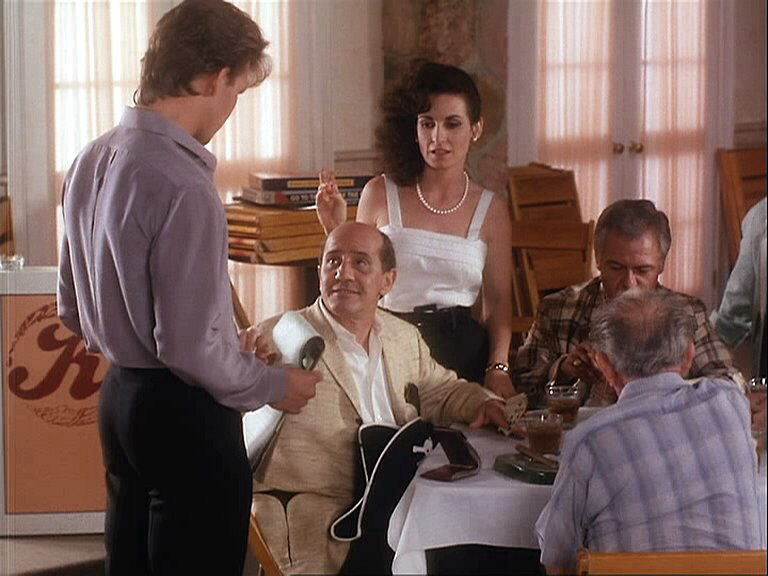 |
| Vivian Pressman (Miranda Garrison) looking rather young and very sexy in the 1987 "Dirty Dancing" |
So, in the 1987 movie, the age difference between Castle (35) and Pressman (Garrison, 37) is only two years, whereas in the 2017 ABC movie the difference between Castle (31) and Pressman (63 is 32 years.
 |
| Vivian Pressman (Miranda Garrison, age 37) in the 1987 movie and Vivian Pressman (Katay Sagal, age 63) in the 2017 movie |
I think that the Castle-Pressman relationship in the 2017 ABC movie is closer to the original story in Bergstein's mind as she was writing her screenplay.
======
I speculate also that the original Castle-Pressman relationship was based in the Arthur Murray Dance Studio where Castle had learned to dance and worked in past years. In my previous blog article, titled Working as an Instructor at Arthur Murray, That article reported that rich female clients sometimes provided money for dance-studio owners and instructors to stay in business and open new studios. The Castle character perhaps viewed the Pressman character as a wealthy source of funding for a future dance studio..
======
I speculate further that Bergstein's originally conceived her third movie Let It Be Me as a sequel to Dirty Dancing. However, by the time Let It Be Me was filmed in 1994 (eight years after Dirty Dancing had been filmed in 1986), the story and main characters were differentiated greatly from those of Dirty Dancing.
In the movie Let It Be Me, male dancer, named Bud, is struggling to make his dance studio into a successful business. A young woman, named Emily, enrolls in dance lessons at the studio in order to practice dancing with her fiance for her upcoming wedding. It turns out that Bud and Emily know each other but have not had any contact with each other since they had ended a sexual relationship 12 years previously, when Emily had been 17 years old. In this regard, Let It Be Me seems to have been conceived as a Dirty Dancing sequel that would have brought Johnny Castle and Baby Houseman back together briefly in the year (1963 + 12 =) 1975.
If so, then Vivian Pressman might have been included as a continuing investor in the dance studio. Such a character is not included in Let It Be Me, but one character is rich, elderly woman who takes dance lessons at the studio and eventually marries one of the dance instructors, who is about her age. The falling-in-love relationship of these two elderly characters is quite charming and heart-warming.
If Let It Be Me had become a real sequel to Dirty Dancing and if Pressman had been included as a character, then Let It Be Me might have ended with Pressman's happy marriage to a dance instructor who was about her own age.
In general, Let It Be Me provides much insight into the difficulties of managing a dance-studio business. Pressman as a wealthy female investor pressuring the male owner to make the business profitable could have been inserted into the story easily.
If Let It Be Me had become a successful sequel, then Bergstien well might have made a prequel about how Castle and Pressman had met at an Arthur Murray Dance Studio before 1963.
Through the three movies -- the prequel, Dirty Dancing and the sequel Let It Be Me -- the continuity would have been the relationship between Johnny Castle and Vivian Pressman.
Sunday, December 28, 2008
Eleanor Bergstein and Five Female Characters
Eleanor Bergstein, the author of Dirty Dancing, based the story on her own experiences. Like the movie’s main character, she grew up in a family that visited resort hotels in the Borscht Belt regularly during summer vacations.

Bergstein was born in 1938 and therefore was 17 years old in about 1955. The movie’s main character was 17 years old in the year 1963 and so would have been born in about 1946. The movie was issued in 1987 and told a story that took place in 1963, so the initial audience was looking back about 24 years.
Why didn’t Bergstein set the movie’s time in about 1955, when she herself was about 17?
Bergstein did not address that question in her running commentary about the movie, but she did say that she worked at such a resort hotel in her summers during her college years and also that she worked as an Arthur Murray dance instructor during her college years. If we estimate that she attended college as an undergraduate from about 1956 through 1959 and further attended as a graduate student from about 1960 to 1963, then we can suppose that her last summer working at the camp might have been in about 1963, which is the summer when the story takes place.
This suggests that Bergstein based two of the movie’s characters on herself:
the 17-year-old girl visiting the resort hotel with her family
the 25-year-old woman teaching dance at the resort hotel.
The movie does not specify the two dance instructors’ ages, but I read somewhere that Patrick Swayze was 35 years old when he played the movie’s dance-instructor, who was supposed to be 25 years old. (Likewise Jennifer Grey was 27 years old when she played the 17-year-old girl.) If the male instructor indeed was supposed to be 25 years old, then we can suppose that the female dance instructor was about the same age.
-----
In the movie, the female dance instructor, named Penny Johnson, had a platonic friendship with the male instructor, named Johnny Castle. Meanwhile she had fallen in love and become pregnant with a college student, named Robbie Gould, who had just been accepted into medical school. We can suppose that he was finishing his undergraduate studies and therefore was about 21 years old.
When Penny Johnson learned that Robbie Gould does not want to marry her, she decided to have an abortion, which could be done only on one particular night when she was supposed to perform a dance with the Johnny Castle. Therefore, the 17-year-old female guest agreed to learn the dance and then pretend to be Penny Johnson on that night. The 17-year-old female guest thus became the 24-year-old dance instructor in the story. Therefore we should appreciate that Eleanor Bergstein in her story perceived herself as both female characters, the younger one eventually becoming the older one.
There is a scene in the movie where the dance instructor danced behind and guided the girl as the girl began to learn to dance. There is another scene where the dance instructor and the girl were mirroring each other's movements. In both scenes we might say that the girl became the dance instructor.


Since Eleanor Bergstein’s own father was a doctor and her family life was happy, we can suppose that she herself as a young woman would have idealized a husband who would have been a doctor. She therefore could have imagined herself as easily seduced by a medical student. Perhaps she even had such an experience.
The dance instructor’s name is Johnny Castle, and the father’s name is Jake Houseman. Both their first names – Johnny and Jake – are nicknames for the proper Biblical name Jonathan.
-----
Both of Eleanor Bergstein's parents died when she was in her early twenties. She was affected most profoundly by the death of her mother, about which she later wrote: “Losing my mother was so frightening. I had an almost total absence of hope, and I closed myself off, unable to face the grief and the pain.”
After both her parents died, Eleanor went to live with another family that had many relatives who had died in the Holocaust. This new family talked about these murdered relatives almost every day, which made Bergstein even more depressed.
She tried to continue making a living a dancer as a professional dancer but then gr1adually became a novelist and then a screenwriter. She married a man who became a professor of poetry at Princeton University. Many of her stories, novels and screenplays included dancing as a story element.
In 1980 a movie based on one of her screenplays was issued. The movie was titled It’s My Turn and starred Jill Clayburgh, who played a mathematics professor, and Michael Douglas, who played a former professional baseball player who had to retire early because of an injury. Each of these two characters had lost a parent through death, and the surviving parents fell in love and married. The two characters met at the wedding of their parents and then fell in love themselves, even though they now were step-sister and step-brother. The script included a scene where the two characters dance, which then leads to their first sexual experience together. The dance scene was removed from the movie’s final version, however, which dismayed Bergstein.
The removal of this dance scene from It’s My Turn decisively motivated Bergstein to write the movie Dirty Dancing, in which dancing is the main theme.
--------------
Eleanor Bergstein was named after Eleanor Roosevelt, but she was called Baby by her family and friends through her teenage years. She had an older sister named Frances, who was named after Frances Perkins, who was President Franklin Roosevelt’s Secretary of Labor from 1933 to 1945.
In the movie Dirty Dancing, the central family’s name is Houseman, its older daughter is called Lisa, and its younger, 17-year-old daughter is called Baby. After Baby became intimate with Johnny Castle, he asked her what her real name was, and she told him that it was Frances, because her parents had named her after the first female member of the US Cabinet.
In the movie, the older sister Lisa was frivolous, and her main interest was beauty and fashion. She thought she might have a successful career in show business and she gladly participated in the resort hotel’s talent show. The audience sees her rehearsing for her talent-show performance, and it is obvious that she had no performance talent and would never succeed in show business.
In the movie, the younger sister Baby (Frances) was very serious and intended to major in international economic development when she began her studies soon at Mount Holyoke College, a prestigious women’s college. At the beginning of the movie, she was already reading a textbook about the economics of peasant societies. She had a plain appearance and she dressed drably (during the first half of the movie). On one occasion Lisa suggested to Baby that she restyle her (Baby’s) hair in a more attractive appearance, but Baby is not interested. When the hotel owner’s grandson flirted with Baby, she tried to avoid him.
In real life, the older sister Frances was the unemotional, serious, intellectually ambitious sister. Frances eventually became a mathematics professor and served as the basis for the character played by Jill Clayburgh in Bergstein’s movie It’s My Turn.
In real life, the younger sister Eleanor was the frivolous, entertaining sister, always called Baby by everyone who knew her. Eleanor worked as a professional dancer, married a poet, lived a Bohemian life, strove to break into show business, and eventually made a career as writer and producer of chick flicks.
Thus we should appreciate that Eleanor Bergman saw herself in three of the movie’s main female roles, as
Baby Houseman,
Penny Johnson,
Lisa Houseman.
The third role is an inside joke for people who know Eleanor Bergman’s real family and who recognize that the two sister’s names and personalities have been switched. Whenever the movie makes fun of the older sister Lisa as a frivolous nitwit who, for example, obviously never will achieve her fantasy of succeeding as a dancer in show business, the movie really is making fun of Eleanor Bergstein herself. And when the movie depicts Baby Houseman as a serious young intellectual, the movie is attributing the real older sister Frances’s most admirable characteristics to the real younger sister Eleanor.
-----
In general, the movie scrambles the two sisters Lisa and Baby and the female dance instructor Penny Johnson. As I have already pointed out, Baby eventually became Penny Johnson. Furthermore, Lisa and Penny fell in love and had sex with the same medical student Robbie Gould. Meanwhile Baby fell in love and has sex with the male dance instructor Johnny Castle, who initially seemed to be the lover and impregnator of Penny. While writing her script, the author Eleanor Bergstein apparently saw herself in each of these three female characters and in each of their situations.
-----
The family’s mother, Marjorie Houseman, plays a role in the film, but because of an unexpected fluke, her role was altered significantly. In real life, Eleanor Bergstein’s real mother, who was a doctor’s wife and a homemaker, had enough money and time to become a superb golfer. On the other hand, Eleanor Bergstein’s real father, who was a busy doctor, always remained a mediocre golfer. Therefore Eleanor Bergstein wrote into the script a scene where both parents are practicing on a putting green. The scene was supposed to display the mother’s competence and give her an opportunity to instruct her husband.
When the scene was filmed, however, the actor playing the father (Jerry Orbach) happened to sink two long puts in a nonchalant manner. Furthermore, the second put swirled around the hole three or four times before it fell in. Since the director Emile Ardonlino enforced a strict rule that all actors must continue to play their roles seriously, even if something unexpected happened, the actor maintained a straight face even though he was supposed to miss both puts.
This unexpected feat, all caught perfectly on film, was so hilarious that Eleanor Bergstein immediately rewrote the dialogue so that the father subsequently instructed the mother condescendingly about her golf technique. One dialogue line that did remain was the father’s remark that if he ever died, the mother probably would immediately marry Arnold Palmer (the most famous professional golfer of that time).
During her running commentary about the film, Eleanor Bergstein told this story about the change of dialogue in the putting scene and apologized to her deceased mother for demeaning her well-deserved reputation as a superb golfer.
Some of the mother’s dialogue might have been removed from the film because the actress who began to play the mother while the movie was being filmed became sick after several days and was replaced. (In one of the first scenes, when all the guests are arriving and unloading their cars, the mother is a blonde, but during the rest of the movie she is a brunette.)
In the scenes where we do see the mother acting, she is restraining the father’s angry reactions to Baby’s actions. For example, in the last scene when Johnny Castle barges into the talent show and grabs Baby and leads her toward the stage, the father rises from his chair to interfere, but the mother grabs the father and pulls him back into his chair.

Thus Eleanor Bergstein intended to present the mother as a strong and capable mother who encouraged her daughters to succeed as independent women. The movie states explicitly, for example, that the younger daughter had been named after the first woman to serve in the US Cabinet (although in the real family the older sister was so named) and was sending this daughter to attend a prestigious women’s college. Thus we should appreciate that the movie’s author Eleanor Bergstein intended to identify the mother with the daughter. This was a mother who wanted to realize her own frustrated professional ambitions through her intellectual, studious, ambitious daughter Frances (the older daughter in the real family).
Thus the author Eleanor Bergstein identifies herself with four of the movie’s female characters:
the younger daughter Baby Houseman,
the dance instructor Penny Johnson,
the older daughter Lisa Houseman,
the mother Marjorie Houseman,
-----
The movie features a fifth female character, named Vivian Pressman. She was a middle-aged female guest, married to a man who spent much of his time at the hotel resort gambling. She took dance lessons from Johnny Castle and had a sexual affair with him. Thus she resembled Baby Houseman, who likewise took dance lessons from and had a sexual affair with Johnny Castle.
(When the actress who was supposed to play the mother had to drop out of the movie because of an illness, she was replaced by the actress, Kelly Bishop, who was supposed originally to play Vivian Presssman. In turn, the role of Vivian Pressman was filled by an assistant choreographer, Miranda Garrison, who had helped train the female “dirty dancers” in the cast. The unexpected but perfect placement of dirty-dancer, sluttish Garrison into the Pressman role is irrefutable proof that the production of the movie Dirty Dancing was inspired, favored and guided miraculously by Mankind’s Loving and Omnipotent God.)
Another similarity is that both Vivian Pressman and Baby Houseman gave money to Johnny Castle for sexual reasons. Vivian Pressman arranged for her gambler husband to give $100 to Johnny Castle for dance lessons, although it is apparent that Vivian Pressman hoped that this monetary payment would enable her own sexual affair with Johnny Castle. On the other hand, Baby Houseman arranged for her father to give $250 to Johnny Castle for Penny Johnson’s abortion.
Eventually, Vivian Pressman was rejected by Johnny Castle and so had a sexual affair instead with the medical student Robbie Gould. The older sister Lisa Houseman intended to have a sexual affair with this same Robbie Gould, but this intention was interrupted when she found Gould and Pressman in the act of sexual intercourse.
Thus, we should appreciate that Eleanor Bergstein identified herself finally with this fifth female role too. This was an older, predatory female that the younger, idealistic females might become. Vivian Pressman competed with the younger sister Baby Houseman for a sexual affair with Johnny Castle and then competed with the older sister Lisa Houseman for a sexual affair with Robby Gould. Although Baby Houseman defeated Vivian Pressman in the competition for Johnny Castle, Pressman subsequently accused Castle of stealing money from her husband and so caused the hotel resort owner Max Kellerman to fire Castle, which seemed to ruin Baby Houseman’s relationships with Castle and with her father.
Vivian Pressman is the movie’s main villain, but the author Eleanor Bergstein identifies with her too. When Bergstein finished writing Dirty Dancing in about 1984, she herself was in her mid-forties, about the same age as the Vivian Pressman character. Vivian Pressman represents the middle-aged Eleanor Bergstein’s enduring, competitive, wicked lust for sexual adventures and experiences with attractive young men.
Thus we should appreciate that Eleanor Bergstein herself identified with the movie’s five main female characters:
the 17-year-old idealistic younger daughter Baby Houseman,
the 25-year-old talented dance instructor Penny Johnson,
the 19-year-old frivolous older daughter Lisa Houseman,
the admirable, faithful middle-aged wife and mother Marjorie Houseman,
the contemptible, adulterous middle-aged wife Vivian Pressman,
Saturday, December 27, 2008
The Resort Hotel's Employees
None of Dirty Dancing’s dialogue mentions that anyone is or is not Jewish or addresses any particular Jewish concern. The overwhelming majority of the people who have watched this movie have not perceived that it takes place in particular Jewish cultural institution or that it has anything at all to do with Jews or Jewish concerns.
In fact, that very absence of Jewish concern is a major reason that the Borscht Belt disappeared. By the mid-1960s the Jewish population of New York had assimilated and prospered into American society. They could go to any resort and enjoy real upper-class life, not just a Jewish imitation. Every Jewish family had a television and could watch successful Jewish performers every day. Even the families that still did visit the Borscht Belt did so more as a familiar, family tradition that had become devoid of Jewish consciousness. Jewish families still preferred that their children eventually marry other Jews, but they also preferred that their children finish their higher educations first, so the Jewish parents’ mingling of their Jewish teenage children during summer vacations had lost its urgency.
A major irony of the Dirty Dancing story is that the main character, a 17-year-old girl in a prosperous family that is visiting such a resort hotel, prefers to spend her time and energy socializing with the employees who live in cabins behind the hotel and who dance in a vulgar, “dirty” manner in a dilapidated warehouse or in a remote forest, meadow and even a lake. For this girl, the cultural enrichment she acquires during her vacation is her encounter not with upper-class WASP (White, Anglo-Saxon Protestant) society, but rather with a lower-class society comprising Irish (e.g. Johnny Castle), Puerto Rican, Negro and various mongrel dregs.
The resort hotel where the movie takes place is called Kellerman’s, and it is owned by a man named Max Kellerman, played by a 63-year-old actor (Jack Weston). He apparently owns two such hotels, the other one being called The Sheldrake. Max Kellerman is assisted by his grandson, Neil Kellerman, who intends to enroll soon in the Cornell School of Hotel Management and who appears to be about 20 years old. This grandson Neil indicates in a remark that he already considers himself to be the owner of the two hotels, foreseeing that his grandfather will retire when he himself graduates from Cornell.
-----
The hotel employs a big-band orchestra, which seems to comprise mostly Cubans of African ancestry. We can assume that this orchestra alternates evenings between the two hotels and that the orchestra members do not do any work at the hotels besides playing music.
When the producers were selecting a resort as a location for the movie, they looked for a resort with a swimming pool, because the movie was supposed to show that the swimming pool was racially integrated. The author Eleanor Bergstein in her running commentary mentioned that the Jewish-owned resorts racially integrated their swimming pools before the other resorts did so, so apparently her original script included a reference to that fact. However, the producers could not find an available resort with a swimming pool (we do see guests swimming in a lake). Therefore none of the movie’s dialogue refers to the racial integration of the swimming pool, although the dialogue refers several times to the Civil Rights movement that was developing in the South in the early 1960s. We can suppose that the African-Americans in the planned swimming-pool scene would have been the orchestra members, who were idle during the days.
Several of the employees who live in the cabins and who dirty-dance in the warehouse are African Americans, but they probably are not orchestra members, who are older and are busy playing their music in the evenings while the young employees are dirty-dancing.

The orchestra conductor is about Max Kellerman’s age, and Max Kellerman seems to treat him as a social peer. We should understand that the orchestra members are an upper and distinct social class of the hotel’s employees. The orchestra members are older and are professionally established, and they rest during the mornings and days and work during the evenings and nights.
-----
Another category of employees works in positions that interact directly with the guests. For example, the movie dialogue mentions explicitly that the restaurant waiters are college students who work in the hotel during their summer vacations. We can suppose that this employee category includes also receptionists, social-activity leaders, life guards, and so forth. Most such employees were former guests who had visited the resort in younger years with their families.
In a scene that follows soon afterward, Mr. Kellerman is instructing the restaurant waiters about their conduct rules during their employment. He tells them:
You waiters are all college guys, and I went to Harvard and Yale to hire you. And why did I do that? Why? I shouldn't have to remind you. This is a family place. That means you keep your fingers out of the water, hair out of the soup, and show the goddamn daughters a good time -- all the daughters, even the dogs. Schlepp 'em out to the terrace, romance 'em any way you want. Got that, guys?
Although these employees are only waiters at the hotel, they are university students and also (although not stated in the dialogue) Jews who might be appropriate marriage candidates for the young women among the guests. Furthermore, the Jewish parents might even welcome romantic interest from such employees toward their daughters. One of the waiters, named Robbie Gould, is a medical student, and so he is treated very warmly by the family father, who himself is a doctor. It is apparent that the father considers this medical student to be a good romantic prospect for either of his two daughters.
-----
As Mr. Kellerman is completing his instructions to his waiters, another group of male employees walks through the restaurant, and Mr. Kellerman instructs them differently:
Well, if it isn't the entertainment staff. Listen, wise ass, you got your own rules. Dance with the daughters. Teach 'em the mambo, the cha-cha, anything they pay for, but that's it, that's where it ends. No funny business, no conversations, and keep you hands off.
This second group of male employees is dressed in matching shirts and is carrying guitars in cases, so it is apparent that they are a musical band. One of this group is dressed differently than the others, and he is the one who Kellerman addresses as “wise ass” and instructs about how to conduct himself with the guest families’ daughters.

Mr. Kellerman addresses this second group as “the entertainment staff” but later in the movie we see some of them doing ordinary jobs on the hotel grounds. We can suppose that some of them cook and wash dishes in the kitchen, clean floors, mow the grass and do other such jobs. In fact, they might not be paid at all by the hotel for playing music as a band. They play in the band only for tips and for the opportunity to acquire some public exposure as a band. Probably they can use the stage on the evenings when the orchestra plays at the other hotel. Their exposure provides them with some possibilities that some families might hire them later to play at Bar Mitzvah, wedding and anniversary parties. Apparently there is also a shortage of male guests at the dance classes for the guests, and so these band members fill in only as needed to correct the male-female ratio for partner dancing but are not supposed to socialize further with the female guests.
(We never see this band play in the movie. The DVD’s commentaries and interviews inform us that the producers had great difficulty convincing Patrick Swayze to accept the role of Johnny Castle, and furthermore Swayze’s own agent advised him against accepting the role. Eleanor Bergstein, the movie’s author, in her running commentary, reminisces about how, before the filming began, Swayze gave her a tape recording of a song, titled She’s Like the Wind, that Swayze had written and performed with a band that he headed in his real life. Therefore I speculate that in order to convince Swayze to accept the role, the producers agreed to provisionally include a scene where Swayze would perform his song with his band. Apparently the scene was removed from the movie’s final version, but the earlier scene where the band encountered Mr. Kellerman remained. As a consolation to Swayze, his song was included in the soundtrack.)
-----
Such a hotel would hire also a lot of female employees to work as housekeepers to clean the rooms. We never see Mr. Kellerman address them, but we do see them hanging around in and around the cabins and dancing in the warehouse.
These ordinary male and female employees – who cook and wash dishes in the kitchen, who clean the floors and do repairs, who mow the grass, who clean the rooms, etc. – were not supposed to socialize with the guests. A major reason for this restriction is that these employees were not Jewish, a fact that is obvious from their appearances – many are African-American or Hispanics.
-----
Two of the employees – Johnny Castle and Penny Johnson – are professional dancers, and they comprise an employee category of their own. They work as professional dancers only during the summers at the resort hotel. Johnny Castle, for example, works primarily as a house painter during the rest of the year. Their employment at the resort hotel comprises several elements:
-
They performed special dances for the hotel guests while the orchestra played. They did so at both hotels.
-
Then they encouraged the hotel guests to dance while the orchestra played. They were available to give special dance lessons to guests who were willing to pay for such lessons.
-
They organized and conducted a talent show that was performed on the final night. Hotel employees were required to participate in the talent show and guests were encouraged to participate.
-
They taught the employees to do group dances that were part of the talent show.

An early scene shows Johnny Castle and Penny Johnson dancing together spectacularly during a ballroom dance on the new guests' first evening at the hotel. Neil Kellerman remarked (to Baby Houseman) that they should stop dancing with each other and start dancing with the guests, because they would not sell dance lessons if they danced only with each other. Thus it seems that the hotel received a cut from the dance lessons that the professional dance instructors sold.
Since these dance-instructor jobs involved much socialization with the guests, the hotel owners would have preferred to hire Jews for these positions, but there simply was a shortage of Jews who could dance so expertly. Therefore non-Jews were hired, but they were supervised closely.
The movie includes several instances of such close supervision by Max Kellerman or by his grandson Neil Kellerman. In one instance, Max Kellerman motioned angrily to the two professional dancers that they should stop their dance performance and begin encouraging the guests to dance. In another instance, Neil Kellerman intruded without knocking into a room where Johnny Castle was giving a private dance lesson to the 17-year-old female guest. Neil Kellerman remarked that the dance lesson must last exactly as long as the time that the guest has paid for and also insisted that the talent show’s group dance by the employees be done in a dance style that Johnny Castle had rejected.
The two dance instructors have non-Jewish names – Johnny Castle and Penny Johnson – and they have personal appearances that are far from Jewish stereotypes.
When Penny Johnson became pregnant after an affair with the waiter Robbie Gould, she and Johnny Castle feared that they might be fired by the Kellermans as a consequence. One reason, which is not stated, was that the Kellermans valued the Jewish medical student Robbie Gould more as an employee than they valued the non-Jewish professional dancer Penny Johnson. If the pregnancy became known, then there would not be enough room on the hotel staff for both Gould and Johnson, and so Johnson would have to go. Gould came from a Jewish family that had been regular customers of the hotel for many years, and now he was attractive to Jewish families who had daughters who were entering a marriageable age.
Another problem caused by Johnson’s pregnancy was that she would not be available to dance in the hotel’s special performances. The pregnancy itself eventually might have prevented such performances, but the problem that developed in the movie was that she decided to have an abortion that had to be performed on a particular night when such a performance was scheduled. This situation led to a decision that the 17-year-old guest would learn the dance sufficiently well to substitute for Johnson on that one night. Many employees were young females, but none of them are available to learn the dance because they all were too busy cleaning the rooms during the days and preparing for the talent show during the evenings.
Since Penny Johnson was a couple months pregnant and since the story took place at the end of the summer, she apparently became romantically involved with Robbie Gould at the beginning of the summer or even during a previous summer while they were both working at the hotel. Penny Johnson sincerely loved Robbie Gould and expected to marry him, especially after she became pregnant. She was an extraordinarily beautiful and talented woman, but Robbie Gould could not consider marrying her, because she had not even graduated from high school and (although not stated) she was not Jewish.
Although Penny Johnson's status on the hotel resort's staff was much higher than the status of the female employees who worked as housekeepers and other such ordinary positions, she was subject to the same sexual rules probably applied to her and to all such female employees. They were forbidden to involve themselves in personal relationships with the male guests or20even with the Jewish male college students who worked as waiters, and any scandals were grounds for immediate firing.
The producers originally had selected an Italian-American actor to play the role of the male professional dancer. The producers soon decided that this first actor would not be able to dance as well as they expected, so they eventually replaced that actor with Patrick Swayze. The author Eleanor Bergstein indicated in her running commentary that this character thus ceased being an Italian-American character and instead became an Irish-American character. None of the dialogue indicates that this character is Irish-American, and the name Johnny Castle is not distinctively Irish, but perhaps this point was made by some dialogue that did not survive into the movie’s final version.
-----
One of the movie’s characters is Johnny Castle’s young cousin, Billy Kostecki, whose name is Polish (indicating the employees’ mongrel pedigrees). In some previous summer, Johnny Castle had convinced Max Kellerman to hire Castle’s cousin Billy Kostecki to do odd jobs at the hotel. Kostecki was about the same age as the 17-year-old female guest and apparently had began a platonic friendship with her during a previous summer when they both were quite young.
Billy Kostecki plays what the author Eleanor Bergstein describes as an "expository role" in the screenplay. At various moments, he explained the developing situation to the young female guest and thus to the audience. In particular, he told her that Penny Johnson had become pregnant and then later that the pregnancy was caused by an affair with the medical student Robbie Gould. In some other moments, Kostecki's explanations advanced and clarified the story conveniently for the audience.

Billy Kostecki also serves as a means to bring the young female guest into the employees' secret world. Kostecki was supposed to carry three watermelons from the kitchen to the remote warehouse where the employees were supposed to be practicing dances for the talent show. He was not able to carry all three watermelons safely, however, so when he noticed the young female guest, he asked her to help him by carrying one of the watermelons. Thus she accompanied him to the warehouse, where she saw and joined the employees, who have been doing their own dirty dancing instead of practicing for the talent show. Without Kostecki's role, the young female guest never would have gone into that warehouse and become involved with the other employees.
Subscribe to:
Posts (Atom)