This blog discusses the movie Dirty Dancing, which was released in 1987 and starred Jennifer Grey and Patrick Swayze. The articles discuss:
* literary aspects, such as characterization, motivation, interactions;
* the music and dances;
* the production of the movie;
* critical reactions.
In my previous article, Vestron's Gamble, I pointed out the following passages (emphasis added):
.... independents like Vestron depend on acquiring other people's movies. They have been forced to pay more and more money to grab the remaining few independent "A" titles, laying out huge up-front guarantees against future royalties of (usually) 20 percent.
[.....]
Vestron's first fully financed picture (structured as a negative pickup), the $6 million Dirty Dancing, turned out so well that ....
I have only a pedestrian understanding of movie financing.
======
I do not know if the royalties are on the gross or on the net. However, since the production costs have become only a tiny part of the movie's gross earnings, the gross and net are essentially the same.
For the sake of easy arithmetic, let's suppose that Dirty Dancing has earned $100 million. If so, then Vestron (or whoever bought Vestron) earned $20 million in royalties. Then someone else -- mostly Linda Gottlieb? -- earned the other $80 million.
======
The Lawyers.com website defines a "negative pickup" in entertainment law as follows:
Negative pickup means a distributor’s guarantee or agreement to pay a specified amount for distribution rights upon delivery of a completed film negative by a stipulated date. The distributor has no obligation to license the film if the picture is not delivered on time and in accordance with the terms of the agreement. A negative pickup guarantee may be used as a collateral security to obtain a bank loan in order to meet the production expenses of a movie.
The Wikipedia article about a negative pickup includes the following passages.
In film production, a negative pickup is a contract entered into by an independent producer and a movie studio conglomerate wherein the studio agrees to purchase the movie from the producer at a given date and for a fixed sum. Depending on whether the studio pays part or all of the cost of the film, the studio will receive the rights (theatrical, television, home entertainment) domestic and/or international to the film, with net profits split between the producer and the studio.
In the case of Dirty Dancing, I suppose that Gottlieb fits the above definition as the "independent producer" and Vestron fits as the "movie studio conglomerate". (However, maybe it's just the opposite.)
If I am supposing correctly, the split of net profits was 80% for Gottlieb and 20% for Vestron.
The Wikipedia article continues.
The word "negative" in this context can be confusing because it does not relate to a numerical value (where negative means less than zero), but instead comes from the pre-digital era in which a motion picture was embodied in physical film negatives.
By selling the rights to distribute the film in territories not covered in the negative pickup ("pre-selling") or making other deals collateral to the production, a producer will usually cover all their costs and make a small profit before production has begun. But financing of the production up to its completion date is the responsibility of the producer—if the film goes over budget, the producer must pay the difference themselves or go back to the studio and renegotiate the deal. This happened on the films Superman, The Empire Strikes Back, Never Say Never Again, The Thief and the Cobbler, and Lone Survivor.
Most negative pickup contracts, either from motion picture studios or television networks, are bankable at pretty much dollar for dollar (less fees); if one holds a negative pickup contract, one essentially holds a cheque from the studio for the cost of the film, post-dated to the day one delivers the film to them. So, while the studio technically does not pay the producer until the film negative is officially delivered (thus "negative pickup"), the producer can nonetheless get a bank loan against a negative pickup contract, which helps them to pay for production of the film.
Studios, on the other hand, typically do not like their contracts being factored at banks or shopped around to independent investors and financiers, as this ultimately gives the producer significant creative latitude over the production. With the money assured, a producer has a free hand to make the film however they please, and they are only answerable to their investors, which in this scenario are unknown to the studio at the time of the contract. If creative disagreements arise between the studio and the producer, the studio has little contractual recourse as long as the film meets certain general contractual requirements, such as duration and technical quality.
An example of this is Terry Gilliam's Brazil, a negative pickup for Universal Pictures produced by Arnon Milchan. In this particular case, the studio had creative disagreements with the director over choice of star, content, and duration, and failed to resolve these issues to its satisfaction, because the negative pickup had essentially granted Milchan final cut.
The studios and distributors will contain this risk by offering the negative pickup contract only to a production that has financiers, a script, and key creative personnel, particularly the director and stars, already attached. Thus the conundrum: unless a film has U.S. distribution, a lot of investors and foreign buyers will not pre-buy a film, and unless the film is already financed, the studios do not want to guarantee distribution. This catch-22 is often resolved by attaching a major actor to the film; the mere appearance of an American movie star's name on a film's poster is often enough to drive box office to cover distribution in many foreign markets.
If someone can explain these clues about the financing of Dirty Dancing, then please do so.
Excerpts from an article titled Vestron's Gamble, written by Anne Thompson and published by the LA Weekly on June 25, 1987 -- about two months before the movie Dirty Dancing was released.
Vestron's Gamble published
by LA Weekly on June 25, 1986
The article mentions (emphasized below) that Vestron normally advanced a movie's production costs against 20% of future royalties. If Vestron did so for the movie Dirty Dancing, then someone else received 80% of the royalties.
I speculate that Linda Gottlieb earned most of that 80%.
The article states also (emphasized below) that Vestron structured the movie as a negative pickup.
The article's text:
The outlook for Vestron Inc. has been bleak for the past year. After founder Austin Furst's home video company rose from the ashes of Time/Life Films in 1981, it reaped record profits in the burgeoning home video market, reaching sales of $200 million in 1985 (up 120 percent from 1984) and a No. 2 market share, based on a volume business in feature film cassettes and music videos such as Michael Jackson's "Thriller." In October 1985 Furst made himself rich by going public with a controversial stock offering. But Vestron's market share plummeted to seventh place in 1986 when its earnings declined 90 percent. In the first quarter of 1987 the company actually lost $2 million and laid off 50 employees.
What happened?
In a way, video pioneer Furst created his own monster: the booming home video market. When it was new, curious video consumers would buy anything, gobbling up Verstron's wide inventory of "B," "C" and "D" titles. As the market grew more profitable, other -- studio -- players became increasingly involved. And, gradually, customers and video outlets began buying more recognizable "A" titles that had already been established by substantial theatrical release.
Whereas the major release their own films via such home video subsidiaries as CBS/Fox Video or Paramount, independents like Vestron depend on acquiring other people's movies. They have been forced to pay more and more money to grab the remaining few independent "A" titles, laying out huge up-front guarantees against future royalties of (usually) 20 percent.
Last year, Vestron paid $25 million to DEG for six movies (including the dud Taipan), and $50 million for 10 Taft-Barish titles. A dangerous business: When a $5-million acquisition like Shanghai Surprise fails to sell more than 100,000 cassettes, Vestron faces big losses; in fact, it lost $1 million on the Madonaa/Penn starrer. ...
The so-called "captives" -- cassette producers that are also arms of major theatrical suppliers -- now dominate the video industry just as much as they do the theatrical business. ....
To cope with these changing forces, Vestron made a significant survival move. If home video depended in theatrical box office, then Vestron needed to produce and distribute its own titles. In January 1986 Vestron formed a motion picture division to create the movies it was paying too much to acquire; later, it created a new TV arm, plus a foreign sales operation from the remains of the defunct Producer's Sales Organization. Vestron is a budding entertainment conglomerate -- if it survives.
Vestron Pictures is the first production/distributor formed by a video company. It started small by acquiring such English-language specialty films as Rebel and Malcolm (two Australian disappointments_ and the current, more popular British released Personal Services and Gothic (scooped up when Atlantic Releasing pronounced the Ken Russell film "unmarketable").
But the company is also financing pictures in the $2 to $6 million range under the direction of recently promoted Vestron Pictures president Bill Quigley and production senior vice president Ruth Vitale.
"We're looking under the radar of the majors and over the gunsights of the specialized film distributors," says Quigley. Before producing a movie, Quigley and Vitale canvas the other Vestron division for market viability. "It's silly to make these decision ins vacuum," says Vitale.
Vestron's gamble is that Quigley and Vitale's pictures will provide its video division with the theatrically driven "A" titles it so desperately craves. Viatale insists that a $6-million budget is sufficient to produce an "A" movie.
Vestron's first fully financed picture (structured as a negative pickup), the $6 million Dirty Dancing, turned out so well that the neophyte distributor is taking the huge gamble of releasing it wide during one of the most competitive summer seasons in recent memory. A highly commercial feel-good dance romance set in the Catskills n 1963, Dirty Dancing (which stars Patrick Swayze and Jennifer Grey) was discovered in turnaround from MGM.
"For a larger studio it would have been a little picture," says producer Linda Gottlieb. "For Vestron it was a big deal, it was their $25 million musical." Vestron is going all the way with Dirty Dancing: Sales chief M.J. Peckos hopes to book it in as many as 800 theaters August 21, when it will compete against all the other hot summer-season box-office performers. If the picture can grab enough audiences without laying out studio-level big bucks for promotion, and hold on to theaters, Dirty Dancing could hit in a big way -- and save the company.
I recently published a series of articles -- Part 1, Part 2, Part 3 and Part 4 -- about the book The Fan's Love Story, which was written by Sue Tabashnik and was published in 2010.
Now I beginning another series of articles about Tabashnik's sequel book, titled The Fans' Love Story: Encore, which was published in 2013. In this series of articles, I will call this book simply Encore.
Cover of The Fans' Love Story -- Encore
The first chapter of Encore is the same as the first chapter of the previous book. This chapter tells how she fell in love with the movie in 1987, joined the Official Patrick Swayze International Fan Club in 2000 and subsequently attended the Club's events, became acquainted with fellow fans, and wrote articles for the Club's publications.
The second chapter of Encore tells the developments between the publication of her first book in 2010 and the publication of her second book in 2013. This second chapter of Encore is divided into the following sections:
Screenings, Festivals and Events
Dirty Dancing Stage Show
Jennifer Grey and Dancing with the Stars
The Dirty Dancing Soundtrack
The Dirty Dancing Remake
The Patrick Swayze Statue at Madame Tussauds Hollywood
Dirty Dancing in Popular Culture
The Dirty Dancing Legacy
I will not dwell on this chapter.
======
The third chapter is a 13-page transcript of Tabashnik's interview of the movie's producer Linda Gottlieb. This interview was very interesting, and so I will summarize it.
Linda Gottlieb, producer of the movie Dirty Dancing
Bergstein met Gottlieb "many years ago" when they happened to be dating two men who were roommates. In 1985, when Bergstein was beginning to develop her screenplay for the movie that became Dirty Dancing, she learned that Gottlieb was working as a producer at the MGM movie company. Bergstein called Gottlieb out of the blue, reminded her that they were acquainted, and asked for help in developing her screenplay.
Gottlieb invited Bergstein to lunch at a sandwich restaurant called Between the Bread. Bergstein explained that her screenplay was about two sisters, one of whom is a natural dancer. The story took place in a Catskills resort. The dancing in the proposed movie would be Latin dancing.
Gottlieb was attracted by the idea that the proposed movie would feature Latin dancing. In the Tabashnik interview, Gottlieb explains:
Tango Argentino had just become a big success as a theatrical show in New York, and I thought, "Well, maybe there is something out there in the zeitgeist that says there's time for Latin music."
According to Wikipedia's article about Tango Argentino, this show premiered in New York in October 1985. Therefore, I figure that this lunch conversation between Bergstein and Gottlieb took place in the last months of 1985.
During that lunch conversation, Bergstein still (according to Gottlieb) did not have much of a story for her screenplay. Rather, Bergstein had merely an idea that included the two sisters, the Latin dancing and the Catskills resort.
Since Bergstein still did not have much of a screenplay story, Gottlieb asked Bergstein to tell about her own life.
She [Bergstein] said, "I grew up in Brooklyn. My father was a doctor. You know, I was a natural dancer. I was one of those girls who used to go dirty dancing with the guys from the wrong side of the tracks."
And I [Gottlieb] literally dropped my spoon and said, "That is a million-dollar title!"
She said, "What is?"
I said, Dirty Dancing.
She said, "But that has nothing to do with the story I want to tell."
I said, "Eleanor, that's the title, and now we're going to get the story."
So at lunch that day, we invented the character of Johnny over this lunch at Between the Bread. In other words, it was not ever in her original thinking, but it came from the title of Dirty Dancing.
Gottlieb asked Bergstein to define her expression "dirty dancing". Their discussion led to an understanding that the expression encompassed both dancing and music.
I said, "You know, if there's dirty dancing, what's the other kind of music?
She said, "You know, it's clean teen music."
And we realized there was a musical clash between the clean teen music (which begins the movie) and the dirty-dancing music.
Gottlieb claims in her interview that the Johnny Castle character was "born" at that lunch discussion.
======
Afterwards, Gottlieb pitched the screenplay concept to MGM producer Frank Yablans. He approved MGM's payment for a screenplay. Gottlieb claims in her Tabashnik interview that she collaborated with Berstein to write the script.
They [MGM] funded the cost of the script -- you know, the first draft, the second draft of the script -- which Eleanor developed with me. I was totally involved in the development of the script.
By the time Bergstein and Gottlieb completed the script's second draft, however, Yablans had been fired from MGM. This unexpected firing gave Gottlieb the opportunity, according to the MGM contract, to buy the script's rights for herself.
Since Yablans was gone, no MGM producer intended to develop the script further into an MGM movie. If Gottlieb could convince another producer to take over the script and give her enough money to reimburse MGM (within one year) for its payment to write the script, then Gottlieb would free herself and Bergstein from all her obligations to MGM in relation to the script.
I [Gottlieb] then took it [the script] and shopped it around to every major studio -- all who turned it down I think I had something like 43 rejections. I mean, I looked everywhere. Nobody wanted to make that movie.
I was trying to raise independent money to do it. A little company, called Vestron, called [in February 1986] through my agent. .... Vestron said they were interested in meeting with me about producing it. There were two people there -- Mitchell Cannold and Steve Reuther. Mitchell himself had grown up in the Catskills, and so the story resonated for him .... They took the title of executive producers on the movie and basically came up with the financing, provided that I could figure out a way to do the movie ... for about $4.5 million.
Unfortunately, Tabashnik did not ask Gottlieb to elaborate about the ownership of the movie's rights, but I speculate that Gottlieb ended up with essentially the entire ownership.
Keep in mind that Gottlieb was an experienced movie producer, whereas relatively Bergstein and Vestron were just novices in the movie business. Perhaps Gottlieb arranged for Bergstein to earn just a flat fee for the script writing and arranged for Vestron to earn a guaranteed but limited return on its investment. (I am just speculating; I do not know.)
=======
When Gottlieb was shopping the script around to various producers, she still had not established the participation of any specific actors. After Vestron provided the $4.5 million, Gottlieb began to hire the cast.
The Gottlieb family and the Grey family were acquainted, because their children had attended the same high school. Jennifer Grey was the first actress who auditioned for the Baby Houseman character. Jennifer came to the audition with her father, the actor Joel Grey.
He [Joel] sort of pushed her [Jennifer] forward. She was stammering and scared.
The first audition was just dancing. All we wanted to do was just turn on some music and see how you move. She clearly moved well. She's a good dancer.
And then she stopped dancing, and she turned to us -- the director, myself and Eleanor. And she said:
I just have to say something. I know I shouldn't, but I have to say something. I'm just like this girl, Baby. I talk too much. I care too much about everything I do. I so understand this girl. I'm exactly like her.
Oh, I shouldn't have said it. Forget I said that.
Of course, we fell in love with her.
Then we saw 150 other girls, and we cast Jennifer. She was the first person we saw.
Years earlier, Gottlieb had considered casting Patrick Swayze in a movie about ballet. She never made that ballet movie, but she kept him in mind. When she began casting the Johnny Castle character for Dirty Dancing, she auditioned him and watched the previous movies that had featured him.
Gottlieb worried that Swayze was too old for Dirty Dancing. He was 37, and Grey was 27. Despite their ages, however, they eventually were selected, because "they both looked much younger".
Gottlieb told Tabashnik that the alternate selections for the leading roles were Billy Zane and Kyra Sedgwick.
======
The above summary covers the first five pages of the 13-page transcript of Tabashnik's interview of Gottlieb. The remaining pages include the following tidbits:
* A stunt-double performed part of the log scene for Jennifer Grey.
* The "Love is Strange" scene was improvised by the director Emile Ardolino.
* Gottlieb considered casting Swayze's wife Lisa to play Penny, but ultimately decided that she was not as "strong" an actress as Cythia Rhodes.
* Gottlieb had to assign several people to get Swayze out of bed in the morning.
* A scene was shot with Jennifer bare-breasted, and Vestron intended to include it in the movie. Eventually, though, Vestron changed its mind and removed the scene.
* Part of the requirements to get a PG-rating was to remove the word shit, which had been said twice in the dialogue.
* Gottlieb, her children and her sister appeared as extras in the movie, because the local population did not have enough people who looked Jewish.
Jewish-looking Linda Gottlieb unloading her car trunk in an early scene
======
Previous articles in this blog that discuss Linda Gottlieb:
In the 1980s, Linda Gottlieb, an East Coast producer for MGM Studios, had lunch in New York City with writer Eleanor Bergstein, who had an idea for a movie about two sisters who are dancers, based in the Catskills.
“I said, ‘Well what’s the story?’ And she said, ‘I don’t really have a story, but it should involve Latin dancing…’” Gottlieb recalled. “So I switched the subject and said, ‘Tell me about yourself.’ She said, ‘I grew up in Brooklyn, my father was a doctor, I was one of those kids who used to go across the tracks to go dirty dancing.’
“I said, ‘That’s a million-dollar title! Now we’ll figure out the story.’ We invented Johnny Castle at lunch.” ....
I spoke with Gottlieb in the light-filled, two-story living room of her 10-room co-op on the Upper East Side of Manhattan –- the pad that Dirty Dancing bought. Petite and chic in cropped white denim jeans, white tee and a lace-collared, three-quarter-sleeve jacket, she bears a slight resemblance to actress Diane Lane, and appears more late 50s than early 70s. Warm and funny, Gottlieb is a natural storyteller.
MGM initially agreed to make the film, but the executive who signed the deal was fired two weeks later — and the rights reverted to Gottlieb for a year, Gottlieb said. She pitched everyone in Hollywood — and was rejected 43 times.
“What they all said was, ‘It’s small and it’s soft.’ These are all men — just think of sexual organs, they don’t want small and soft, they want big and hard,” said Gottlieb, cackling with laughter. “They said ‘it’s a girls’ film, it’s a historical film and it’s about Jews.’ They weren’t wrong logically, but I always saw it as a very sexy movie.” ....
The next challenge: Convincing the studio to go with a different kind of lead. “They wanted a terrible blond bimbo for the part,” Gottlieb recalled. “And I said, ‘It has to have a less than perfect girl in center. Basically if that woman gets the handsome guy, then you have created the archetypal fairy tale that gives us all hope.’”
The casting director looked at 127 people before choosing Grey, who was 27 years old at the time, and Swayze, who was 37. (Billy Zane and Kyra Sedgwick were the other finalists screen-tested for the roles.) But Grey and Swayze, who had worked together in Red Dawn, disliked each other.
“He felt like she was a wimp,” said Gottlieb. “She was genuine, naïve; you would do a take eight times and Jennifer would do it differently every time. Patrick was a pro; he would deliver the same thing again and again. She would cry easily, she was emotional and he sort of made fun of her. He was a macho guy.”
The book The Time of Our Lives: Dirty Dancing and Popular Culture, published in 2013, edited by Yannis Tzioumakis and Siân Lincoln, is a collection of scholarly essays about the movie.
The cover of the book
"The Time of Our Lives: Dirty Dancing and Popular Culture"
I already have published 13 blog articles about the book and its articles:
Now I will review another of the book's articles -- "Vestron Video and Dirty Dancing", written by Frederick Wasser.
=====
Frederick Wasser
The book identifies Frederick Wasser as follows:
Frederick Wasser is a professor and the chair of the Department of. Television and Radio at Brooklyn College, CUNY. His scholarly interests are in media industries, contemporary Hollywood and political economy of the culture industries. He wrote an influential book on the video cassette recorder entitled Veni, Vidi, Video (University of Texas Press, 2001). His most recent book is Steven Spielberg’s America (Polity Press, 2011). He comes to scholarly studies after working as a sound editor and other jobs in Hollywood in the 1980s. He helped edit at least one Vestron film in this time period (not Dirty Dancing).
Pay attention that Wasser is an expert on the history of the video-cassette recorder and has some inside knowledge about the Vestron company.
======
Wasser's article mainly tells the history of the Vestron company, which provided the money -- about $6 million -- to make the movie Dirty Dancing. However, the article does not provide details about the interaction between Vestron and the movie's producers. In particular, the article does not explain in detail how Vestron decided to fund the movie or affected the production, filming, editing or marketing.
Despite the lack of information about that interaction, I found this article to be very informative, insightful and interesting. I judge Wasser's article to be one of the best in the book. I hope that Wasser might in the future elaborate this article to provide many more details about that interaction.
======
The article's key passage is this:
It [Dirty Dancing] was a story that could only be expressed when the creators found a studio willing and able to produce it. It was a unique road and it made for a unique film that only Vestron managed to make, one time. And then not even Vestron could duplicate it.
In my own words, Vestron's funding of the movie was a fluke. Without Vestron, the movie never would have been made.
Vestron decided to fund the movie in early 1986, and the movie was filmed later in that same year. If the funding for the movie had been requested just a year earlier or later, the funding might not have been provided by Vestron or by any other company.
======
A story is often told about Eleanor Bergstein's script being rejected by a series of established move studios before the script was accepted by Verizon. That story is essentially true, but keep in mind that Bergstein's previous movie -- It's My Turn -- was a flop and that the script of Dirty Dancing that was rejected repeatedly during 1985 was quite inferior to the 1987 movie.
The studio managers who rejected the script in 1985 were not stupid. Rather, Vestron enjoyed the dumb luck that the lousy script that it funded was improved -- with little guidance from Vestron -- into a superb movie. (Bergstein herself deserves major credit for the improvements, because she went along with them.)
=====
I summarize Wasser's article as follows.
During the 1940s, a half-dozen integrated studios -- the so-called "majors" -- dominated the production, distribution and exhibition of movies. In other words, a major made a movie and then distributed it to the major's movie theaters and showed it in those theaters.
During the following decades, these majors increasingly bought movies from other companies that had used their own resources to make the movies. The majors merely distributed and showed such movies in the majors' theaters.
They [the majors] encouraged independent producers to make movies with their own money and then bought the rights to distribute these movies to theaters This kind of deal was known as a "negative pickup". This allowed the [major] studios to produce relatively few films with their own money while maintaining a full distribution schedule. The overall result was that there were fewer major films in the market.
Eventually, the smaller, non-major studios strove to cut out the majors as middleman and to distribute their movies directly to theaters. Thus, during the 1950s and 1960s, the majors lost much of their previous control over the production, distribution and exhibition of movies.
During the 1970s, the majors were able to re-establish their economic positions by concentrating their efforts on the production of so-called "blockbuster" movies. Examples of such movies were The Godfather (1972), The Exorcist (1973), Jaws (1975) and Star Wars (1977).
Whenever a major made a blockbuster, it made a lot of money but also it became able to exert its control over the movie theaters. A major with a blockbuster could dictate to the theaters preferential treatment about when and how the blockbuster movie would be shown in the theaters. A major similarly could dictate terms to so-called "ancillary markets" -- foreign distributors and theaters, soundtrack-album producers, television broadcasters, and merchandisers (toys, clothing, souvenirs, etc.).
Because the majors were so focused on making only blockbusters, "independent" movie studios were able to specialize in making movies that targeted smaller, niche audiences. For example, some independent studios specialized in making horror movies.
======
In this situation, in the mid-1970s, the video-cassette recorder appeared and developed as a movie-watching tool. Sony's Betamax VCR became available in stores in 1975. In the following years, small businesses began to rent out movie recordings, and a series of copyright lawsuits eventually established the legality of such businesses. More and more people rented movies to watch at home rather than go to movie theaters.
Therefore during the 1980s, the entire movie business went through huge changes and had to establish new orientations and methods. Business insiders were able to take advantage of new opportunities.
======
At the beginning of the 1980s, Austin Furst was working as an executive in the HBO cable-television company. He had been assigned to get rid of an unsatisfactory division of HBO that sold video-cassettes for home viewing, and he decided to buy that division for himself. Furst recognized that there already were and increasingly would be many movies for which he could buy the video-cassette rights.
Furst named his company Vestron and began operations in 1982. He initially had managed to buy the video-cassette rights of various feature movies, including Fort Apache, The Bronx, and The Cannonball Run. Vestron immediately began distributing to the growing number of small businesses that rented out video cassettes. In addition to buying the rights to such feature movies, Vestron bought the rights also to various travel movies, educational movies, and current-events movies (e.g. the Pope's visits to the USA).
In 1983, Vestron collaborated with Showtime and MTV to produce a documentary movie called The Making of Michael Jackson's Thriller.
This video cassette turned out to be very profitable for Vestron, The cassette was a popular rental, and 900,000 of the cassettes were purchased outright.
In the following years, Furst cautiously looked for other opportunities to co-produce movies that might be very profitable as video cassettes.
In Vestron's first years, Furst himself had owned the company, but in 1985 he decided to make the company public and thus sell stock shares. As he was going through that process, he came to think that Vestron would be more attractive to stock purchasers if the company were developing more capabilities to produce movies. Therefore Vestron announced in January 1986 that it was establishing a new division that produce feature movies. This was the first time that such a division had been established in any company that mainly distributed video cassettes for home rentals.
======
Wasser's article does not tell how Linda Gottlieb brought Eleanor Bergstein's script to Vestron, but I provided that story in my previous blog article, titled How Linda Gottlieb Began Producing Dirty Dancing. My article included the following passage:
.... "Eleanor [Bergstein. the screenwriter] and I were having lunch when she told me she wanted to do a dance story about two sisters," said [producer Linda] Gottlieb, who was then developing projects as an East Coast producer for MGM. "She talked about a Catskills resort and tango dancing in the early '60s.
"Then she said, 'I used to do dirty dancing, but that has nothing to do with this story.' I dropped my fork. I said, Dirty Dancing as a title is worth a million dollars." ...
Gottlieb talked MGM into financing and developing the script, but before it could go into production, there was a change in studio management and the new regime didn't want it. Nobody else did, either. Gottlieb said she shopped Dirty Dancing everywhere she knew, including all of the major studios, only to face quick rejection at each stop.
"They all regarded it as soft, small and old-fashioned," she said. "They never saw the movie in it that I saw."
Gottlieb, who had left MGM to co-write a book (When Smart People Fail) about turning defeat into success, said she took the script to Vestron after reading in The New York Times [in January 1986] that the Stamford, Connecticut-based company planned to begin producing its own movies.
She [Gottlieb] said Vestron quickly agreed to finance Dirty Dancing, but only if she could guarantee bringing it in for $5 million, about half of what she said it would have cost to film with union crews in New York. Gottlieb, who had had 16 years' experience developing and producing educational films, finally hired non-union crews and got the movie done -- for $5.2 million -- in right-to-work states Virginia and North Carolina. ....
Three Vestron executives who headed Vestron's new movie-making division -- William Quigley, Mitchell Cannold and Ruth Vitale -- are named by Wasser as making the decision (approved by Furst) to fund the Dirty Dancing project beginning in February 1986. This was Vestron's first such project.
Vestron's executives liked the fact that Dirty Dancing would feature a lot of songs, especially from the late 1950s and early 1960s. The executives themselves liked those period songs. They figured that such music had contributed to the recent successes of such movies as Grease and Footloose.
Wasser's article discusses at length Vestron's considerations in setting the movie's budget at about $6 million. Vestron copied the experiences of the Orion and Hemdale movie-producing companies, which budgeted their movies at about $6 million.
To meet that budget, the project hired a director -- Emile Ardolino -- and hired actors -- Jennifer Grey, Jerry Orbach, Jack Weston, etc. -- who were not able to demand huge salaries. The most expensive hire was Patrick Swayze, who was paid $200,000.
The movie's producers waited ten months after the filming to release the move in late August 1987. The late summer is a time when there is relatively little competition in the movie theaters.
The movie turned out to be surprisingly successful in the theaters, with box-office sales of $63 million in American theaters 1987. The movie ranked 11th in box-office sales -- and the top ten all had been produced by major studios. In addition, Vestron made a lot of money selling the movie's video cassettes -- more than 300,000 in that year.
Vestron's profit was more than $85 million in that year.
=====
Despite Vestron's huge profit from its very first project, subsequent projects failed. Vestron tried to turn the movie into a television series, but the series was canceled after only ten episodes. Vestron was not able to convince Swayze and Grey to make a sequel movie. Vestron's movies Earth Girls Are Easy and Dream a Little Dream flopped in the movie theaters.
In general, feature movies were becoming much more expensive to make and market already in the late 1980s. The major studios were re-establishing their dominance of the entire business. Many independent studios were bankrupt by the early 1990s.
You can earn a lot of money by making feature movies, but you also can lose a lot of money.
Vestron focused more and more on making horror movies and movies for middle-aged audiences. Vestron suffered another flop with the 1989 movie Parents.
However, the major studios began making more movies that targeted that same demographic.
In 1991, Vestron had to declare bankruptcy, but it managed to sell its assets for $27 million to the company LIVE Entertainment.
=====
Still, I wonder what happened with all the money that Vestron earned from Dirty Dancing.
Also, I sure would be interested in seeing a detailed budget for the movie.
=====
In January 1987, Vestron decided to begin making feature movies, and Gottlieb immediately provided the Dirty Dancing script. Already in February 1987, Vestron agreed to provide $6 to make the movie, which was filmed later that same year. The movie opened in the theaters in August 1987.
Although Vestron earned many millions of dollars from Dirty Dancing, the company fell into financial trouble by the end of the 1980s and declared bankruptcy in 1991.
Vestron in 1986 was perhaps Gottlieb's only opportunity ever to convince any company to fund Dirty Dancing.
=====
Wasser's article is superb. I can only summarize it here. The article contains much detailed information about the movie business, especially in regard to the video-cassette business.
I could not find Wasser's article on the Intenet. As far as I know, the article is available to read only in the book.
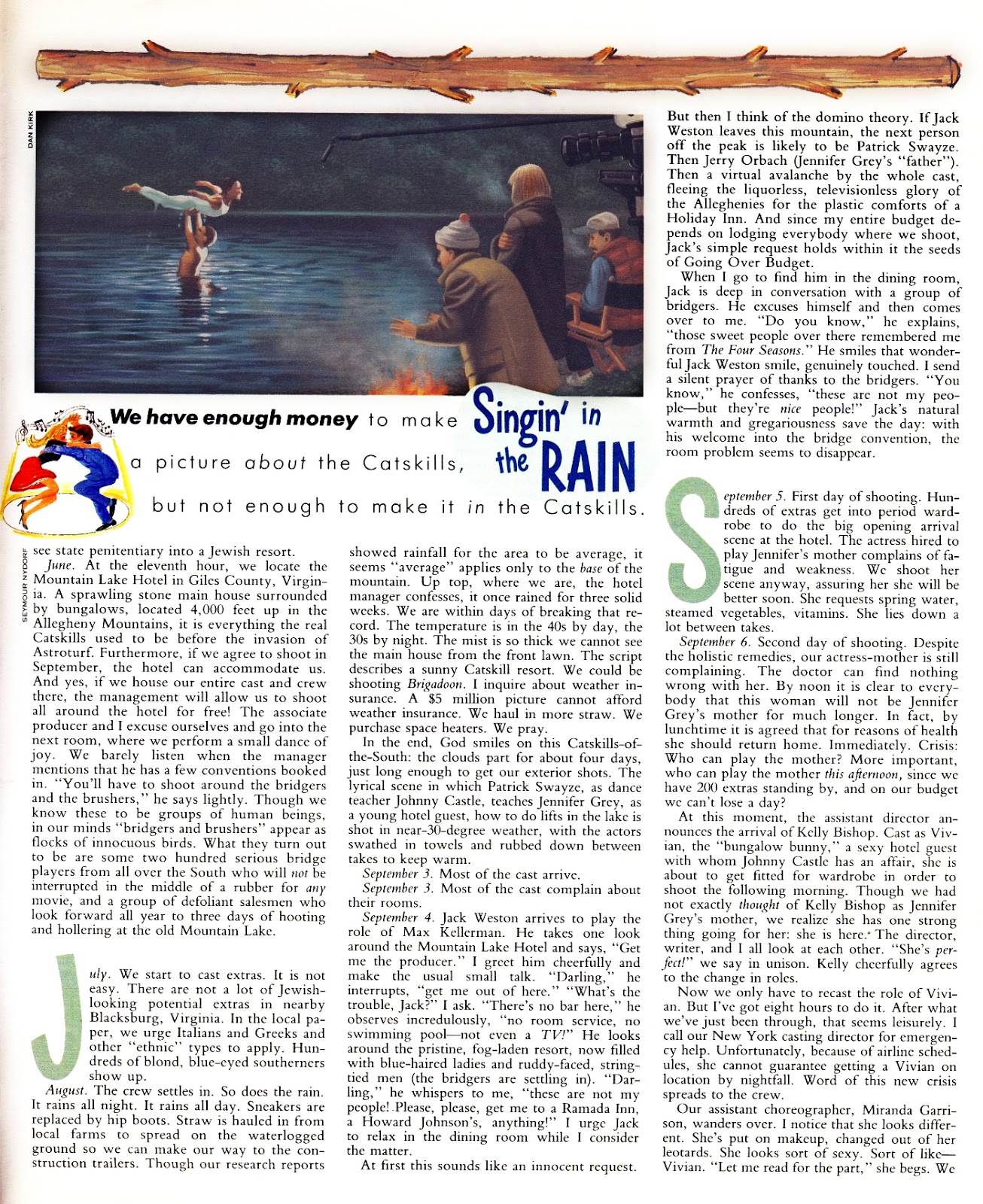
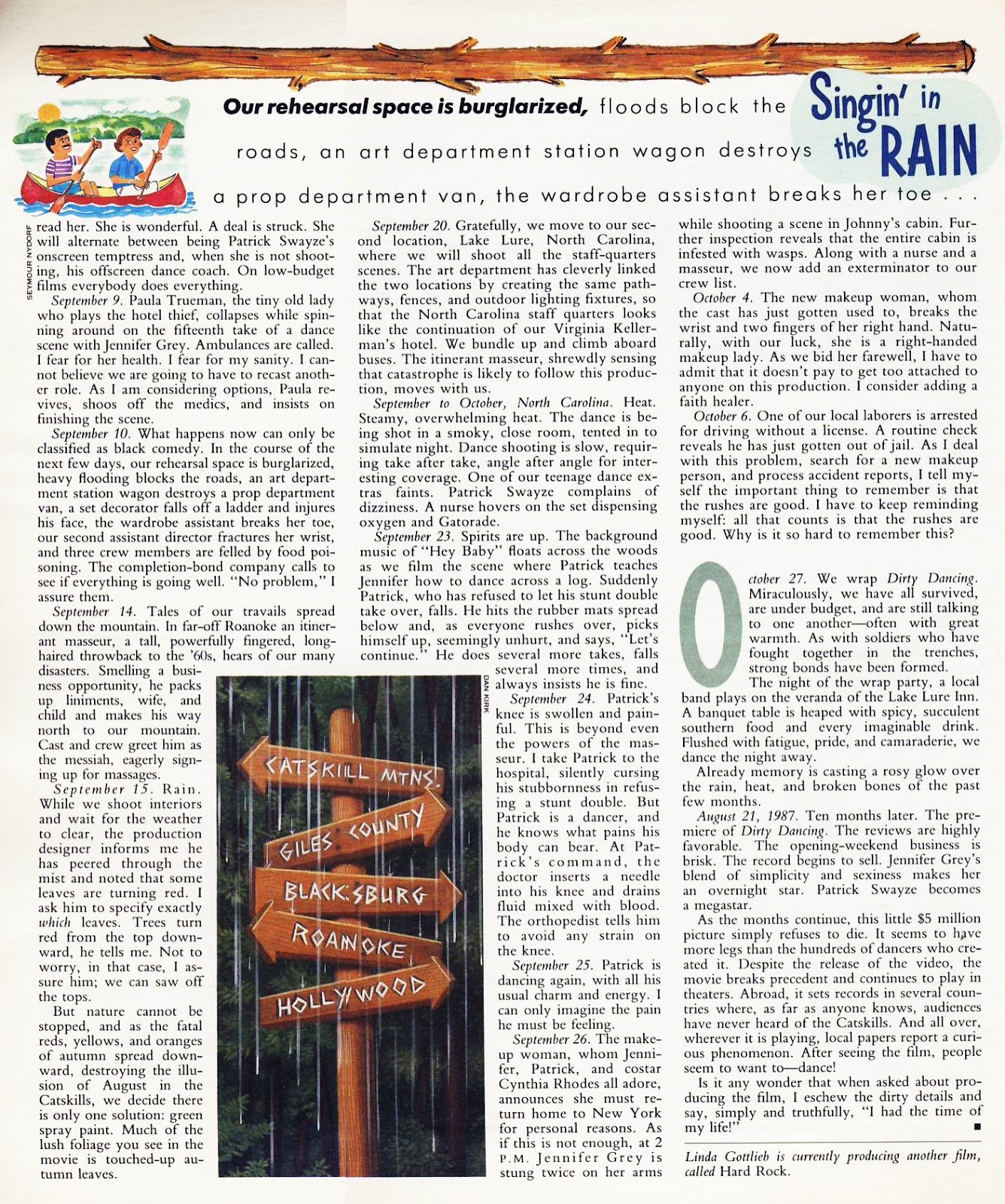
Linda Gottlieb, the producer of Dirty Dancing, described her experiences in an article, titled "Singin' in the Rain", that was published in Premier magazine in May 1988.
In 2010, the Dirty Dancing screenwriter Eleanor Bergstein wrote a Letter to Fans, in which she claimed that the original script no longer exists. She indicated, however, that the movie matches the original script so closely that the movie's dialogue transcript is, for all practical purposes, the original script. Her "Letter to Fans" includes the following passages:
No single "original script" of Dirty Dancing exists today. Anyone who shows you one will next be selling you the Brooklyn Bridge.
Not all the scenes I wrote are here, or could be found. What I retrieved from my trunks is a collection of fragmented pages, different typefaces, coffee stains, holes from staples removed with my fingernails.
They were originally on different colored paper, green pink, blue, yellow, representing different drafts, but we ran out of colors and finally used whatever paper was around.
The represented changes were because we didn't have enough money, lost our location, lost the light, replaced an actor. ....
What amazes me most looking over these annotated pages was how much everything remained the same.
So many things changed, but almost never the words. The dialogue in almost all cases is identical with what is on the screen. [Director] Emile [Ardolino] and I were very specific about no words being changed. Occasionally after hearing a speech in an actor's mouth, I cut a few words -- less is more.
But most important things remained exactly the same, from "Ma, will you look at that," through "and most of all I'm scared of walking out of this room and never feeling the rest of my whole life the way I feel when I'm with you," to "Sit down, Jake." ...
There was a long discussion on set about "a little head in the woods" instead of "go down on" which the crew was very opinionated about in terms of which was the correct period expression.
"It's hopeless" changed from "I wish you hadn't found me" ...
There's a different typescript for the scene where Penny tells Baby she doesn't sleep around. This scene was a request from Cynthia, which I typed on my bed with my portable Olivetti the night before, while the splendid David surprised us with a locker room at dawn.
Bergstein's account here is nonsense. Of course there was an original script, and copies were given to many people. However, each such person signed a non-disclosure agreement and still will be sued now if he is caught providing a copy of the original script to the public.
Bergstein does not want any student of the movie to compare the movie to the original script, because the differences certainly are enormous.
=====
In addition, most of the people -- especially Bergstein -- involved in making the movie enjoy wallowing in a fantasy that they proved all the other professional movie-makers to be wrong. Supposedly, all the other movie-makers who had rejected Bergstein's original script were stupid fools.
The worst day, as screenwriter Eleanor Bergstein remembers it, was when [the production company] Vestron executives brought in movie producer Aaron Russo to advise how to salvage Dirty Dancing.
"Burn the negative and collect the insurance money," he reportedly suggested. ...
Every studio in Hollywood passed on the screenplay. The indie outfit that produced it considered it a straight-to-video release. After all these false starts, the movie no one wanted leaped into the hearts of film-goers around the world. ...
Though [MGM executive Eileen] Maisel advocated on behalf of Dirty Dancing, she lost her job in a corporate regime change. Linda Gottlieb, another MGM exec and the film's ultimate producer, also fought for it. But in the end, new management put it in turnaround, trying to unload it. ...
MGM dropped its option. Bergstein's agent sent the orphaned screenplay to a video distributor called Vestron. To stay alive, the little video company had decided to make low-budget movies and distribute them itself.
At a time when the average cost of making a movie was between $15 million and $25 million, Vestron offered $4.7 million for the film. Bergstein and Gottlieb jumped at it. ...
The fantasy is that countless professional movie-makers were too foolish to recognize the brilliance of Bergstein's original script. All those fools were proved wrong by the movie's cast and crew, who followed the script precisely to make the movie that turned out to be so hugely successful.
The likely truth, however, is that Bergstein's original script was rejected by so many professional movie-makers because it was lousy. The script had had to be re-written drastically for the movie to succeed. That truth is why 1) the original script has been suppressed and 2) Bergstein's fans have been told told falsely that the movie is almost exactly like her original script and 3) Bergstein in advance tries to discredit any future appearance of the original script as "selling you the Brooklyn Bridge".
=====
Before Bergstein wrote her Dirty Dancing script, she had written one other script that became a movie -- It's My Turn, which had been released in 1980. In a previous blog article, I wrote that this previous movie was lousy -- an opinion I expressed in the following passages:
The movie turned out to be lousy, but we watched it to the end. ....
A major reason why the movie is bad is that the story is implausible.
Kate [the heroine] is a character with whom very few female viewers would identify. ... I didn't believe in this Kate character for even one second.
For me as a male viewer of the movie, I even thought that the Kate character was morally repugnant.
* Attending the preparations for her widowed father's wedding, Kate has a sexual affair with the son of the father's new bride. If this affair had been exposed, her father's wedding and marriage could have been ruined.
* Kate treats her father's new wife meanly.
* Kate asks Ben to continue their affair long-distance after he returns home to his wife and she returns home to her now cuckolded boyfriend.
* Ben refuses to continue the affair because he is married. Nevertheless, he sends her a present by mail, and she seems to be happy and hopeful that her affair might continue after all.
* After she returns to Chicago, she dumps her boyfriend Homer because, she complains that he has not been paying enough attention to her. So, it's Homer's fault. She does not admit to Homer that she already has become a baseball player's groupie.
In general, men do not admire such women and do not consider movies featuring such women to be romantic comedies.
Since [Michael] Douglas and [Jill] Clayburgh were expensive actors, the movie's investors must have lost a ton of money.
I regret now that I did not use the word "atrocious" when I reviewed It's My Turn.
In that same blog article, I quoted someone who saw the movie and reviewed it astutely on the movie's Amazon webpage.
The whole film, It's My Turn, from beginning to end, is jive. Watching this film was a truly hateful experience.
... The characters portrayed in It's My Turn seem about as real as the two-dimensional cardboard likenesses of film stars that one might see in the lobby of a theatre.
The whole concept behind the movie is laughable. It's full of campy 70's feminist rhetoric, and about as deep as a soap opera about Barbie and Ken. .... The dialogue sounds like a series of mindless jokes. ....
I saw this film at the local cineplex over twenty years ago, and since then, have never forgotten the experience. Upon the conclusion of the film I felt that I had wasted two hours of my life. I was so irritated that I seriously considered breaking into the projection room, taking the film from the projector and burning it with some lighter fluid and a match. ....
In view of this preceding movie, everyone should be skeptical of any assumption that Bergstein's next script, for Dirty Dancing, was brilliant.
(After Dirty Dancing, Bergstein wrote the script for a third movie, Let It Be Me, which I do like.)
======
Patrick and Lisa Swayze jointly wrote an autobiography titled The Time of My Life. Anyone who thinks that Bergstein's script was not rewritten drastically should read the following passages (pages 130 - 137) from the chapter about their experience in the filming of Dirty Dancing.
I [Patrick] read the script for Dirty Dancing one evening in our new house. Right away it filled me with emotion — but not the kind it was supposed to. I didn’t like it. It seemed fluffy — nothing more than a summer-camp movie. Lisa read it, too, and she felt the same way. ....
Even though the screenplay was weak, with some work it could explore all those elements through a strong story filled with compelling characters.
Potential is a wonderful thing, but would the writer and director be open to rewrites? The next morning, as Lisa and I worked on remodeling our kitchen, we talked about how the script could be better. And despite our initial reservations, we began to get a little excited about it. ... I also wanted to find out if we could really turn this into a great movie or not. ...
... I still had reservations about going for the role of Johnny Castle, for one big reason. Even if the script could be vastly improved, I wasn’t sure this movie was the right step to take in my career. ....
I was scared to say yes, scared I’d be undoing what I’d worked for the last eight years to build. Rut at the same time, both Lisa and .1 believed that Dirty Dancing had the potential to be wonderful. ...
Once I’d been cast as Johnny, Lisa and I started looking at how the script might be improved. Eleanor, Emile and others were doing the same thing, so it definitely was a group effort, but I was as grateful as ever for Lisa’s insights. ....
I want to know what’s weak, so I can work on improving it. Whenever we worked on a script or scene for a movie, we’d always play devil’s advocate with each other, switching positions and thinking through every angle but Sunday. What does the writer intend here? What does the director see? Could the story have higher stakes? Is this how my character would react? Do these characters talk like real live flesh-and-bone human beings? Once you’ve gone through every possible scenario with a script, when you get back down to the words on the page you know right away what works and what doesn’t.
That’s how Lisa and I work together: We find the intention and emotional flow of a scene, and the words follow naturally. ....
The draft of the script we’d read only hinted at deeper sociological and emotional currents, but we all knew that if we could just push the characters a little further, and explore them a little more deeply, we’d really have something. So everyone jumped right in, working day and night to tear apart things that weren’t working and deepen the parts that were. Eleanor’s script had strong bones, but now we were adding the flesh to them — and we’d continue doing so all the way through filming. And by the time we were done, we had a beautiful script.
Some of what Lisa and I suggested made it into the film, and some didn’t. We inserted the fight scene between Johnny and the cad waiter, Robbie, to give Johnny the rougher edge his character needed. We wrote it so Johnny would stop before knocking the guy out, though, since he’d be wary of getting fired — something that had no doubt happened to him before.
Lisa and I also stayed up the entire night before filming the final scene, where Johnny grabs the microphone in front of everyone at the resort, so we could rewrite his big speech. Sometimes we’d be working on new dialogue right up to shooting — and then continue fixing it between takes. We never stopped trying to make it better. ....
We did a lot of rewriting for the big final scene ....
Throughout the filming, we kept inserting little touches to help flesh out the characters and their relationships. ....
The more we added and revised, the stronger the characters got. ....
I think that Swayze's account of the drastic rewriting is believable, whereas Bergstein's account of her screenplay remaining almost unchanged is not believable.
=====
As the producers began to develop this movie project, they surely understood that the movie's success would depended on convincing Patrick Swayze to play Johnny Castle. He was perfect for the role, but he initially resisted the offer. The budget was rather small, so the producers could not offer him a large amount of money. The producers were willing, however, offer him three concessions:
1) One of his songs would be included in the soundtrack.
2) He would be granted great authority in changing the script.
3) His wife Lisa would be cast as Penny Johnson.
The third concession was kept secret, as a last resort to convince Swayze to accept the role. As it turned out, the first two concessions sufficed to convince him. In his autobiography, Swayze wrote (page 134):
As perfect as the role of Johnny was for me, the role of Penny was equally perfect for Lisa. She auditioned for it, and wowed everyone. But ultimately, Cynthia Rhodes was cast as Penny. Cynthia was also a good choice, but what tipped the scales was the fact that she’d had a starring role in Staying Alive, with John Travolta. Cynthia had some momentum, and momentum sells in Hollywood.
What we didn’t know, but found out much later, was that Eleanor expected me to insist on casting Lisa as a condition of I getting me. But I really didn’t think of myself as having that kind of power as an actor, so it never even occurred to me to ask. As Lisa now jokes, because she and Cynthia are both slender and blond, half the time people think it’s her in the movie!
In addition to Lisa's lack of career "momentum", I assume that movie producers routinely avoid casting married actors together on the general business principle that nepotism often causes serious problems. In addition, I think that Lisa Swayze -- despite her beauty and talent -- had a troublesome personality that impeded her career as an actress. (When I write an article about the Swayze autobiography, I will explain that idea.)
The above passages from the Swayze autobiography indicate that as soon as Patrick decided to do the movie, he and Lisa immediately -- "the next morning" -- began to develop script changes, apparently exercising an extraordinary and explicit authority to propose script changes.
I'm sure that Swayze eventually earned much more money from his soundtrack song -- "She's Like the Wind" -- than he earned for acting the role of Johnny Castle.
=====
The producers' concession that Patrick Swayze could change the script opened the floodgates for the director, choreographer, other actors -- and even Patrick's wife Lisa -- to propose changes. Swayze's autobiography indicates that the group process of changing Bergstein's original script could be described as a feeding frenzy. The original script was turned into the "collection of fragmented pages ... on different colored paper" that Bergstein described in her "Letter to Fans".
As a result, Bergstein's original script was dramatically changed and improved -- and the movie turned out to be brilliant.
In a following article, I will speculate about what was in the original script and what was changed.
Celebrity biographer Wendy Leigh published Patrick Swayze: One Last Dance in 2009. Leigh has written other biographies of John F. Kennedy, Jr., David Bowie, Madonna, Barbara Eden, Grace Kelly, Arnold Schwarzenegger, Edward Windsor, Zsa Zsz Gabor, and Liza Minelli.
Cover of Wendy Leigh's biography
"Patrick Swayze: One Last Dance"
In 2009, Swayze was writing his autobiography, which would be published in 2010 under the title The Time of My Life. Therefore Swayze refused to be interviewed for Leigh's biography and apparently asked his close relatives and friends to refuse to be interviewed.
Despite these limitations, Leigh did manage to interview many people who knew Swayze as a young man, in particular people who knew him as an adolescent, including his first serious girlfriend. Leigh did interview Swayze's manager, Lois Zetter, and various film personnel. Leigh also read voluminously about Swayze. Leigh's biography is informative and interesting. The book's end notes refer to her published sources. Leigh knows how to write a celebrity biography.
----------
Swayze, born in 1952, grew up dancing because his mother owned a dance studio in Dallas, Texas. (The following videos are not associated with Leigh's book.)
As a young man, he intended to become a professional ballet dancer, and in 1975 he was living in New York City and dancing in the Joffrey Ballet Company. In 1976, Because of a tooth abscess, he caught a staph infection that almost resulted in the amputation of a leg that previously had been injured while playing high-school football. Although he recovered from the infection and still was able to dance, he decided that his knee's condition now precluded a career as a professional ballet dancer.
He decided to become an actor instead and began to take acting lessons and try out for roles.
He soon was hired to play the lead role of Danny Zuko in the Broadway musical Grease. When the show closed in 1979, Swayze and his wife Lisa moved to Los Angeles to begin establishing movie careers.
----------
Swayze's parents had been happily married and had raised him in the Roman Catholic Church. He had met Lisa when they both danced at his mother's studio. They married soon after he moved to New York, and they stayed married (and apparently faithful) to his death. She wanted to become an actress, and he tried to help her, but she could not match his extraordinary success.
He had an inferiority complex about his intellect. I got the impression from Leigh's book that he studied minimally in high school, being busy mostly with dancing and sports. In that respect he was similar to his Dirty Dancing character Johnny Castle.
A non-dancing interest that he shared with Lisa was carpentry, and they supported themselves largely by doing carpentry projects together during their first years in Los Angeles.
----------
Swayze soon played a leading role in a teen movie called Skatetown, but subsequently turned down a series of roles that might have type-cast him as a "teen idol". He held out for more mature roles and tried, mostly without success, to get his wife cast into his movies.
In 1984 he appeared in a leading role in the movie Red Dawn, about a group of young people who resist a Soviet invasion of the USA. Jennifer Grey (later the star of Dirty Dancing) also appeared in that movie, and they had some scenes together, but they did not become personal friends.
In 1985, Swayze appeared in a leading role in a television mini-series called North and South, about the Civil War. Swayze played a Confederate officer. Swayze's career managers considered his real-life personality to be "heroic, idealistic and gentlemanly", and they tried to cast him into roles that matched that personality. The considered his role in North and South to be such a fitting match.
Swayze drank too much for many years. The problem became significantly worse in 1982, when his father died unexpectedly, and continued beyond 1986, when he participated in the filming of Dirty Dancing.
------
Although Swayze had played several leading roles, he did not come quickly to the attention of screenwriter Eleanor Bergstein and producer Linda Gottlieb after the MGM movie studio decided to make the Dirty Dancing movie. Swayze did not come to their attention quickly, because he avoided dancing roles and did not even mention his dancing ability on his resume.
By 1986, he had spent the last seven years of his career diligently toiling away in Hollywood, fighting tooth and nail to escape classification as either a latter-day Troy Donahue or a sleeker, less pumped-up Schwarzenegger, or even an ersatz John Wayne, and he certainly didn't want to be Fred Astaire or Gene Kelly. Moreover, he was so rigidly resolved not to hitch his shooting star to a musical that he decreed that his resume must not detail his dance training. ....
Eleanor [Bergstein] had first pitched her Dirty Dancing concept to MGM in 1984, whereupon producer Linda Gottlieb signed on board to produce it. .... Director Emile Ardolili was hired to direct, and Kenny Ortega .... came on board as choreographer. However, two years after her initial pitch to MGM, the movie stil hadn't been made, simply because she still hadn't been ale to find the right actor to play Johnny. ....
Eleanor had chanced on Patrick's picture ... [and] now knew that in Patrick Swayze she'd met her hero, Johnny Castle, i living color .... Now all she had to do was convince him to accept the part. ... Here was a relatively untried screenwriter ... virtually at his feet, telling him that she couldn't make her movie without him, exhorting him to appear in her low-budget, small-time production, playing a down-market character ....
Despite the intensity of her pitch, and even after taking a positive meeting with Emile Ardolino, he had serious misgivings about playing a dancer ... and decreed that unless he first met and approved of choreographer Kenny Ortega, he wasn't going to play Johnny.
Aware that Patrick was due to fly from New York to L.A., and determined to snare him for the movie, Ardolino booked Kenny a seat next to Patrick on the same flight and instructed im to convince Patrick to accept the part of Johnny.
Toward the end of the fight, "Patrick pointed his finger at me ... and he said, 'I'm going to do this movie, Ortega, and don't let me down. This is a really important time in my life. Right now, these choices that I'm making right now are really important. I'm excited by what you have to say, what Emilio and Eleanor have to say. Come through for me, don't let me down,'" Kenny remembered.
The crew and actors assembled at the Mountain Lake Resort in Giles, County, Virginia, in late August 1986. After rehearsing for two weeks, they began on September 5 the 43 days of filming.
Because Swayze already had played several leading roles, he had the confidence to argue for his own artistic visions strongly and persistently.
Early on they shot the first scene, in which Baby watches, mesmerized, as Patrick and Cynthia Rhodes (Playing his first dance partner, Penny) dance together. Cynthia, a seasoned dancer, was immediately impressed by his dancing. .... Patrick and Cynthia were both such brilliant dancers that the director and producer were afraid that their dancing would throw the movie off balance.
"Everybody kept telling me to tone it down, that we were too hot together, and it was going to overpower my later scenes with Jennifer," Patrick remembered. He knew what everyone wanted, but sure of his artistic vision, his own abilities, he fought back, insisting that the hotter his dance with Cynthia, the more the audience would wonder why they weren't romantically involved, but to not avail.
But he was now no longer the wide-eyed greenhorn ... with little power over the production. He was the star of North and South and now the start of Dirty Dancing as well, with the success of the entire movie resting primarily on his square, manly shoulders. Aware of his own power, he made a stand.
"I refused to shoot it unless they did it my way, because I knew what I planned to do later with Jennifer would blow the relationship with Cynthia away. So I fought and fought for that, but I really didn't have to fight too hard because everyone was willing to at least hear me out," he said.
Of course, Swayze turned out to be right about how that dance scene should be performed. The audiences watching it were delighted.
On the other hand, Swayze's stubbornness caused some trouble. On September 23, he refused to allow a stunt double perform any of the scene were Swayze and Grey danced on a log. He fell from the log several times. Although he fell onto rubber mats, the repeated impacts aggravated his old knee injury.
Forever, the stoic, this time Patrick had pushed his body too far. The following morning he awoke with a swollen and painful knee ... his left one. An exasperated Linda Gottlieb, silently cursing Patrick's obstinate refusal of a stunt double, drove him to the hospital. There he gritted his teeth while -- at his request -- the doctor drained 80 ccs of fluid intermingled with blood from his knee. Afterward, the orthopedist gave him a strict warning to avoid any strain on his knee.
But ... he knew the show had to go on, no matter what. And 24 hours later he was back dancing with, as Linda put it, "all his usual charm and energy. I can only imagine the pain he was feeling." ....
In the last days of shooting, as Jennifer and Patrick prepared to shoot the lake scene, the temperature dropped to 40 degrees. Both of them stripped down to the minimal, then they plunged into the ice-cold water. ....
"My knee was filled with fluid and killing me," Patrick later ruefully recalled. "Suddenly, I have to dance with Jennifer and look like I'm the happiest guy in the world when I probably belong on crutches.
During the filming, Swayze had to deal with what he considered to be Grey's excessive emotions and clumsy dancing.
"I remember Patrick Swayze complaining that Jennifer was just too nervous and emotional," Linda Gottlieb recalled. ... "She would burst into tears at the drop of a hat. This duo that had such terrific chemistry on screen didn't get on and would frequently fight, frequently argue off screen. ... Patrick and Jennifer hated each other. Jennifer didn't want to do any of the love scenes. She would stand there saying, 'I don't like the way he kisses.'"
However, Patrick's manager, Lois Zetter, has a different recollection of his on-set relationship with Jennifer and remembers it being cordial.
"They got on well, except it was hard on him that she wasn't a professional dancer and had no experience. Which was difficult for hm as he had a bad knee and had to dance twice as hard to compensate for her inexperience."
"I remember he was very thoughtful around Jennifer Grey because at that point it was still early in her career," said George Baetz, Dirty Dancing's sound recordist. "He was a very considerate person, which is unusual on a film set, and he was really nice to Jennifer between takes. He worked really hard and did his own stunts. .... He was very easy-going, very professional, joked a lot, was well-prepared for his scenes and was enjoyable to be around."
As usual, Swayze had tried to arrange for his wife Lisa to play a role.
.... his dearest wish had been that Lisa costar in the movie with him, not as Baby, but as Penny. Instead, Lisa's only involvement with the movie would be the visits she made to the set.
I don't understand why Lisa was not cast as Penny, because she dances well.
In Dirty Dancing, Swayze had to dance deliberately below his ability.
"From a dancer's point of view, Dirty Dancing was a very frustrating experience," he said. "Fighting my ego was the most difficult thing because I'm a much better dancer than Johnny Castle is. Johnny had trained at Arthur Murray, but Joffrey. My level of training went far beyond his. But in order to be true to the character, I couldn't allow myself to be too technically proficient. ....
My mom called me up and said, 'Patrick, I know you can do better than that,'" he recalled. But as he firmly pointed out to her, Johnny was a Catskills dance instructor, trained by Arthur Murray and not by Patsy Swayze.
However, Swayze did insist on performing one expert dance move in the movie.
"I got away with one moment, very technical, at the end, when I come off the stage, do a double pirouette, then go down on one knee. That's the one time I got to throw in something that required real technical proficiency," he said. ....
John Mojjis witnessed the double pirouette scene being filmed and noted afterward that before Patrick made the jump -- wary of injuring his bad knee - he insisted that a pile of mattresses be laid on the floor for him to land on. Nevertheless, it took Patrick, the quintessential perfectionist, more than 25 times to get the jump exactly the way he wanted it.
----------
Leigh writes at length that the movie's huge success subsequently affected Swayze's private life. Here are some excerpts:
Dirty Dancing would make him rich, famous, and successful beyond his wildest dreams, but the price would be high. .... His days of dancing at clubs, free and untroubled by fans, were already well and truly behind him. .... Swayze mania was now in full throttle and he was mobbed wherever he went. When he made an appearance at a Sam Goody record store, five thousand screaming fans were on hand, desparate to catch just a glimpse of him. ....
Lisa was now in the nightmarish position of having to cope with the tidal wave of female attention that came in the wake of Patrick's stardom, with love-struck women literally knocking her off his arm in the haste to get at him. ....
In general, his life was completely decimated by the tsunami of mass adoration that flooded over him. .... Now condemned to play the part of Patrick Swayze, the Hollywood icon of masculinity, for all eternity, he began to live the role in all its darkest and most dramatic extremes. ....
He also suffered from low self-esteem, which caused him to think that he didn't deserve all the attention. "I don't fee famous. I feel like I'm the same jerk I've always been! People say your'e special, but that's not true," he said, later describing himself as a "driven individual, wrapped up in suffering and paying my dues. Because of what I look like and what I could do with my body, I wasn't sure there was anything inside of me."
On a deep level, he felt he was unworthy and then, and through the years, perhaps unconsciously set out to sabotage himself by drinking too much, risking his life in death-defying stunts, and proving himself.
-------
Two movies that Swayze had made before Dirty Dancing were released after Dirty Dancing -- "thus confusing and slightly alienating some of the fans." Leigh's description of Swayze's experiences during those two earlier movies sheds some light on his state of mind while making Dirty Dancing.
The first was Steel Dawn, a futuristic movie set in a post-nuclear world in which he played Nomad, a mysterious warrior. According to [his manger] Lois Zetter, he took the part primarily because Lisa would be co-starring s his love interest, and it had always been his dearest wish for them to work together. ....
In herrole as Kasha, Lisa was strong, proud, and suitably somber. Patrick, his hair long and blond, gave a credible performance as Nomad, although fans and critics alike would later dismiss the movie out of hand when it was released just three months after Dirty Dancing.
I wonder (pure speculation) if problems happened related to Lisa during the filming of Steel Dawn that caused her not being cast as Penny in Dirty Dancing. Since he was able to drive a hard bargain to agree to play Johnny Castle, it seems to me he should have been able to require that Lisa play Penny. I note also that Lisa visited the Dirty Dancing set only occasionally, although he needed her presence to curb his drinking.
The second movie he made before Dirty Dancing, which was released afterward, would also perplex and irritate a public infatuated with his Johnny Castle persona, particularly because in that movie, Tiger Warsaw, he played the part of a violent, sociopathic drug addict. ....
"Tiger Warsaw is the most hardcore, emotionally demanding film I've ever done," he said. .... "but also the most destructive for me personally." ...
Drink was the outlet for his excessiveness, and his danger point, particularly when he was on location in Pennsylvania, without Lisa by his side to curb him. With classic honesty he confessed .... "While I'm making films I get very hyper because my brain is racing all over the place. I survive on two ours sleep a night, and I sit in my hotel room drinking beer and vodka, which can't be good for anyone. I'm an excessive person in every way, and I have to fight to control my drinking. ...."
On November 6, 1988, Steel Dawn was released, both shocking and somewhat disappointing Patrick's adoring public, not to mention the critics. Since the film came so closely on the gilded heels of Dirty Dancing, many of Patrick's fans were appalled by it. The movie opened and closed within two weeks, taking in a paltry $526,000 ....
----------
I did not read Leigh's biography of Swayze beyond his Dirty Dancing experiences.
Not associated with Leigh's biography but related to this first part of Swayze's life are the following webpages:
* the Bio website has an excellent video about Swayze's early life here.