span.fullpost {display:none;}
Showing posts with label Vivian Pressman. Show all posts

Friday, June 8, 2018

Baby Houseman's Perspective on Vivian Pressman

During the preparation of the talent show, Baby Houseman watches Vivian Pressman talking quietly with Johnny Castle.  As Vivian walks away from Johnny, he looks back toward Baby, who pretends that she had not been watching Vivian and Johnny.


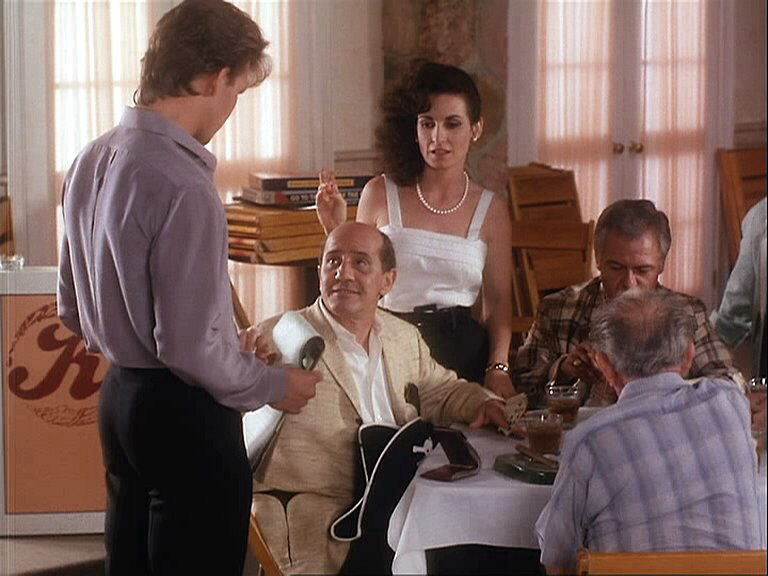
Then Johnny follows Vivian to a table where she is standing by her husband, Moe Pressman, who is playing cards with some other men. Johnny talks briefly with Moe and then walks further away.

Moe offering Johnny money to give Vivian a dance lesson
Baby has not been able to hear Johnny's conversations with Vivian or Moe. However, she is able to see that Moe gives some money to Johnny but then takes it back. As she watches Johnny walk away further from the card table, she sighs and smiles with apparent relief.

Although Baby cannot not hear the conversations, she understands, from what she saw, that Vivian wanted to arrange a paid dance lesson but that Johnny declined the offer.

======

That scene takes place on Saturday, August 31. Baby had become sexual with Johnny in his cabin on the night of Thursday-Friday and had returned to his bed in his cabin on the afternoon of Friday.

Early on Saturday, Baby and Johnny do their "Love Is Strange" dance. Then Neil Kellerman enters the room and upsets Johnny's dance plan for the talent show.

While walking outside, Baby and Johnny talk. He says that if he loses his job at Kellerman's resort, he might have to become a house painter.

In my last essay, titled  Good news -- Uncle Paul can finally get you in the union, I argued that this conversation about Johnny possibly becoming a house painter causes Baby to realize that her relationship with Johnny must end after her family departs from the resort. She does not, however, tell Johnny about her realization.

Johnny wants the resolution to continue, and so he gets mad because Baby will not introduce him as her boyfriend to her father. Johnny walks away angrily.

Baby finds Johnny at Penny Johnson's cabin and apologizes to him. Robbie Gould walks by and remarks that Baby is "slumming" in her relationship with Johnny.

Later on Saturday, Baby, Johnny and others are preparing for the talent show. Baby watches Johnny talk with Vivian and then with Moe and then walk further away.

The preparations for the talent show continue. Johnny has just given Moe a pirate hat and told him to get ready to rehearse his pirate act.

 ======

At this point in the story, during the preparations for the talent show, Baby feels relieved because Johnny will not spend time later giving Vivian a dance lesson. Rather, Johnny will spend maximum time with Baby alone. Johnny and Baby will spend the entire night together in his cabin.

During the preparations for the talent show, Baby saw Johnny talking with Vivian, but Baby could not hear that Vivian said to Johnny:
This is our last night together, lover. I've got something worked out for us.
Did Baby recognize and care that Vivian was Johnny's lover?

======

A week earlier, Baby had heard Max Kellerman describe Vivian as a "bungalow bunny".

Max Kellerman telling the Housemans
that Vivian Pressman is a "bungalow bunny"
While Max was talking, Johnny and Vivian were dancing. At first she is wearing a white fur wrap, but she drops it onto the dance floor as she continues to dance.

Johnny dancing with Vivian, the "bungalow bunny".
She has just dropped a white fur wrap onto the dance floor.
The fur wrap and the dialogue indicate that she is wealthy and pays Johnny for dance lessons:
Vivian Pressman
Hi, Max. Aren't my dance lessons starting to pay off?

Max Kellerman
(Addressing Vivian)
You look great, Vivian! Terrific!

(Addressing Jake and Marjorie)
That's Vivian Pressman, one of the bungalow bunnies. That's what we call the women who stay here all week long. The husbands only come up on weekends. Moe Pressman's a big card player. He'll join our game.

(Addressing Vivian)
Moe coming up on Friday?

Vivian Pressman
Friday.

Max Kellerman
(Addressing Vivian)
He's away a lot. I know. It's a hardship.
The remarks about Moe's long absences suggest that Vivian is available for sexual adventures while she stays in the area.

======

On one occasion when Johnny and Baby are in bed together, he tells her that wealthy women at the hotel entice him with valuable gifts and sexual pleasures.
... women are throwing themselves at you and they smell so good. They really take care of themselves. I never knew women could be like that.

They're so goddamn rich, you think they must know about everything. They're slipping their room keys in my hand two and three times a day -- different women --

.... They were using me.
Baby certainly assumed that Vivian was one such woman.

During the preparations for the talent show, Baby saw Vivian approach Johnny and talk quietly with him. Then Baby saw Moe offer Johnny money and assumed that Moe was offering to pay Johnny to give Vivian a dance lesson.

Baby might have assumed also that Vivian intended to use the dance lesson as a means to get into a sexual encounter with Johnny. Baby herself wanted intended to get into a sexual encounter with Johnny that very same night.

Keep in mind, though, that Baby intended (in my opinion) to end her relationship with Johnny. In that regard, Baby might have felt no resentment about Johnny's continuing relationship with Vivian. It was only during this Saturday-Sunday night that Baby wanted Johnny exclusively for herself.

======

Since Vivian did not get to spend time with Johnny during that Saturday-Sunday night, she got into a sexual encounter with Robbie. This encounter was discovered by Baby's sister Lisa.


Since Lisa previously had confided to Baby that she herself intended "to go all the way" with Robbie during that Saturday-Sunday night, Lisa surely told Baby on Sunday that she had found Robbie in bed with Vivian during that night.

When Baby heard this news about Vivian from Lisa, Baby might have figured that Vivian was not Johnny's lover, but rather Robbie's lover. If Baby figured so, then she no longer considered Vivian to be her rival for Johnny's time and affection.

======

 After Baby and Johnny do their dance performance at the talent show, everyone joins in the dancing -- except for Vivian. At 4:15 in the following video clip, Vivian walks alone and angrily out of the room.


Exactly why is Vivian angry? Surely Vivian knows that Johnny has many other lovers besides herself. Perhaps Vivian is angry only because she had planned to enjoy a sexual encounter with Johnny after the talent show, but now she sees that he has been captivated by Baby.

If Baby happened to see Vivian's departure from the room, she perhaps did not perceived any relationship to herself. Baby might have assumed mistakenly that Vivian simply was sneaking out to meet with her lover Robbie.

======

In general, Baby never was concerned much about Vivian. Baby probably assumed that Vivian was one of the wealthy women who slipped her room key into Johnny's hand, but Baby did not know that for sure.

Baby did know that Vivian was married to Moe, who was spending this weekend at the resort and was even participating in the talent show. If Baby gave any thought at all to the possibility that Vivian might cheat on her husband later that evening, after the talent show, then Baby would assume that Vivian intended to cheat with Robbie, not with Johnny.

Anyway, Baby does not intend to continue her relationship with Johnny seriously after her family departs from the resort in a few hours. Perhaps Baby hopes that Johnny ultimately will get together with Penny.

Baby is much less concerned about Vivian interfering with Johnny than the movie audience is concerned about Vivian. interfering with Johnny. The movie audience knows somewhat more about Vivian than Baby knows.

Sunday, December 10, 2017

Johnny's Dream About Jake

Baby and Johnny are lying next to each other on their backs in bed, relaxing after some sexual activity. Johnny says:
You want to hear something crazy?

Last night, I dreamt we were walking along, and we met your father. He said, "Come on," and he put his arm around me. Just like he did with Robbie.
Baby does not respond.

Johnny telling Baby about his dream
as they listen to the song "In the Still of the Night"
=====

That happened on the night of Saturday, August 31. The talent show will be on the following day, Sunday, September 1.

Johnny had his dream during the previous night from Friday to Saturday, August 30-31. The dream might have been prompted by the events that had happened on Friday, which I have summarized as follows:
Friday, August 30

At breakfast, Jake tells his family they are going home the next day (Saturday). Because Lisa wants to perform in the talent show (Sunday), Jake relents to stay. After Jake has re-examined Penny in her cabin and left, Baby and Johnny enter the cabin. Penny asks how their performance went on the previous night, and Baby says she didn't do the lift. After Baby leaves the cabin, Penny tells Johnny to stay away from Baby.

The Houseman family is inside a room because it is raining.

Baby returns to Johnny's cabin and they have fun and talk in bed.

That night, Baby and Lisa are in their hotel bedroom, and Lisa says she intends to "go all the way" with Robbie. Baby advises Lisa to wait and do it "with someone that you sort of love".
Baby slept in her hotel room with Lisa that night.

During the night between Friday and Saturday, Johnny has his dream. If Baby had spent that night in Johnny's cabin, he would have told her about his dream on Saturday morning.

(Maybe Vivian Pressman slept in Johnny's cabin that night. Vivian sure planned to sleep in Johnny's cabin during the following night.)

Then during Saturday the following events happen.
Saturday, August 31

Baby and Johnny do the "Love is Strange" dance in a practice room. Neil insists that Johnny teach the employees to dance the pachanga for the talent show. Baby advises Johnny to discuss the dance choice with Neil again. Johnny says he might have to go back to a house-painting job.

The radio announces:
It's almost over. The Labor Day weekend is here. Soon it's back to the old books and back to work. What a terrible thought!
Johnny gets mad because Baby won't tell her father about their relationship. Johnny leaves, but Baby finds him in Penny's cabin. Baby and Johnny go out onto the cabin's porch and begin to make peace with each other. Johnny fights with Robbie.

Various people are preparing for the Sunday talent show. Vivian invites Johnny to meet her later that evening. While playing cards, Moe offers Johnny money to give Vivian a dance lesson. Johnny refuses the money. Lisa goes to Robbie's cabin and finds him having sexual intercourse with Vivian. Baby goes to Johnny's cabin and has fun with him in bed again.
Then Johnny tells Baby about his dream that happened on the previous night.

======

Let's think some more about Friday.

Friday morning at breakfast, Jake announced to his family that they all would leave on Saturday. Then he relented and agreed to stay through Sunday.

Later on that Friday afternoon, Baby went to Johnny's cabin and had fun with him in bed. While there, Baby surely told Johnny that her father knew she and Johnny were had become intimate. Her father had learned from Lisa that Baby had been away from their hotel room during the entire Thursday-Friday night. Her father was angry and had decided to separate Baby and Johnny by the family's leaving a day early.

Furthermore, Baby was worried that her father would watch her -- or arrange for someone else to watch her -- until the family departed on Sunday.

Because Baby thought she was being watched, she slept in her hotel room during the Friday-Saturday night.

This was the situation when Johnny went to sleep on Friday night and had his dream.

======

Although Johnny spends considerable time with Baby during Saturday, he does not tell her during the day about his dream.

After the "Love Is Strange" dance, Johnny becomes angry at Neil about the talent show. Then Johnny becomes angry at Baby because she is not telling her father about them. The latter angry moment would have been a fit occasion to tell Baby about his dream, but he does not do so.

Johnny continues to be angry. He fights with Robbie.

He is stressed by preparing for the talent show.

He does not relax until he is in bed at night, and then he tells Baby about the dream he had seen during the previous night.

=====

So, Johnny's dream indicates that he wants Jake to become his buddy -- a day after Johnny has had sex with Jake's 17-year-old daughter right after Jake ordered her to stay away from Johnny.

Johnny barely knows Jake, who now has a valid reason for despising him. Baby is trying to prevent Johnny and her father from coming within eyesight of each other.

Johnny has sex with Vivian Pressman. Does Johnny dream about her husband Moe putting his arm around him?

Johnny has sex with lots of women. Does he dream about their husbands, boyfriends and fathers?

The entire Houseman family will leave on Sunday night or Monday morning. Then Baby and Jake will be gone from Johnny's life forever.

Why does Johnny care so much about Jake liking him during those couple of remaining days?

=====

Let's look at Johnny's dream story again.
You want to hear something crazy?

Last night, I dreamt we were walking along, and we met your father. He said, "Come on," and he put his arm around me. Just like he did with Robbie.
What really irks Johnny is that he feels socially inferior to Robbie. This feeling makes Johnny so angry that during the day following his dream he beats Robbie up.

=====

Johnny's beating Robbie up was Johnny's second encounter with Robbie during that day.

After the "Love Is Strange" dance and Johnny's argument with Neil, Baby and Johnny are walking outside and talking. Johnny says he might have to go back to painting houses.

Then Baby and Johnny notice Jake, Robbie and Lisa walking and talking about the Domino Theory. Baby makes Johnny duck down with her so they won't be seen by her father.

After Jake, Robbie and Lisa walk away, Johnny gets mad at Baby because she is not telling her father that Johnny is "her guy". Johnny is extra mad because he has just seen Jake walking and talking with Robbie.

A short time later that same day, Johnny beats up Robbie.

=====

I suspect that the dream was inserted into the Dirty Dancing story by Patrick Swayze. Eleanor Bergstein's original script portrayed Johnny as a confident, unapologetic and bold character -- similar to her character Ben Lewin in her previous movie It's My Turn.

All the insecure and neurotic characteristics of Johnny Castle were added by Swayze.

When Swayze wrote Johnny's monologue about the dream, Swayze did not even bother himself to write a response for Baby to speak. The scene is a moment for just Swayze to shine as an actor and to make his character Johnny more emotionally complex.

======

Right before Johnny told Baby about his dream, he put on a record of the song "In the Still of the Night". The song plays while he is telling he about his dream.


The song's first two stanzas:
In the still of the night
I held you,
Held you tight,
Because I love,
Love you so.

I promise I'll never let you go --
In the still of the night.
Since Johnny chose this particular song to play while he told Baby about his dream, he apparently is fantasizing somewhat that he might become engaged with Baby and eventually join the Houseman family. Then Jake might put his arm around Johnny as his future son-in-law.

If Johnny joins the Houseman family, however, he might become Robbie's brother-in-law. Earlier that day, Johnny had seen Jake, Robbie and Lisa walking together. Obviously, Robbie and Lisa had reconciled.

Furthermore, Baby surely had told Johnny that Lisa intended to have sex with Robbie that same night. As far as Baby and Johnny knew, Lisa and Robbie were having sex right while Johnny was telling Baby about his dream.

If Lisa and Robbie were becoming an intimate couple and if Johnny was fantasizing about becoming engaged with Baby, then there was a real possibility that Johnny might become Robbie's brother-in-law.

In that sense, Johnny might have felt that his dream was prophetic -- that Jake eventually would embrace both Johnny and Robbie as his sons-in-law.

Sunday, November 19, 2017

Baby Houseman's Walk of Shame

The Urban Dictionary defines the expression Walk of Shame:
The walk from another person(s) house, apartment, condo, dorm, van, bar, park bench or other; to your place of residence wearing the same clothes you had on the night before.

Typically used when someone leaves the home of a sexual escapade (quite possibly with someone you met the night before) in the morning; hair sticking out in all directions, lines on your face, and missing at least one article of clothing. ...


=====

Baby Houseman did her walk of shame on the morning of Sunday, September 1.

Baby begins her walk of shame.
Baby is wearing her party dress and carrying, in her hand, a pair of high-heel shoes.

Baby's walk of shame was seen by one other person -- by Vivian Pressman, who was beginning her own walk of shame.

Vivian Pressman sees Baby's walk of shame.
Vivian herself is beginning her own walk of shame.

=====

On the previous evening Baby was seen wearing the clothes in the below image.

Baby's clothes on the evening
before her walk of shame.
The that same previous evening, Vivian was seen wearing the clothes in the below image.

Vivian's clothes on the evening
before her walk of shame.
Later that evening, Baby and Vivian changed into party dresses, but the reason is not revealed in the movie. In the morning, Baby and Vivian are wearing their party dresses as they begin their walks of shame.

=====

On Friday, August 30 -- two days before Baby's walk of shame -- Baby father, Jake Houseman, declared at breakfast that the family would leave the resort early. Although Jake changed his mind already during breakfast, Baby was afraid that he would catch her socializing with the dancers and therefore decide again to leave the resort early. Therefore, Baby was very careful about being seen by her father socializing with the dancers.


On Sunday, September 1, Baby no longer worried much about being seen -- even is she was doing a walk of shame from Johnny Castle's cabin in the morning. Later that morning, she even admitted to her parents that she had spent the night in his cabin.

By Sunday, the family already was committed to stay through the talent show that evening. Baby and Johnny would perform their dance in the talent show, no matter what.

However, Baby did not foresee that Johnny would be fired during the day because of a stolen wallet.

=====


=====

This is the first in a series of three articles.

The second article is Johnny Castle's Alibi That He Was Alone and Reading.

The third article is Billy Kostecki was Johnny Castle's Wingman.

Wednesday, July 19, 2017

My Praise for ABC's "Dirty Dancing" -- Part 1

On May 24, 2017, ABC broadcast the ABC original movie event (notice that expression on the poster) titled Dirty Dancing.


ABC does not call the movie a remake, which is the word used by most people who discuss the movie. Here in this blog article, I will use the expression ABC original movie (not remake).

If you have not seen the ABC original movie, then watching this video, made by Clevver News, summarizes it well.


Having watched the ABC original movie three times, I like it. I encourage people to watch the ABC original movie with an open mind. I encourage people who already have watched it -- even if they hated it -- to watch it again.

-----

The ABC original movie has received little praise. The website Rotten Tomatoes reports favorable reviews from only 20% of the professional reviewers and from 12% of ordinary reviewers. I will provide excerpts from four negative reviews.

Then I will provide my own, positive review.

-----

 Here are excerpts from a negative review, written by television critic Neil Genzlinger for The New York Times:
The Dirty Dancing phenomenon was never really about the story — or the music — or even the dancing. It was about the way those things came together at a particular moment in time for a particular audience in a gritty movie featuring two engaging stars.

That kind of lightning in a bottle can’t be recreated, a point ABC takes a wearying three hours to make on Wednesday night with its new, chemistry-free version of that beloved film. Most of the signature scenes are reproduced — watermelons are carried, a dance lift in a lake is attempted — but the emotional investment that made the 1987 movie an unexpected worldwide phenomenon is nowhere to be felt. ...

The music is also handled differently. Rather than having a soundtrack, the remake often has actors singing the numbers as they would on Broadway. But the device generally feels forced and isn’t used often enough to give this treatment the feel of a full-fledged musical. It’s more like “a movie in which actors occasionally burst into song for no reason.” A real musical deploys its songs organically; here they tend to interrupt rather than enhance.

The hope for this “Dirty Dancing” is presumably that it will both charm the original fans and appeal to viewers who today are the age that those fans were in 1987. But no young person in 2017 wants to hear another word about the 1960s. And the moviegoers who loved Dirty Dancing in the Reagan administration will recognize this new version for the sterile imitation that it is. ...
-----

Here are excepts from a second negative review, written by movie critic Mae Abdulbaki for The Young Folks:
Remaking one of the most popular and beloved movies in the history of cinema feels almost disrespectful on many levels. Going into the TV movie remake of Dirty Dancing with a clear and open mind, I figured that if at least the dancing was good, then there was something to enjoy. However, the updated version doesn’t even meet the lowest of expectations and blows past mediocre to land at downright terrible. The film is slow and dull, the lead actors have absolutely no chemistry, and the musical aspect doesn’t add anything to the film beyond being time-consuming.

The Dirty Dancing remake follows the same general storyline of the original film. It’s still set in the 1960s, Baby Houseman (Abigail Breslin) still ends up falling for Johnny Castle (Colt Prattes), and she still fights the expectations set by her father (Bruce Greenwood). However, it modifies some of the narrative and, to put it simply, makes it much more palatable and suitable for a younger audience. This Disney-washing, if you will, takes away some of the more serious and important aspects of the original film and makes it feel like more of a saccharine version of it. The remake also expands on several characters’ backstory, like that of Baby’s mother (Debra Messing) and father. This version of the film gives them marital problems and allows Baby’s sister, Lisa (Sarah Hyland), to develop outside of the story of simply falling for a jerk.

It’s important for any remake to set itself apart from the original film it’s based on, but Dirty Dancing only allows for so many changes and mostly follows the original narrative verbatim. The additional aspects–the singing, the expansion of some character dynamics, its attempts at being really cute – don’t add anything to the film at all. The TV movie is long, clocking in at two hours and ten minutes, and there are several instances where it becomes boring to watch. ....
-----

Here are excerpts from a third negative review, written by television critic Sonia Saraiya for Variety:
Dirty Dancing on ABC is a sappy, passionless, schlocky remake of the original, without even the iota of imagination necessary to expand upon the 1987 film. Nearly every element of the film that caught worldwide audiences’ imaginations has been sanded down into an advertisement-ready imagining of the swinging ‘60s.

What stands out most, surprisingly, is the smallest of details — the cast doesn’t sweat, even while they are dancing in the hot summer, or while they are making love in the middle of the humid night. There’s nothing dirty about this. And there’s barely even dancing: The production attached “Hamilton” choreographer Andy Blankenbuehler, but it’s unclear what they did with his talents, because dance sequences do not take up much of the film’s run-time, and what is seen is sadly below par. The average ABC viewer can see better on an off-week of Dancing With the Stars.

This is not to specifically ding lead Abigail Breslin, who is quite winning during the scenes where Baby is called upon to express emotions. But Dirty Dancing is a dance movie, and Breslin, while competent, is not a dazzling performer. Opposite her, Colt Prattes, who plays Johnny, is a better dancer but a far worse actor.

The two have all the chemistry of mannequins, which makes their already improbable love story completely incomprehensible. And then to make matters worse, they start singing — a bizarre departure from the mise-en-scene in a story that puts realism at the forefront. In the original film, when Swayze and Grey lipsync to “(I’ve Had) The Time of My Life” or “Love Is Strange,” there’s an impromptu enthusiasm to the scenes — just two kids singing along to their favorite songs. In the remake, those rareified moments of intimacy become another opportunity to showboat for the camera. ...
----------

Here are excerpts from a fourth negative review, written by film-maker Scout Tafoya for Roger Ebert.
.... Every room is a little too big and every actor is a little too far away from the camera, as in a multi-camera sitcom. [Director Wayne] Blair has no eye for the dancing, which is his most lethal failing. He has no sense of how to film bodies, the space needed to ensure we see the impressive physicality of each performer, no sense of how to communicate the sensual thrill of two people touching. Blair may well be trying to shoot around the lackluster choreography, which also fails the performers at every turn. The dancers may as well be rogue parade floats accidentally smacking into each other. The music direction is similarly ghastly. Slick, soulless covers of 60s and 80s pop and ballads stumble around like reanimated corpses on the soundtrack.

That's all bad enough, but the final 15 minutes detonate a nuclear bomb of misbegotten ambition in the viewer's brain. It dares you to reconsider your opinion of every poorly staged number and overacted monologue. Prattes' constipated Johnny Castle storms the dance hall for his closing performance, walks over to the table where Baby and her family sit, and delivers the now iconic line that lodged "Dirty Dancing" into popular cinematic imagination. His somnambulant read of "Nobody puts Baby in a corner" spurts from his lips like a mouthful of water he'd forgotten to swallow. A film which had been held together with hope and a prayer until this point, finally falls apart. ....
=========

Now I will provide my own, positive opinion of the ABC original movie. My basic arguments:

* Some stories become so implanted in our culture that they flourish with a multitude of variations and embellishments. Our culture is full of people who love the story and want to retell it. Younger generations of producers, directors, actors, musicians and designers will want to apply their own artistic talents to present the story to younger generations of audiences. We should welcome, appreciate and celebrate these creative efforts -- not denounce, mock and stifle them.

* You can enjoy a lot of fun, surprises and laughs by watching new presentations. For example, in the ABC original movie, the the actor who plays Johnny is much smaller than Patrick Swayze and the actress who plays Baby is much heavier than Jennifer Grey, and so the audience feels amused in anticipating and watching the lift movement in the final dance. It's funny!

* New presentations will fill in gaps in the original story, clarify fuzzy elements, add new characters and subplots, enlarge minor characters, challenge established assumptions and interpretations -- and thus enrich the original story.

* New presentations might attract other social groups to become fans of the story. For example, the ABC original movie adds an African-American character and enlarges the roles of the older characters.

* Some elements of new presentations might be improvements. For example, ABC's Neil Kellerman is a different, more realistic and thought-provoking character.

=========

In order to open your mind about the ABC movie, I suggest that you replace the  expression remake in your thinking with the word original movie. To help you do so, I will use the following expressions in this article:

* The ABC original movie.

* The Gottlieb original movie. (This is the 1987 movie that was produced by Linda Gottlieb and that starred Jennifer Grey and Patrick Swayze.)

* The San Pietro original movie. (This is a 2014 movie made by an Italian amateur theater club at the Communale San Pietro.)


* The Uskup original movie. (This is a 2012 movie made by a Umskup drama club in the Czech Republic.)


These four movies differ so much that each deserves to be called "original". Each can be enjoyed in its own circumstances and on its level.

If you were a tourist who happened to come across those live performances in Italy or the Czech Republic, you would have enjoyed watching them. You would have smiled and laughed the entire time. You would not have judged them harshly. They were just young foreigners having fun and putting their own spin on the story -- changing it into an Italian story or a Czech story, with their own cultural references and jokes.

Likewise, the new generations of Americans who made the ABC original movie have adapted the story to their own attitudes and sensibilities. By casting a grungy actor and a chubby actress into the lead roles, they have provocatively outraged the older generations that devoutly venerate the now ancient movie, which has become a sacred cow.

A grungy Johnny and a chubby Baby
in a "Dirty Dancing" for new generations. 
Many girls and young women now identify primarily with the Baby Houseman played by Abigail Breslin, an actress they have watched for many years.

======

The website IMDb lists 48 Tarzan movies, from 1918 through 2005. Each one can be appreciated on its own merits, as an original movie. We don't consider the last 47 of these Tarzan movies to be "remakes" of the first Tarzan movie that was made in 1918.


The Tarzan movies continue to be made for various reasons. They are exotic, exciting and funny. They feature an extraordinarily handsome male character. They can raise various cultural, political and environmental issues. The basic story is so well known that the audience keeps it in mind while watching new, alternate, spun-off stories.

======

In an earlier article in my blog, I wrote about the two Footloose movies -- released in 1984 and 2011. Each is a good movie, and each can be appreciated independently.

Of course, the Tarzan movies and the Footloose movies are based on written works that existed before the movies, whereas the Dirty Dancing movies are not based no a prior written work. However, very few people have read the Tarzan novel or the Footloose article. In the mind of the public that has not read the Tarzan novel, all the Tarzan movies are based on abstract story that has become a part of our culture.

Likewise, the Dirty Dancing story is so well known that the story -- as an abstraction -- has become a part of our culture.

======

Consider the story of The Wizard of Oz. Because of the 1939 movie, the story has become so well known that other works can be based quite loosely on the abstract story -- for example, Broadway musical The Wiz and the television series The Tin Man.

======

The Dirty Dancing story has been made into a stage musical (which I have not studied or seen). Somehow, moving the story from a movie onto a theater stage is "really fun". As an example of that open-minded attitude, here is an excerpt from a theater review written by Jane Horwitz for the Washington Post.
.... So, is this highly commercial, “live” re-creation of a beloved film an example of great and artful theatrical innovation? Nope, it is not. But is it really fun? Yup. ....

The characters talk a bit more about civil rights, Vietnam, and class conflict onstage. Musically, choruses of “We Shall Overcome” and “This Land Is Your Land” emphasize, somewhat awkwardly, growing political and social unrest. ....

You know the story: The Houseman family arrives for three weeks of fun in the Catskills at Kellerman’s resort. .... Baby jumps at the chance to learn Penny’s part for a steamy number with Johnny.

All these crises whiz by amid the strains of, among others, “The Time of My Life,” “Do You Love Me?,” “Cry to Me,” and the comical “Lisa’s Hula” for the hotel talent show. Audiences hear some master recordings from the film’s soundtrack, and other numbers performed live. A couple of terrific singers shine: Doug Carpenter, who plays Johnny’s cousin Billy Kostecki, belts a gorgeous “In the Still of the Night,” and Jennlee Shallow movingly solos on “You Don’t Own Me” and “We Shall Overcome.” ....

A few weaker links in the acting department dampen the fizz at times, but most such moments go by too fast to cause damage. ....
If it's "really fun" for a theater company to change the story so that the characters sing some of the songs and so that new songs are added, then it might be "really fun" if ABC exercises similar creativity.

========

In ancient Greece there were annual festivals that featured drama competitions. A mythical story -- for example the Oedipus Rex story -- would be chosen for the year's competition. The entire population already knew the mythical story from famous legends and poems. Various drama clubs were sponsored by wealthy patrons, and each club prepared a play and then performed it at the festival. A prize was presented for the year's best play.

Although each play was about the same mythical story, each play presented unique scripts, songs, characters and plot details. Watching the variety of plays was an enriching experience. The mythical story was elaborated. Some minor characters became major characters. Background details and subplots were added. New poetry and songs became popular. Citizens who attended such a festival and watched a dozen different plays about, for example, Oedipus Rex enriched their understanding of that mythical story.

Even if an Oedipus Rex play already had been performed many years previously, the various new plays performed at this year's festival were not considered to be "re-makes". Rather, each new play was appreciated as an original play.

========

The ABC original movie enriches the abstract "Dirty Dancing" story that has become a part of our culture.

Even if you watched the ABC original movie and hated it, the new idea has been planted into your mind that Jake as a young man used to work as a waiter at the Kellerman resort hotel and that he met Marjorie there. You never will get that idea out of your subconscious mind.

Similarly, people who watched the stage play know now that the song "We Shall Overcome" was sung at the Kellerman resort hotel during the Kellermans' vacation.

As the abstract story is told variously in separate dramas, new details are added -- for example, young Jake the waiter and the song "We Shall Overcome". This elaboration is similar to the drama-festival elaboration of the Oedipus Rex story in Greece's culture.

=======

This essay is the first in a series of four articles.

The series second article is here.

Sunday, June 18, 2017

Vivian Pressman and Johnny Castle

The actress Kelly Bishop was hired for the role of Vivian Pressman in Dirty Dancing because Bishop danced well. The characters Vivian Pressman and Johnny Castle were supposed to dance together in the movie. Watch this video of Bishop starting at 3:20.


The Wikipedia article about Kelly Bishop describes her dancing and acting experience before the filming of Dirty Dancing in 1986:
.... She grew up in Denver, Colorado, where she trained to be a ballet dancer, attending American Ballet Theatre's Jacqueline Kennedy Onassis School and the San Jose Ballet School. At eighteen, she headed to New York City and landed her first job dancing in a year-round ballet company at Radio City Music Hall. Bishop continued to dance in Las Vegas, summer stock and on television until she was cast in 1967 in Golden Rainbow, her first Broadway role.

Bishop's big break came when she was cast as the sexy, hard-edged Sheila in the Broadway production of A Chorus Line. Her performance earned her the 1976 Tony Award as "Best Supporting or Featured Actress (Musical)" as well as the 1976 Drama Desk Award for "Outstanding Actress in a Musical".

She also acted in the Broadway productions of Six Degrees of Separation, Neil Simon's Proposals, the Tony Award-winning The Last Night of Ballyhoo and Bus Stop
Bishop's experience indicates that the role of Pressman was supposed to be much more significant and was supposed to portray Pressman as an excellent dancer. However, Pressman -- now a bit part played by the movie's assistant choreographer Miranda Garrison -- is seen dancing for only a moment.

Johnny Castle and Vivian Pressman (Miranda Garrison) dancing
in the Kellerman gazebo in the 1987 "Dirty Dancing"
Bishop's role as Marjorie Houseman turned out to be a good stepping stone in her acting career. In the following year she went on to a big supporting role in the 1978 movie An Unmarried Woman, which was a commercial success and was nominated for three Academy Awards.

======

In the ABC Dirty Dancing original movie that was broadcast in May 2017, Pressman indeed is a major character who dances rather well. I suppose that the ABC movie's scriptwriters were informed by research and interviews about the 1987 movie's original story. Much of the original story was cut out as the script and film was edited.

In the 2017 ABC movie, Pressman is a former Miss Rhode Island beauty contestant who married a wealthy man. After her divorce, she herself remains quite wealthy. Although she is much older than Johnny Castle, she has been involved in a sexual affair with him rather openly for quite a while. She performs songs and dances in the Kellerman ballroom, whee she also dances with him as the orchestra plays.

Johnny Castle and Vivian Pressman dancing in
the Kellerman ballroom in the 2017 ABC "Dirty Dancing"
Unfortunately, I could not find any YouTube videos showing the Pressman character in the ABC 2017 movie. (I have been writing a long article about the ABC movie, which I will publish soon.)

Johnny Castle and Vivian Pressman dancing in
the Kellerman ballroom in the 2017 AC "Dirty Dancing"
I suppose that the 2017 ABC movie's Pressman is largely similar to the intended Pressman in the 1987 movie. By the time Bishop arrived for filming in 1986, however, the Pressman role had been reduced drastically. Because of Bishop's professional stature, she was compensated with the role of Marjorie Houseman.

======

In the 1987 movie, Castle's relationship with Pressman is rather secret, but in the 2017 ABC the relationship is quite public.

In the 1987 movie, Castle and Pressman are close in age. Castle was played by the actor Patrick Swayze, who was 35 years old, and Pressman was played by the actress Miranda Garrison, who was 37 years old. However, Pressman was supposed to be played by Bishop, who was 42 years old.

Vivian Pressman (Miranda Garrison) looking rather young and very sexy
in the 1987 "Dirty Dancing"
In the 2017 ABC movie, Castle was played by the actor Colt Prattes, who was 31 years old, and Pressman was played by Katay Sagal, who was 63 years old.

So, in the 1987 movie, the age difference between Castle (35) and Pressman (Garrison, 37) is only two years, whereas in the 2017 ABC movie the difference between Castle (31) and Pressman (63 is 32 years.

Vivian Pressman (Miranda Garrison, age 37) in the 1987 movie and
Vivian Pressman (Katay Sagal, age 63) in the 2017 movie
In the 1987 movie, the relationship is rather secret. In the 2017 ABC movie, the relationship is rather public.

I think that the Castle-Pressman relationship in the 2017 ABC movie is closer to the original story in Bergstein's mind as she was writing her screenplay.

======

 I speculate also that the original Castle-Pressman relationship was based in the Arthur Murray Dance Studio where Castle had learned to dance and worked in past years. In my previous blog article, titled Working as an Instructor at Arthur Murray, That article reported that rich female clients sometimes provided money for dance-studio owners and instructors to stay in business and open new studios. The Castle character perhaps viewed the Pressman character as a wealthy source of funding for a future dance studio..

======

I speculate further that Bergstein's originally conceived her third movie Let It Be Me as a sequel to Dirty Dancing. However, by the time Let It Be Me was filmed in 1994 (eight years after Dirty Dancing had been filmed in 1986), the story and main characters were differentiated greatly from those of Dirty Dancing.

In the movie Let It Be Me, male dancer, named Bud, is struggling to make his dance studio into a successful business. A young woman, named Emily, enrolls in dance lessons at the studio in order to practice dancing with her fiance for her upcoming wedding. It turns out that Bud and Emily know each other but have not had any contact with each other since they had ended a sexual relationship 12 years previously, when Emily had been 17 years old. In this regard, Let It Be Me seems to have been conceived as a Dirty Dancing sequel that would have brought Johnny Castle and Baby Houseman back together briefly in the year (1963 + 12 =) 1975.

If so, then Vivian Pressman might have been included as a continuing investor in the dance studio. Such a character is not included in Let It Be Me, but one character is rich, elderly woman who takes dance lessons at the studio and eventually marries one of the dance instructors, who is about her age. The falling-in-love relationship of these two elderly characters is quite charming and heart-warming.

If Let It Be Me had become a real sequel to Dirty Dancing and if Pressman had been included as a character, then Let It Be Me might have ended with Pressman's happy marriage to a dance instructor who was  about her own age.

In general, Let It Be Me provides much insight into the difficulties of managing a dance-studio business. Pressman as a wealthy female investor pressuring the male owner to make the business profitable could have been inserted into the story easily.

If Let It Be Me had become a successful sequel, then Bergstien well might have made a prequel about how Castle and Pressman had met at an Arthur Murray Dance Studio before 1963.

Through the three movies -- the prequel, Dirty Dancing and the sequel Let It Be Me -- the continuity would have been the relationship between Johnny Castle and Vivian Pressman.

Monday, December 29, 2008

Disconnected Women - Penny Johnson, Vivian Pressman and Marjorie Houseman

The movie Dirty Dancing begins with a doctor’s younger daughter exclaiming: “I thought I’d never find a guy as great as my Dad!” In the story that follows, this younger daughter Baby lost much of her ability to communicate with her father and transfered her main affection to a young man who worked as a dance instructor. Meanwhile the older daughter Lisa, who had been infatuated with a young man who was a medical student, began to talk much more with the father and then broke off her relationship with her medical-student boyfriend.

For each of these two daughters, their father Dr. Jake Houseman was a safe harbor. Each daughter could transfer her own affection and communication from the father to a young man, but if the relationship with the young man failed, then the daughter eventually could return to her father as a safe emotional haven.

Besides these two daughters, the story features three female characters – 1) Penny Johnson, a dance instructor, 2) Vivian Pressman, an adulterous married woman and 3) Marjorie Houseman, the doctor’s wife and the daughters’ mother. The first two of these women are disconnected, frustrated and angry throughout the story. The third is disconnected and frustrated, but not apparently angry.

-----

Penny Johnson, the female dance instructor, was kicked out of her home when she was 16 years old by her mother. There is no mention of her father. We can speculate that Penny was the child of an unplanned pregnancy, and we can suppose that she was an extremely rebellious teenager, beyond the control of her unmarried mother.

Penny told Baby what happened after she had been kicked out of her home by her mother:
Penny: I’ve been dancing ever since. It’s the only thing I ever wanted to do anyway.

Baby: I envy you.
Of course, what Baby envied was Penny’s beauty and dancing. Baby was oblivious to Penny’s deprivations and insecurities.

In a conversation with Johnny Castle’s cousin Billy Kostecki, Baby learned that Penny and Johnny were only a platonic, dancing couple now, but that they had been a romantic couple long ago, when they were still “kids”.
Baby: They look great together.

Billy: Yeah. You’d think they were a couple, wouldn’t you.

Baby: Aren’t they?

Billy: No, not since we were kids.
The movie’s dialogue provides several clues about this previous romantic relationship. We already know that Penny had always wanted to dance, that she had been thrown out of her home when she was 16 years old, and that she began working as a professional dancer immediately after she was thrown out of her home. One business that employs dancers is the Arthur Murray company, which teaches ballroom dancing. The movie’s author Eleanor Bergstein worked her way through college by teaching dance in this business. It seems, therefore, that Bergstein created her character Penny Johnson as a young woman who likewise began earning her living, while still a teenager, as a dance instructor in an Arthur Murray business.

(With regard to Penny’s being kicked out of her home, remember that both of Eleanor Bergstein’s parents died when she was in early twenties and that she therefore had to leave her own family home and go live with another family.)

The movie does not describe how Penny Johnson began working as a professional dancer, but it does mention how Johnny Castle was recruited to work as a dance instructor for the Arthur Murray company. When Baby asked Johnny where he had learned to be a dancer, Johnny answered:


Well, this guy came into this luncheonette one day, and we were all sitting around doing nothing. And he said that Arthur Murray was giving a test for instructors. So, if you passed, they teach you different dances, show you how to break them down, teach them.
Apparently, Johnny had been sitting in a luncheonette with a group of people who already knew how to dance well. A recruiter for the Arthur Murray company came into the luncheonette to recruit dance instructors (not dance students). We therefore can speculate that Penny already was working as an Arthur Murray dance instructor and that she knew that Johnny (with whom she had been in a romantic couple when they were still “kids”) and his friends had the dancing ability to become instructors too, and so Penny recommended to her supervisors at Arthur Murray that they go to the luncheonette and recruit Johnny and his friends.

We know from the dialogue that Penny had worked for a while as a Rockette dancer at some time before the story, but apparently she still was working with Johnny as an Arthur Murray dance instructor when the movie’s story takes place.

Based on all these clues, we can speculate further that Penny was thrown out of her home by her mother because of Penny’s relationship with Johnny – when they were still “kids.” Apparently, this relationship was sexual, because a mother does not throw her 16-year-old daughter out of her home because of a puppy-love relationship.

By the time of the movie’s story, however, the relationship between Johnny and Penny had become only platonic. They still worked together as a couple, performing and teaching dance, in the resort hotel. Johnny now was extremely promiscuous, having brief sexual affairs with several of the resort hotel’s female guests every week. And Penny now had fallen in love with Robbie Gould, a medical student who worked as a summer waiter in the resort hotel’s restaurant. Furthermore, Penny has become pregnant from Robbie, and Robbie has abandoned her and has refused to pay for her abortion. Johnny knew about Penny’s predicament and tried to help her as a friend.

Throughout the movie, Penny Johnson usually spoke angrily. In her first conversations with Baby, when Baby was just trying to express her own admiration toward her or to offer helpful suggestions, Penny responded with sarcasm and hostility. At one point, Penny hissed:
Baby? Is that your name? You know what, Baby, you don’t know shit about my problems. …. Go back to your playpen, Baby.
Gradually, however, after Baby provided the money for the abortion and offered to substitute for Penny in a scheduled performance at the other, Sheldrake resort hotel, Penny became civil and then candid with Baby. Penny also helped Johnny teach Baby how to dance.

In one scene, Penny was helping Baby were alone in a locker room as Baby was trying on Penny’s dress that Baby would wear in the performance at the Sheldrake. Baby said was afraid that she would forget her dance moves and techniques during the performance, but Penny reassured her and reminded her to let Johnny lead her.

At that moment, Penny had a lot on her mind, because she would go to the abortionist later that day. Then she said:
Thanks, Baby. I just want you to know that I don’t sleep around, whatever Robbie might have told you. I thought that he loved me. I thought it was something special. Anyway, I just wanted to know that. …. I’m scared. I’m so scared, Baby.
Later, after Dr. Houseman has treated Penny for her abortion complications, Baby and Johnny came to visit Penny, who was lying in bed.

In this conversation Penny spoke nicely to Baby, and then Baby left the room, leaving Penny and Johnny to talk together alone. By this time, Penny has recognized that Johnny and Baby have begun to have a sexual relationship, and so Penny and Johnny said to each other:
Penny (angrily): What are you doing? How many times have you told me, never get mixed up with them?

Johnny: I know what I’m doing.

Penny (angrily): You listen to me. You’ve got to stop it now.
In this conversation, Penny and Johnny are talking about the resort hotel’s rule that employees of their status were forbidden to become involved in intimate relationships with the guests. As dance instructors, Penny and Johnny were the two employees most likely to become involved in such relationships, so the prohibition was especially significant to them. Johnny nevertheless did become involved very promiscuously. He felt he could get away with violating the rule, because “I know what I’m doing,” but he frequently nagged Penny to obey the rule.

This conversation raises two questions.

The first question is what possible relationships had provoked Johnny to nag Penny in the past. It is possible that Penny had involved herself intimately with guests, but the only relationship we know about from the story is Robbie Gould, who at the time of the story was a medical student who worked as a waiter in the resort hotel during that summer. Perhaps Penny and Robbie had begun their relationship in a previous summer when Robbie was still just a guest visiting the resort hotel with his family.

The second question is why Penny objected so strongly to Johnny’s intimate relationship with Baby, when Penny surely knew by now that Johnny promiscuously involved himself with brief affairs with many female guests. What was it about Johnny’s relationship with Baby that caused Penny to warn Johnny so sharply? Perhaps the reason was simply Baby’s young age, perhaps it was that the hotel owners’ attention eventually might be attracted to the situation because of Penny’s abortion or because Baby had replaced Penny at the Sheldrake performance.

In any case , Johnny initially agreed that Penny’s warning was right. Immediately after he left that conversation with Penny, he encountered Baby and indicated to her that he was ending their affair. That resolve did not last long, but it was real for a while.

At the end of the story, Penny was professionally and romantically alone. Her dance partner Johnny had been fired by the hotel’s owner because of Johnny’s relationship with Baby, and Johnny had fallen in love with Baby and had declared his love publicly. Penny’s own future employment was endangered, and even her platonic friendship with Johnny was endangered.

In the meantime, Baby was now Johnny’s dance partner and romantic. Baby would begin attending college in a few weeks, and perhaps she could earn some money by working in her free time as a dance instructor, with Johnny, for an Arthur Murray business near her college. And then in the summers she and Johnny could work as dance instructors at some other resort hotel in the Borscht Belt (as the movie’s author Eleanor Bergstein had worked during her own college years).

Penny herself soon would resume working full-time as a dance instructor for an Arthur Murray business. If there was a shortage of male instructors, then she could suggest some good place, perhaps a luncheonette, where an Arthur Murray recruiter might find some young men who danced well enough to learn how to teach dance. But Penny herself was not getting any younger.

Penny still wanted to get married and start a family. After Dr. Houseman had treated the complications from her abortion, she was very relieved when he told her she still would be able to have children. At the end of the movie, Penny was angry that she still had no prospective husband in sight.

-----

Vivian Pressman was a middle-aged married woman. The resort hotel’s owner Max Kellerman described her to Jake and Marjorie Houseman as follows:

That’s Vivian Pressman, one of the bungalow bunnies. That’s what we call the women who stay here all week. The husbands only come up on weekends. Moe Pressman’s a big card player; he’ll join our game. He’s away a lot, I know. It’s a hardship.
While staying at the resort hotel during the week, Vivian Pressman paid Johnny Castle for dance lessons and also paid extra for sexual sessions. Johnny said that he had sexual relations with many female guests. At one point Johnny even remarked to Baby that “women are stuffing diamonds in my pockets.”

On the second-to-last night, the night before the talent show, Vivian walked up to Johnny, who was preparing for the talent show, and whispered: “This is our last night together, lover. I’ve got something worked out for us.”

A short time later, Johnny walked by a table where a group of men were playing cards. One of the men, Vivian’s husband Moe Pressman, gave Johnny $100 and said, “I’ve been playing cards all weekend, and I’ve got an all-night game tonight. Why don’t you give my wife some extra dance lessons?”

Obviously Vivian understood that her husband Moe preferred to play cards all night, so she had asked him to pay for dance lessons so that she could have some fun of her own. It’s not clear whether Moe knew and did not care that Vivian was having a sexual affair with Johnny or whether he simply was inattentive and oblivious about her adultery.

By this time, however, Johnny had decided that he wanted to stop his own sexual promiscuity and so he declined to take Moe’s money, saying: I’m sorry, Mr. Pressman, but I’m booked up for the whole weekend with the show. I won’t have time for anything else. I don’t think it’d be fair to take the money.”

Vivian was standing nearby and heard Johnny reject her husband’s money and indicate that he would be too busy preparing the talent show to give any dance lessons. Thus Vivian understood angrily that Johnny would not have another sexual session with her.

Vivian Pressman then arranged to have sex with Robbie Gould instead, and they were seen together in bed by Lisa Houseman when she herself went to Robbie’s cabin to have sex with him for the first time. Lisa was upset and left, leaving Robbie and Vivian alone in the cabin to continue their sexual session. This happened in the early evening. (Eleanor Bergstein mentioned in her running commentary that the scene was filmed “at dusk.”)

Early the next morning as Vivian Pressman was leaving Robbie Gould’s cabin, she saw Johnny Castle and Baby Houseman coming out of Johnny’s cabin. Johnny and Baby kissed, and so Vivian understood that Johnny had declined Vivian’s arrangements because he preferred to spend the night having sex with Baby.

Later that day, the resort hotel’s owner Max Kellerman fired Johnny for stealing Moe Pressman’s wallet. Kellerman explained that Moe’s wallet had disappeared while he had been playing cards all night. Moe was certain that he still had his wallet at 1:30 a.m., when the wallet was in his jacket that he hung from the back of his chair. Then at 3:45 a.m. Moe found that his wallet was missing from his jacket. Later, after Moe Pressman had reported the disappearance to Max Kellerman, Vivian Pressman told Kellerman that she had seen Johnny Castle walk close by the jacket during that night. Max Kellerman then accused Johnny Castle of the theft and fired him.

This sequence of events has some gaps that we can fill in. During the afternoon, Vivian Pressman had arranged for her husband to offer $100 to Johnny Castle for dance lessons, but Johnny refused the money and thus refused the sex session with Vivian. Then Lisa Houseman saw Vivian Pressman having sex with Robbie Gould in Robbie’s cabin at dusk, and so Lisa left. In the middle of the night, Vivian must have left Robbie’s cabin and gone to make a public appearance in the place where her husband Moe was playing cards.

Vivian would have made a public appearance at the gambling table for several reasons: 1) to make sure that Moe still intended to play cards all night, 2) to tell Moe that she was going to their hotel room to sleep, and 3) to get from Moe’s wallet the $100 that Johnny had rejected. Vivian then took the $100 back to Robbie’s room, gave him the money and spent the rest of the night in Robbie’s room. At dawn, she left Robbie’s room and saw Johnny and Baby kissing as they exited Johnny’s cabin.

Later that morning, when Moe told Vivian that his wallet was missing, Vivian responded that she had seen Johnny standing near the jacket, which was hanging from Moe’s chair. Therefore, Johnny was accused of the theft. This all happened before breakfast, because Max Kellerman told the Housemans during breakfast that he intended to fire Johnny for the theft.

Practically the entire audience of the movie assumes that Vivian incriminated Johnny in order to get revenge because Johnny had preferred to spend the night with Baby. I think, however, that a kinder explanation can be proposed. It’s hard for me to believe that Vivian really was so deliberately vindictive toward Johnny.

I think that when Vivian went to see Moe at the gambling table at 1:30 a .m., she did not steal the $100 from Moe’s wallet, but rather simply asked Moe openly for the money. Vivian told Moe that Johnny had found time after all, after the talent-show rehearsal, to give Vivian a dancing lesson after midnight. The lesson had just finished, and so she wanted to pay Johnny the promised $100 and then go alone to their hotel room to sleep. Vivian then returned to Robbie’s room and gave the money to Robbie.

Later, when Vivian was discussing the missing wallet with Moe, Vivian confirmed to him that she had seen the wallet in his possession at 1:30 a.m., when he had given her the $100 for Johnny. In order to strengthen her story, she even assured Moe that Johnny too had been with her right there near Moe’s chair, even though Moe had not noticed him. Later when Max Kellerman heard Vivian’s story, he concluded falsely that Johnny had stolen the wallet. But Vivian never had intended for anyone to blame Johnny. Vivian Pressman was not such an evil person. Rather she was a person whose dissatisfaction had led her into adulterous activities that eventually would cause problems for herself or for people around her.

The wallet was stolen by the Schumachers, an old couple who regularly visited resort hotels and stealing wallets from other guests. They must watched the card game very attentively and seen Moe Pressman give Vivian Pressman the $100, put his wallet into his jacket, and hang his jacket from his chair. Sometime after that time, 1:30 a.m., and 3:45 a.m., they stole the wallet from the jacket.

The Schumachers eventually were caught because Baby previously had noticed two wallets fall out of Ms. Schumacher’s purse and also had noticed the Schumachers at the Sheldrake resort hotel, where several wallets had been stolen. Based on this new information from Baby, Max Kellerman gave the police two drinking glasses that the Schumachers had used. The police took fingerprints from the drinking glasses and found that warrants had been issued for the arrest of the Schumachers for stealing from guests at resort hotels in Florida and Arizona.

We can suppose that Doctor Houseman pressured Max Kellerman to continue the investigation of the theft based on Baby’s new information. Max Kellerman already had made up his mind that Johnny Castle was guilty. Since, however, Doctor Houseman had saved Kellerman’s life when Kellerman had become sick with high blood pressure during a previous summer, Kellerman felt morally obligated to comply with Houseman’s insistence that Baby’s information be taken seriously. Doctor Houseman himself took Baby’s information seriously because he recognized how embarrassed she had been to admit to him, her father, that she had spent the night with Johnny.

Thus, toward the end of the movie, Vivian Pressman set dramatic, consequential events into motion when she asked her husband Moe Pressman for $100. At the beginning of the story, Baby Houseman had likewise set dramatic, consequential events into motion when she had asked her father Doctor Houseman for $250. These two incidents when women asked for money – once from a father and later from a husband – for secret, illegitimate activities provide a parallel and balanced structure to the story.

At the end of the movie, during the talent show, when Johnny took Baby up onto the stage to perform their dance, Vivian Pressman is seen in a front row sitting alone. Next to her is an empty chair, where her husband should be sitting. (Probably he has learned that she lied about Johnny Castle being at the gambling table and receiving the $100.) Vivian looks morose and angry, although all the surrounding audience, sitting as couples and families, looks happy.

-----

Marjorie Houseman, the wife of Dr. Jake Houseman and the mother of Lisa and Baby, plays a small role in the story. Jake Houseman keeps secret from her all the events and considerations involving Baby, the abortion money and the abortion complications. Jake even orders Baby to wipe the makeup off her face before her mother sees it. Marjorie also seems to be completely unaware of Baby’s romance with Johnny and of Lisa’s romance with Robbie.

Perhaps the original script included a larger role for Marjorie. Many scenes were cut because the movie was becoming too long. In addition, the actress who originally was supposed to play Marjorie became sick during the first week of filming after, so various changes had to be made unexpectedly. Kelly Bishop, the actress who was supposed to play Vivian Pressman was moved into the role of Marjorie Houseman, and Miranda Garrison, an assistant choreographer, replaced Bishop as Vivian Pressman. Perhaps some of Marjorie Houseman's role was diminished in these changes.


Marjorie Houseman is a homemaker who has raised two daughters. She always has hoped that her daughters will be able to fulfill themselves in ambitions careers. She named her younger daughter (Baby) Frances, after Frances Perkins, the first woman member of a Presidential Cabinet; the Secretary of Labor under President Franklin Roosevelt was Frances Perkins. (In the author 's own real family, Eleanor Bergstein was named after Eleanor Roosevelt and her sister Frances was named after Frances Perkins.)

In the movie's story, the oldest daughter already is attending college, and the younger daughter will enroll as a college freshman right after this summer vacation. Marjorie’s husband is a doctor who is wealthy enough to give his daughter $250 (1963 dollars) for no explained reason. Marjorie therefore will not have to get a job. Marjorie is entering a new period of her life in which she will have to re-define her own purposes and activities.

Perhaps Marjorie Houseman will become frustrated and angry. Perhaps her own marriage will become like the alienated hostile marriage between Vivian and Moe Pressman. Early in the movie, we see an entertainment show for the resort hotel’s guests. A male comedian tells a joke: “I finally met a girl, exactly like my mother – dresses like her, acts like her – so I brought her home. My father doesn’t like her!”

Later in the movie, Marjorie and Jake are putting golf balls, and Jake jokes to Baby: “If your mother ever leaves me, it’ll be for Arnold Palmer.” Apparently, Jake already senses some alienation and dissatisfaction in Marjorie.

In the original script, the scene was supposed to show Marjorie as the better golfer, and she was supposed to give Jake tips about improving his putting. Since, however, the actor playing Jake sank an amazing put, the scene was redone so that he gave her the tips. In that context Jake’s joke about Marjorie leaving him for Arnold Palmer made much more sense.

Perhaps the best expression of Marjorie Houseman's personality occurs in the last scene, when Johnny Castle has invaded the talent show and had grabbed Baby and was leading her to the stage to perform their dance. At that moment, Jake Houseman stood up to stop Baby, but Marjorie grabbed Jake and made him sit back down. Then when Baby began to dance brilliantly with Johnny on the stage, an admiring Marjorie says to Jake, "I think she gets this from me."

At this moment we can appreciate that Marjorie is much more relaxed than Jake about Baby's efforts. Marjorie is willing to watch Baby take some risks in her personal life. She seems to accept calmly the revelation that Baby has become personally involved with the dance instructor and become his dance partner. Marjorie genuinely admires Baby's dancing but feels that she herself possesses similar talents and spirit. When she sees Baby's accomplishment, she can honestly boast, "I think she gets this from me."

For Marjorie, the story ends very happily. She feels confident about her daughters' future accomplishments and probably also about her own.

Sunday, December 28, 2008

Eleanor Bergstein and Five Female Characters

Eleanor Bergstein, the author of Dirty Dancing, based the story on her own experiences. Like the movie’s main character, she grew up in a family that visited resort hotels in the Borscht Belt regularly during summer vacations.


Bergstein was born in 1938 and therefore was 17 years old in about 1955. The movie’s main character was 17 years old in the year 1963 and so would have been born in about 1946. The movie was issued in 1987 and told a story that took place in 1963, so the initial audience was looking back about 24 years.

Why didn’t Bergstein set the movie’s time in about 1955, when she herself was about 17?

Bergstein did not address that question in her running commentary about the movie, but she did say that she worked at such a resort hotel in her summers during her college years and also that she worked as an Arthur Murray dance instructor during her college years. If we estimate that she attended college as an undergraduate from about 1956 through 1959 and further attended as a graduate student from about 1960 to 1963, then we can suppose that her last summer working at the camp might have been in about 1963, which is the summer when the story takes place.

This suggests that Bergstein based two of the movie’s characters on herself:

  • the 17-year-old girl visiting the resort hotel with her family

  • the 25-year-old woman teaching dance at the resort hotel.

The movie does not specify the two dance instructors’ ages, but I read somewhere that Patrick Swayze was 35 years old when he played the movie’s dance-instructor, who was supposed to be 25 years old. (Likewise Jennifer Grey was 27 years old when she played the 17-year-old girl.) If the male instructor indeed was supposed to be 25 years old, then we can suppose that the female dance instructor was about the same age.

-----

In the movie, the female dance instructor, named Penny Johnson, had a platonic friendship with the male instructor, named Johnny Castle. Meanwhile she had fallen in love and become pregnant with a college student, named Robbie Gould, who had just been accepted into medical school. We can suppose that he was finishing his undergraduate studies and therefore was about 21 years old.

When Penny Johnson learned that Robbie Gould does not want to marry her, she decided to have an abortion, which could be done only on one particular night when she was supposed to perform a dance with the Johnny Castle. Therefore, the 17-year-old female guest agreed to learn the dance and then pretend to be Penny Johnson on that night. The 17-year-old female guest thus became the 24-year-old dance instructor in the story. Therefore we should appreciate that Eleanor Bergstein in her story perceived herself as both female characters, the younger one eventually becoming the older one.

There is a scene in the movie where the dance instructor danced behind and guided the girl as the girl began to learn to dance. There is another scene where the dance instructor and the girl were mirroring each other's movements. In both scenes we might say that the girl became the dance instructor.


Since Eleanor Bergstein’s own father was a doctor and her family life was happy, we can suppose that she herself as a young woman would have idealized a husband who would have been a doctor. She therefore could have imagined herself as easily seduced by a medical student. Perhaps she even had such an experience.

The dance instructor’s name is Johnny Castle, and the father’s name is Jake Houseman. Both their first names – Johnny and Jake – are nicknames for the proper Biblical name Jonathan.

-----

Both of Eleanor Bergstein's parents died when she was in her early twenties. She was affected most profoundly by the death of her mother, about which she later wrote: “Losing my mother was so frightening. I had an almost total absence of hope, and I closed myself off, unable to face the grief and the pain.”

After both her parents died, Eleanor went to live with another family that had many relatives who had died in the Holocaust. This new family talked about these murdered relatives almost every day, which made Bergstein even more depressed.

She tried to continue making a living a dancer as a professional dancer but then gr1adually became a novelist and then a screenwriter. She married a man who became a professor of poetry at Princeton University. Many of her stories, novels and screenplays included dancing as a story element.

In 1980 a movie based on one of her screenplays was issued. The movie was titled It’s My Turn and starred Jill Clayburgh, who played a mathematics professor, and Michael Douglas, who played a former professional baseball player who had to retire early because of an injury. Each of these two characters had lost a parent through death, and the surviving parents fell in love and married. The two characters met at the wedding of their parents and then fell in love themselves, even though they now were step-sister and step-brother. The script included a scene where the two characters dance, which then leads to their first sexual experience together. The dance scene was removed from the movie’s final version, however, which dismayed Bergstein.

The removal of this dance scene from It’s My Turn decisively motivated Bergstein to write the movie Dirty Dancing, in which dancing is the main theme.

--------------

Eleanor Bergstein was named after Eleanor Roosevelt, but she was called Baby by her family and friends through her teenage years. She had an older sister named Frances, who was named after Frances Perkins, who was President Franklin Roosevelt’s Secretary of Labor from 1933 to 1945.

In the movie Dirty Dancing, the central family’s name is Houseman, its older daughter is called Lisa, and its younger, 17-year-old daughter is called Baby. After Baby became intimate with Johnny Castle, he asked her what her real name was, and she told him that it was Frances, because her parents had named her after the first female member of the US Cabinet.

In the movie, the older sister Lisa was frivolous, and her main interest was beauty and fashion. She thought she might have a successful career in show business and she gladly participated in the resort hotel’s talent show. The audience sees her rehearsing for her talent-show performance, and it is obvious that she had no performance talent and would never succeed in show business.

In the movie, the younger sister Baby (Frances) was very serious and intended to major in international economic development when she began her studies soon at Mount Holyoke College, a prestigious women’s college. At the beginning of the movie, she was already reading a textbook about the economics of peasant societies. She had a plain appearance and she dressed drably (during the first half of the movie). On one occasion Lisa suggested to Baby that she restyle her (Baby’s) hair in a more attractive appearance, but Baby is not interested. When the hotel owner’s grandson flirted with Baby, she tried to avoid him.

In real life, the older sister Frances was the unemotional, serious, intellectually ambitious sister. Frances eventually became a mathematics professor and served as the basis for the character played by Jill Clayburgh in Bergstein’s movie It’s My Turn.

In real life, the younger sister Eleanor was the frivolous, entertaining sister, always called Baby by everyone who knew her. Eleanor worked as a professional dancer, married a poet, lived a Bohemian life, strove to break into show business, and eventually made a career as writer and producer of chick flicks.

Thus we should appreciate that Eleanor Bergman saw herself in three of the movie’s main female roles, as

  • Baby Houseman,

  • Penny Johnson,

  • Lisa Houseman.

The third role is an inside joke for people who know Eleanor Bergman’s real family and who recognize that the two sister’s names and personalities have been switched. Whenever the movie makes fun of the older sister Lisa as a frivolous nitwit who, for example, obviously never will achieve her fantasy of succeeding as a dancer in show business, the movie really is making fun of Eleanor Bergstein herself. And when the movie depicts Baby Houseman as a serious young intellectual, the movie is attributing the real older sister Frances’s most admirable characteristics to the real younger sister Eleanor.

-----

In general, the movie scrambles the two sisters Lisa and Baby and the female dance instructor Penny Johnson. As I have already pointed out, Baby eventually became Penny Johnson. Furthermore, Lisa and Penny fell in love and had sex with the same medical student Robbie Gould. Meanwhile Baby fell in love and has sex with the male dance instructor Johnny Castle, who initially seemed to be the lover and impregnator of Penny. While writing her script, the author Eleanor Bergstein apparently saw herself in each of these three female characters and in each of their situations.

-----

The family’s mother, Marjorie Houseman, plays a role in the film, but because of an unexpected fluke, her role was altered significantly. In real life, Eleanor Bergstein’s real mother, who was a doctor’s wife and a homemaker, had enough money and time to become a superb golfer. On the other hand, Eleanor Bergstein’s real father, who was a busy doctor, always remained a mediocre golfer. Therefore Eleanor Bergstein wrote into the script a scene where both parents are practicing on a putting green. The scene was supposed to display the mother’s competence and give her an opportunity to instruct her husband.

When the scene was filmed, however, the actor playing the father (Jerry Orbach) happened to sink two long puts in a nonchalant manner. Furthermore, the second put swirled around the hole three or four times before it fell in. Since the director Emile Ardonlino enforced a strict rule that all actors must continue to play their roles seriously, even if something unexpected happened, the actor maintained a straight face even though he was supposed to miss both puts.

This unexpected feat, all caught perfectly on film, was so hilarious that Eleanor Bergstein immediately rewrote the dialogue so that the father subsequently instructed the mother condescendingly about her golf technique. One dialogue line that did remain was the father’s remark that if he ever died, the mother probably would immediately marry Arnold Palmer (the most famous professional golfer of that time).

During her running commentary about the film, Eleanor Bergstein told this story about the change of dialogue in the putting scene and apologized to her deceased mother for demeaning her well-deserved reputation as a superb golfer.

Some of the mother’s dialogue might have been removed from the film because the actress who began to play the mother while the movie was being filmed became sick after several days and was replaced. (In one of the first scenes, when all the guests are arriving and unloading their cars, the mother is a blonde, but during the rest of the movie she is a brunette.)

In the scenes where we do see the mother acting, she is restraining the father’s angry reactions to Baby’s actions. For example, in the last scene when Johnny Castle barges into the talent show and grabs Baby and leads her toward the stage, the father rises from his chair to interfere, but the mother grabs the father and pulls him back into his chair.


Thus Eleanor Bergstein intended to present the mother as a strong and capable mother who encouraged her daughters to succeed as independent women. The movie states explicitly, for example, that the younger daughter had been named after the first woman to serve in the US Cabinet (although in the real family the older sister was so named) and was sending this daughter to attend a prestigious women’s college. Thus we should appreciate that the movie’s author Eleanor Bergstein intended to identify the mother with the daughter. This was a mother who wanted to realize her own frustrated professional ambitions through her intellectual, studious, ambitious daughter Frances (the older daughter in the real family).

Thus the author Eleanor Bergstein identifies herself with four of the movie’s female characters:

  • the younger daughter Baby Houseman,

  • the dance instructor Penny Johnson,

  • the older daughter Lisa Houseman,

  • the mother Marjorie Houseman,

-----

The movie features a fifth female character, named Vivian Pressman. She was a middle-aged female guest, married to a man who spent much of his time at the hotel resort gambling. She took dance lessons from Johnny Castle and had a sexual affair with him. Thus she resembled Baby Houseman, who likewise took dance lessons from and had a sexual affair with Johnny Castle.

(When the actress who was supposed to play the mother had to drop out of the movie because of an illness, she was replaced by the actress, Kelly Bishop, who was supposed originally to play Vivian Presssman. In turn, the role of Vivian Pressman was filled by an assistant choreographer, Miranda Garrison, who had helped train the female “dirty dancers” in the cast. The unexpected but perfect placement of dirty-dancer, sluttish Garrison into the Pressman role is irrefutable proof that the production of the movie Dirty Dancing was inspired, favored and guided miraculously by Mankind’s Loving and Omnipotent God.)

Another similarity is that both Vivian Pressman and Baby Houseman gave money to Johnny Castle for sexual reasons. Vivian Pressman arranged for her gambler husband to give $100 to Johnny Castle for dance lessons, although it is apparent that Vivian Pressman hoped that this monetary payment would enable her own sexual affair with Johnny Castle. On the other hand, Baby Houseman arranged for her father to give $250 to Johnny Castle for Penny Johnson’s abortion.

Eventually, Vivian Pressman was rejected by Johnny Castle and so had a sexual affair instead with the medical student Robbie Gould. The older sister Lisa Houseman intended to have a sexual affair with this same Robbie Gould, but this intention was interrupted when she found Gould and Pressman in the act of sexual intercourse.

Thus, we should appreciate that Eleanor Bergstein identified herself finally with this fifth female role too. This was an older, predatory female that the younger, idealistic females might become. Vivian Pressman competed with the younger sister Baby Houseman for a sexual affair with Johnny Castle and then competed with the older sister Lisa Houseman for a sexual affair with Robby Gould. Although Baby Houseman defeated Vivian Pressman in the competition for Johnny Castle, Pressman subsequently accused Castle of stealing money from her husband and so caused the hotel resort owner Max Kellerman to fire Castle, which seemed to ruin Baby Houseman’s relationships with Castle and with her father.

Vivian Pressman is the movie’s main villain, but the author Eleanor Bergstein identifies with her too. When Bergstein finished writing Dirty Dancing in about 1984, she herself was in her mid-forties, about the same age as the Vivian Pressman character. Vivian Pressman represents the middle-aged Eleanor Bergstein’s enduring, competitive, wicked lust for sexual adventures and experiences with attractive young men.

Thus we should appreciate that Eleanor Bergstein herself identified with the movie’s five main female characters:

  • the 17-year-old idealistic younger daughter Baby Houseman,

  • the 25-year-old talented dance instructor Penny Johnson,

  • the 19-year-old frivolous older daughter Lisa Houseman,

  • the admirable, faithful middle-aged wife and mother Marjorie Houseman,

  • the contemptible, adulterous middle-aged wife Vivian Pressman,