span.fullpost {display:none;}
Showing posts with label Arthur Murray. Show all posts

Sunday, June 18, 2017

Vivian Pressman and Johnny Castle

The actress Kelly Bishop was hired for the role of Vivian Pressman in Dirty Dancing because Bishop danced well. The characters Vivian Pressman and Johnny Castle were supposed to dance together in the movie. Watch this video of Bishop starting at 3:20.


The Wikipedia article about Kelly Bishop describes her dancing and acting experience before the filming of Dirty Dancing in 1986:
.... She grew up in Denver, Colorado, where she trained to be a ballet dancer, attending American Ballet Theatre's Jacqueline Kennedy Onassis School and the San Jose Ballet School. At eighteen, she headed to New York City and landed her first job dancing in a year-round ballet company at Radio City Music Hall. Bishop continued to dance in Las Vegas, summer stock and on television until she was cast in 1967 in Golden Rainbow, her first Broadway role.

Bishop's big break came when she was cast as the sexy, hard-edged Sheila in the Broadway production of A Chorus Line. Her performance earned her the 1976 Tony Award as "Best Supporting or Featured Actress (Musical)" as well as the 1976 Drama Desk Award for "Outstanding Actress in a Musical".

She also acted in the Broadway productions of Six Degrees of Separation, Neil Simon's Proposals, the Tony Award-winning The Last Night of Ballyhoo and Bus Stop
Bishop's experience indicates that the role of Pressman was supposed to be much more significant and was supposed to portray Pressman as an excellent dancer. However, Pressman -- now a bit part played by the movie's assistant choreographer Miranda Garrison -- is seen dancing for only a moment.

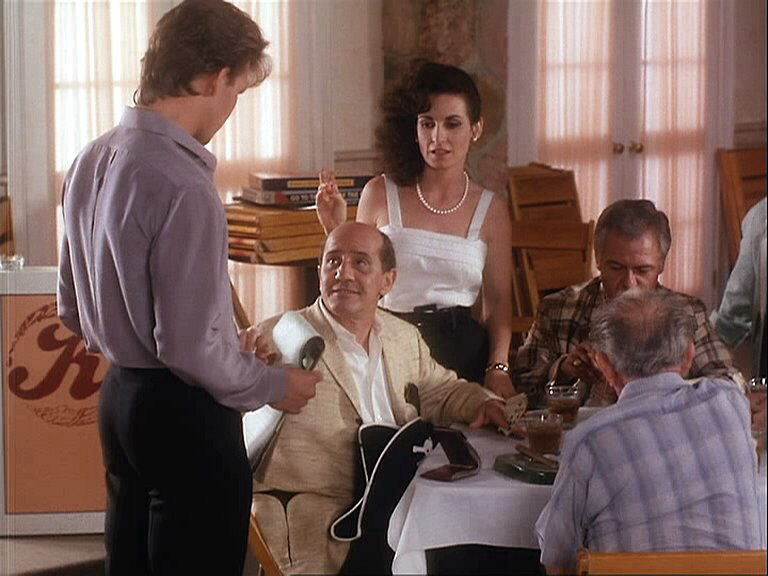
Johnny Castle and Vivian Pressman (Miranda Garrison) dancing
in the Kellerman gazebo in the 1987 "Dirty Dancing"
Bishop's role as Marjorie Houseman turned out to be a good stepping stone in her acting career. In the following year she went on to a big supporting role in the 1978 movie An Unmarried Woman, which was a commercial success and was nominated for three Academy Awards.

======

In the ABC Dirty Dancing original movie that was broadcast in May 2017, Pressman indeed is a major character who dances rather well. I suppose that the ABC movie's scriptwriters were informed by research and interviews about the 1987 movie's original story. Much of the original story was cut out as the script and film was edited.

In the 2017 ABC movie, Pressman is a former Miss Rhode Island beauty contestant who married a wealthy man. After her divorce, she herself remains quite wealthy. Although she is much older than Johnny Castle, she has been involved in a sexual affair with him rather openly for quite a while. She performs songs and dances in the Kellerman ballroom, whee she also dances with him as the orchestra plays.

Johnny Castle and Vivian Pressman dancing in
the Kellerman ballroom in the 2017 ABC "Dirty Dancing"
Unfortunately, I could not find any YouTube videos showing the Pressman character in the ABC 2017 movie. (I have been writing a long article about the ABC movie, which I will publish soon.)

Johnny Castle and Vivian Pressman dancing in
the Kellerman ballroom in the 2017 AC "Dirty Dancing"
I suppose that the 2017 ABC movie's Pressman is largely similar to the intended Pressman in the 1987 movie. By the time Bishop arrived for filming in 1986, however, the Pressman role had been reduced drastically. Because of Bishop's professional stature, she was compensated with the role of Marjorie Houseman.

======

In the 1987 movie, Castle's relationship with Pressman is rather secret, but in the 2017 ABC the relationship is quite public.

In the 1987 movie, Castle and Pressman are close in age. Castle was played by the actor Patrick Swayze, who was 35 years old, and Pressman was played by the actress Miranda Garrison, who was 37 years old. However, Pressman was supposed to be played by Bishop, who was 42 years old.

Vivian Pressman (Miranda Garrison) looking rather young and very sexy
in the 1987 "Dirty Dancing"
In the 2017 ABC movie, Castle was played by the actor Colt Prattes, who was 31 years old, and Pressman was played by Katay Sagal, who was 63 years old.

So, in the 1987 movie, the age difference between Castle (35) and Pressman (Garrison, 37) is only two years, whereas in the 2017 ABC movie the difference between Castle (31) and Pressman (63 is 32 years.

Vivian Pressman (Miranda Garrison, age 37) in the 1987 movie and
Vivian Pressman (Katay Sagal, age 63) in the 2017 movie
In the 1987 movie, the relationship is rather secret. In the 2017 ABC movie, the relationship is rather public.

I think that the Castle-Pressman relationship in the 2017 ABC movie is closer to the original story in Bergstein's mind as she was writing her screenplay.

======

 I speculate also that the original Castle-Pressman relationship was based in the Arthur Murray Dance Studio where Castle had learned to dance and worked in past years. In my previous blog article, titled Working as an Instructor at Arthur Murray, That article reported that rich female clients sometimes provided money for dance-studio owners and instructors to stay in business and open new studios. The Castle character perhaps viewed the Pressman character as a wealthy source of funding for a future dance studio..

======

I speculate further that Bergstein's originally conceived her third movie Let It Be Me as a sequel to Dirty Dancing. However, by the time Let It Be Me was filmed in 1994 (eight years after Dirty Dancing had been filmed in 1986), the story and main characters were differentiated greatly from those of Dirty Dancing.

In the movie Let It Be Me, male dancer, named Bud, is struggling to make his dance studio into a successful business. A young woman, named Emily, enrolls in dance lessons at the studio in order to practice dancing with her fiance for her upcoming wedding. It turns out that Bud and Emily know each other but have not had any contact with each other since they had ended a sexual relationship 12 years previously, when Emily had been 17 years old. In this regard, Let It Be Me seems to have been conceived as a Dirty Dancing sequel that would have brought Johnny Castle and Baby Houseman back together briefly in the year (1963 + 12 =) 1975.

If so, then Vivian Pressman might have been included as a continuing investor in the dance studio. Such a character is not included in Let It Be Me, but one character is rich, elderly woman who takes dance lessons at the studio and eventually marries one of the dance instructors, who is about her age. The falling-in-love relationship of these two elderly characters is quite charming and heart-warming.

If Let It Be Me had become a real sequel to Dirty Dancing and if Pressman had been included as a character, then Let It Be Me might have ended with Pressman's happy marriage to a dance instructor who was  about her own age.

In general, Let It Be Me provides much insight into the difficulties of managing a dance-studio business. Pressman as a wealthy female investor pressuring the male owner to make the business profitable could have been inserted into the story easily.

If Let It Be Me had become a successful sequel, then Bergstien well might have made a prequel about how Castle and Pressman had met at an Arthur Murray Dance Studio before 1963.

Through the three movies -- the prequel, Dirty Dancing and the sequel Let It Be Me -- the continuity would have been the relationship between Johnny Castle and Vivian Pressman.

Tuesday, June 13, 2017

The Arthur Murray Dance Studio

A dialogue between Baby Houseman and Johnny Castle
Baby
So where'd you learn to be a dancer?

Johnny
Well, this guy came into this luncheonette one day, and we were all sitting around doing nothing. And he said that Arthur Murray was giving a test for instructors.

So, if you passed, they teach you different dances, show you how to break them down, teach them.
======

The Wikipedia article about Arthur Murray includes the following passages:
Arthur Murray (April 4, 1895 – March 3, 1991) was an American ballroom dancer and businessman, whose name is most often associated with the dance studio chain that bears his name. ....

Arthur Murray was born in Galicia, Austria-Hungary, in 1895 as Moses Teichman. In August 1897, he was brought to America by his mother Sarah .... They settled in Ludlow Street, in the Lower East Side of Manhattan with his father, Abraham Teichmann.

Murray was shy as a child and self-conscious about his tall, lanky appearance. He wanted very much to be a part of the social activities that most of his friends enjoyed, particularly the dances, but was afraid to socialize with girls. At the age of 14, Joe Feigenbaum, a friend of his whom he admired because of his popularity with girls, taught him his first dance steps. To get practice on the dance floor, Murray attended weddings in his neighborhood, where he found willing dance partners of every size and age.

In 1912, at the age of 17, he taught dance at night while working as a draftsman by day. He studied under the popular dance team of Irene and Vernon Castle and went to work for them.

Murray won his first dance contest at the Grand Central Palace, a public dance hall where he later became a part-time dance teacher after graduation from high school. The first prize had been a silver cup, but Murray went home with nothing to show for his win. His partner of the evening took it; it was destined for a pawnshop. This loss made an impression on Murray, and in later years every winner in his dance contests took home a prize.

Between jobs as a dance instructor, Murray worked as a draftsman at the Brooklyn Navy Yard and as a reporter at the New Haven Register.

He soon began teaching ballroom dancing to patients from the greater Boston, Massachusetts area, at the Devereux Mansion Physical Therapy Clinic in Marblehead, Massachusetts, before moving to Asheville, North Carolina. At the outbreak of World War I, under the pressure of the anti-German sentiment prevalent in the U.S., Teichmann changed to a less German-sounding name.

In 1919, Murray began studying business administration at the Georgia School of Technology, and taught ballroom dancing in Atlanta at the Georgian Terrace Hotel. In 1920, he organized the world's first "radio dance"; a band on the Georgia Tech campus played "Ramblin' Wreck from Georgia Tech" and other songs, which were broadcast to a group of about 150 dancers (mostly Tech students) situated atop the roof of the Capital City Club in downtown Atlanta.

Murray was inspired by a casual remark made by William Jennings Bryan one evening at the hotel: "... You know, I have a fine idea on how you can collect your money. Just teach 'em with the left foot and don't tell 'em what to do with the right foot until they pay up!" Murray thought about Bryan's remark, and devised the idea of teaching dance steps with footprint diagrams supplied by mail. Within a couple of years, over 500,000 dance courses had been sold.

.

On April 24, 1925, Murray married his famous dance partner, Kathryn Kohnfelder, whom he had met at a radio station in New Jersey. She had been in the audience while he was broadcasting a dance lesson.

After their marriage, the mail-order business declined and the Murrays opened a dance school offering personal instruction. Their business prospered, especially in 1938 and 1939 when Arthur picked two little-known dances, the "Lambeth Walk" and "The Big Apple", and turned them into dance crazes. They were taught at hotel chains throughout the country, and the name "Arthur Murray" became a household word.

This business was expanded more widely in 1938, when an Arthur Murray dance studio franchise was opened in Minneapolis, Minnesota. Others followed. His slogan was: "If you can walk, we teach you how to dance", and the company guaranteed that the pupils learn to dance in ten lessons.

After WWII, Murray's business grew with the rise of interest in Latin dance, and he regularly taught and broadcast in Cuba in the 1950s. Murray went on television with a dance program hosted by his wife, Kathryn Murray, The Arthur Murray Party, which ran from 1950 to 1960, on CBS, NBC, DuMont, ABC, and then on CBS. ....

In the late 1970s. By then, there were more than 3,560 dance studios bearing his name. In 2007, about 220 Arthur Murray Studios remained in operation..
The Arthur Murray company has a webpage with an illustrated timeline of Murray's life and his company.

=======

The following video shows parts of an Arthur Murray Party episode that was broadcast in October 1958.


When this episode was broadcast, Baby Houseman would have been about 13 years old.

======

Later in this blog, I published a follow-up article titled Working as an Instructor at Arthur Murray.

Monday, December 29, 2008

Disconnected Women - Penny Johnson, Vivian Pressman and Marjorie Houseman

The movie Dirty Dancing begins with a doctor’s younger daughter exclaiming: “I thought I’d never find a guy as great as my Dad!” In the story that follows, this younger daughter Baby lost much of her ability to communicate with her father and transfered her main affection to a young man who worked as a dance instructor. Meanwhile the older daughter Lisa, who had been infatuated with a young man who was a medical student, began to talk much more with the father and then broke off her relationship with her medical-student boyfriend.

For each of these two daughters, their father Dr. Jake Houseman was a safe harbor. Each daughter could transfer her own affection and communication from the father to a young man, but if the relationship with the young man failed, then the daughter eventually could return to her father as a safe emotional haven.

Besides these two daughters, the story features three female characters – 1) Penny Johnson, a dance instructor, 2) Vivian Pressman, an adulterous married woman and 3) Marjorie Houseman, the doctor’s wife and the daughters’ mother. The first two of these women are disconnected, frustrated and angry throughout the story. The third is disconnected and frustrated, but not apparently angry.

-----

Penny Johnson, the female dance instructor, was kicked out of her home when she was 16 years old by her mother. There is no mention of her father. We can speculate that Penny was the child of an unplanned pregnancy, and we can suppose that she was an extremely rebellious teenager, beyond the control of her unmarried mother.

Penny told Baby what happened after she had been kicked out of her home by her mother:
Penny: I’ve been dancing ever since. It’s the only thing I ever wanted to do anyway.

Baby: I envy you.
Of course, what Baby envied was Penny’s beauty and dancing. Baby was oblivious to Penny’s deprivations and insecurities.

In a conversation with Johnny Castle’s cousin Billy Kostecki, Baby learned that Penny and Johnny were only a platonic, dancing couple now, but that they had been a romantic couple long ago, when they were still “kids”.
Baby: They look great together.

Billy: Yeah. You’d think they were a couple, wouldn’t you.

Baby: Aren’t they?

Billy: No, not since we were kids.
The movie’s dialogue provides several clues about this previous romantic relationship. We already know that Penny had always wanted to dance, that she had been thrown out of her home when she was 16 years old, and that she began working as a professional dancer immediately after she was thrown out of her home. One business that employs dancers is the Arthur Murray company, which teaches ballroom dancing. The movie’s author Eleanor Bergstein worked her way through college by teaching dance in this business. It seems, therefore, that Bergstein created her character Penny Johnson as a young woman who likewise began earning her living, while still a teenager, as a dance instructor in an Arthur Murray business.

(With regard to Penny’s being kicked out of her home, remember that both of Eleanor Bergstein’s parents died when she was in early twenties and that she therefore had to leave her own family home and go live with another family.)

The movie does not describe how Penny Johnson began working as a professional dancer, but it does mention how Johnny Castle was recruited to work as a dance instructor for the Arthur Murray company. When Baby asked Johnny where he had learned to be a dancer, Johnny answered:


Well, this guy came into this luncheonette one day, and we were all sitting around doing nothing. And he said that Arthur Murray was giving a test for instructors. So, if you passed, they teach you different dances, show you how to break them down, teach them.
Apparently, Johnny had been sitting in a luncheonette with a group of people who already knew how to dance well. A recruiter for the Arthur Murray company came into the luncheonette to recruit dance instructors (not dance students). We therefore can speculate that Penny already was working as an Arthur Murray dance instructor and that she knew that Johnny (with whom she had been in a romantic couple when they were still “kids”) and his friends had the dancing ability to become instructors too, and so Penny recommended to her supervisors at Arthur Murray that they go to the luncheonette and recruit Johnny and his friends.

We know from the dialogue that Penny had worked for a while as a Rockette dancer at some time before the story, but apparently she still was working with Johnny as an Arthur Murray dance instructor when the movie’s story takes place.

Based on all these clues, we can speculate further that Penny was thrown out of her home by her mother because of Penny’s relationship with Johnny – when they were still “kids.” Apparently, this relationship was sexual, because a mother does not throw her 16-year-old daughter out of her home because of a puppy-love relationship.

By the time of the movie’s story, however, the relationship between Johnny and Penny had become only platonic. They still worked together as a couple, performing and teaching dance, in the resort hotel. Johnny now was extremely promiscuous, having brief sexual affairs with several of the resort hotel’s female guests every week. And Penny now had fallen in love with Robbie Gould, a medical student who worked as a summer waiter in the resort hotel’s restaurant. Furthermore, Penny has become pregnant from Robbie, and Robbie has abandoned her and has refused to pay for her abortion. Johnny knew about Penny’s predicament and tried to help her as a friend.

Throughout the movie, Penny Johnson usually spoke angrily. In her first conversations with Baby, when Baby was just trying to express her own admiration toward her or to offer helpful suggestions, Penny responded with sarcasm and hostility. At one point, Penny hissed:
Baby? Is that your name? You know what, Baby, you don’t know shit about my problems. …. Go back to your playpen, Baby.
Gradually, however, after Baby provided the money for the abortion and offered to substitute for Penny in a scheduled performance at the other, Sheldrake resort hotel, Penny became civil and then candid with Baby. Penny also helped Johnny teach Baby how to dance.

In one scene, Penny was helping Baby were alone in a locker room as Baby was trying on Penny’s dress that Baby would wear in the performance at the Sheldrake. Baby said was afraid that she would forget her dance moves and techniques during the performance, but Penny reassured her and reminded her to let Johnny lead her.

At that moment, Penny had a lot on her mind, because she would go to the abortionist later that day. Then she said:
Thanks, Baby. I just want you to know that I don’t sleep around, whatever Robbie might have told you. I thought that he loved me. I thought it was something special. Anyway, I just wanted to know that. …. I’m scared. I’m so scared, Baby.
Later, after Dr. Houseman has treated Penny for her abortion complications, Baby and Johnny came to visit Penny, who was lying in bed.

In this conversation Penny spoke nicely to Baby, and then Baby left the room, leaving Penny and Johnny to talk together alone. By this time, Penny has recognized that Johnny and Baby have begun to have a sexual relationship, and so Penny and Johnny said to each other:
Penny (angrily): What are you doing? How many times have you told me, never get mixed up with them?

Johnny: I know what I’m doing.

Penny (angrily): You listen to me. You’ve got to stop it now.
In this conversation, Penny and Johnny are talking about the resort hotel’s rule that employees of their status were forbidden to become involved in intimate relationships with the guests. As dance instructors, Penny and Johnny were the two employees most likely to become involved in such relationships, so the prohibition was especially significant to them. Johnny nevertheless did become involved very promiscuously. He felt he could get away with violating the rule, because “I know what I’m doing,” but he frequently nagged Penny to obey the rule.

This conversation raises two questions.

The first question is what possible relationships had provoked Johnny to nag Penny in the past. It is possible that Penny had involved herself intimately with guests, but the only relationship we know about from the story is Robbie Gould, who at the time of the story was a medical student who worked as a waiter in the resort hotel during that summer. Perhaps Penny and Robbie had begun their relationship in a previous summer when Robbie was still just a guest visiting the resort hotel with his family.

The second question is why Penny objected so strongly to Johnny’s intimate relationship with Baby, when Penny surely knew by now that Johnny promiscuously involved himself with brief affairs with many female guests. What was it about Johnny’s relationship with Baby that caused Penny to warn Johnny so sharply? Perhaps the reason was simply Baby’s young age, perhaps it was that the hotel owners’ attention eventually might be attracted to the situation because of Penny’s abortion or because Baby had replaced Penny at the Sheldrake performance.

In any case , Johnny initially agreed that Penny’s warning was right. Immediately after he left that conversation with Penny, he encountered Baby and indicated to her that he was ending their affair. That resolve did not last long, but it was real for a while.

At the end of the story, Penny was professionally and romantically alone. Her dance partner Johnny had been fired by the hotel’s owner because of Johnny’s relationship with Baby, and Johnny had fallen in love with Baby and had declared his love publicly. Penny’s own future employment was endangered, and even her platonic friendship with Johnny was endangered.

In the meantime, Baby was now Johnny’s dance partner and romantic. Baby would begin attending college in a few weeks, and perhaps she could earn some money by working in her free time as a dance instructor, with Johnny, for an Arthur Murray business near her college. And then in the summers she and Johnny could work as dance instructors at some other resort hotel in the Borscht Belt (as the movie’s author Eleanor Bergstein had worked during her own college years).

Penny herself soon would resume working full-time as a dance instructor for an Arthur Murray business. If there was a shortage of male instructors, then she could suggest some good place, perhaps a luncheonette, where an Arthur Murray recruiter might find some young men who danced well enough to learn how to teach dance. But Penny herself was not getting any younger.

Penny still wanted to get married and start a family. After Dr. Houseman had treated the complications from her abortion, she was very relieved when he told her she still would be able to have children. At the end of the movie, Penny was angry that she still had no prospective husband in sight.

-----

Vivian Pressman was a middle-aged married woman. The resort hotel’s owner Max Kellerman described her to Jake and Marjorie Houseman as follows:

That’s Vivian Pressman, one of the bungalow bunnies. That’s what we call the women who stay here all week. The husbands only come up on weekends. Moe Pressman’s a big card player; he’ll join our game. He’s away a lot, I know. It’s a hardship.
While staying at the resort hotel during the week, Vivian Pressman paid Johnny Castle for dance lessons and also paid extra for sexual sessions. Johnny said that he had sexual relations with many female guests. At one point Johnny even remarked to Baby that “women are stuffing diamonds in my pockets.”

On the second-to-last night, the night before the talent show, Vivian walked up to Johnny, who was preparing for the talent show, and whispered: “This is our last night together, lover. I’ve got something worked out for us.”

A short time later, Johnny walked by a table where a group of men were playing cards. One of the men, Vivian’s husband Moe Pressman, gave Johnny $100 and said, “I’ve been playing cards all weekend, and I’ve got an all-night game tonight. Why don’t you give my wife some extra dance lessons?”

Obviously Vivian understood that her husband Moe preferred to play cards all night, so she had asked him to pay for dance lessons so that she could have some fun of her own. It’s not clear whether Moe knew and did not care that Vivian was having a sexual affair with Johnny or whether he simply was inattentive and oblivious about her adultery.

By this time, however, Johnny had decided that he wanted to stop his own sexual promiscuity and so he declined to take Moe’s money, saying: I’m sorry, Mr. Pressman, but I’m booked up for the whole weekend with the show. I won’t have time for anything else. I don’t think it’d be fair to take the money.”

Vivian was standing nearby and heard Johnny reject her husband’s money and indicate that he would be too busy preparing the talent show to give any dance lessons. Thus Vivian understood angrily that Johnny would not have another sexual session with her.

Vivian Pressman then arranged to have sex with Robbie Gould instead, and they were seen together in bed by Lisa Houseman when she herself went to Robbie’s cabin to have sex with him for the first time. Lisa was upset and left, leaving Robbie and Vivian alone in the cabin to continue their sexual session. This happened in the early evening. (Eleanor Bergstein mentioned in her running commentary that the scene was filmed “at dusk.”)

Early the next morning as Vivian Pressman was leaving Robbie Gould’s cabin, she saw Johnny Castle and Baby Houseman coming out of Johnny’s cabin. Johnny and Baby kissed, and so Vivian understood that Johnny had declined Vivian’s arrangements because he preferred to spend the night having sex with Baby.

Later that day, the resort hotel’s owner Max Kellerman fired Johnny for stealing Moe Pressman’s wallet. Kellerman explained that Moe’s wallet had disappeared while he had been playing cards all night. Moe was certain that he still had his wallet at 1:30 a.m., when the wallet was in his jacket that he hung from the back of his chair. Then at 3:45 a.m. Moe found that his wallet was missing from his jacket. Later, after Moe Pressman had reported the disappearance to Max Kellerman, Vivian Pressman told Kellerman that she had seen Johnny Castle walk close by the jacket during that night. Max Kellerman then accused Johnny Castle of the theft and fired him.

This sequence of events has some gaps that we can fill in. During the afternoon, Vivian Pressman had arranged for her husband to offer $100 to Johnny Castle for dance lessons, but Johnny refused the money and thus refused the sex session with Vivian. Then Lisa Houseman saw Vivian Pressman having sex with Robbie Gould in Robbie’s cabin at dusk, and so Lisa left. In the middle of the night, Vivian must have left Robbie’s cabin and gone to make a public appearance in the place where her husband Moe was playing cards.

Vivian would have made a public appearance at the gambling table for several reasons: 1) to make sure that Moe still intended to play cards all night, 2) to tell Moe that she was going to their hotel room to sleep, and 3) to get from Moe’s wallet the $100 that Johnny had rejected. Vivian then took the $100 back to Robbie’s room, gave him the money and spent the rest of the night in Robbie’s room. At dawn, she left Robbie’s room and saw Johnny and Baby kissing as they exited Johnny’s cabin.

Later that morning, when Moe told Vivian that his wallet was missing, Vivian responded that she had seen Johnny standing near the jacket, which was hanging from Moe’s chair. Therefore, Johnny was accused of the theft. This all happened before breakfast, because Max Kellerman told the Housemans during breakfast that he intended to fire Johnny for the theft.

Practically the entire audience of the movie assumes that Vivian incriminated Johnny in order to get revenge because Johnny had preferred to spend the night with Baby. I think, however, that a kinder explanation can be proposed. It’s hard for me to believe that Vivian really was so deliberately vindictive toward Johnny.

I think that when Vivian went to see Moe at the gambling table at 1:30 a .m., she did not steal the $100 from Moe’s wallet, but rather simply asked Moe openly for the money. Vivian told Moe that Johnny had found time after all, after the talent-show rehearsal, to give Vivian a dancing lesson after midnight. The lesson had just finished, and so she wanted to pay Johnny the promised $100 and then go alone to their hotel room to sleep. Vivian then returned to Robbie’s room and gave the money to Robbie.

Later, when Vivian was discussing the missing wallet with Moe, Vivian confirmed to him that she had seen the wallet in his possession at 1:30 a.m., when he had given her the $100 for Johnny. In order to strengthen her story, she even assured Moe that Johnny too had been with her right there near Moe’s chair, even though Moe had not noticed him. Later when Max Kellerman heard Vivian’s story, he concluded falsely that Johnny had stolen the wallet. But Vivian never had intended for anyone to blame Johnny. Vivian Pressman was not such an evil person. Rather she was a person whose dissatisfaction had led her into adulterous activities that eventually would cause problems for herself or for people around her.

The wallet was stolen by the Schumachers, an old couple who regularly visited resort hotels and stealing wallets from other guests. They must watched the card game very attentively and seen Moe Pressman give Vivian Pressman the $100, put his wallet into his jacket, and hang his jacket from his chair. Sometime after that time, 1:30 a.m., and 3:45 a.m., they stole the wallet from the jacket.

The Schumachers eventually were caught because Baby previously had noticed two wallets fall out of Ms. Schumacher’s purse and also had noticed the Schumachers at the Sheldrake resort hotel, where several wallets had been stolen. Based on this new information from Baby, Max Kellerman gave the police two drinking glasses that the Schumachers had used. The police took fingerprints from the drinking glasses and found that warrants had been issued for the arrest of the Schumachers for stealing from guests at resort hotels in Florida and Arizona.

We can suppose that Doctor Houseman pressured Max Kellerman to continue the investigation of the theft based on Baby’s new information. Max Kellerman already had made up his mind that Johnny Castle was guilty. Since, however, Doctor Houseman had saved Kellerman’s life when Kellerman had become sick with high blood pressure during a previous summer, Kellerman felt morally obligated to comply with Houseman’s insistence that Baby’s information be taken seriously. Doctor Houseman himself took Baby’s information seriously because he recognized how embarrassed she had been to admit to him, her father, that she had spent the night with Johnny.

Thus, toward the end of the movie, Vivian Pressman set dramatic, consequential events into motion when she asked her husband Moe Pressman for $100. At the beginning of the story, Baby Houseman had likewise set dramatic, consequential events into motion when she had asked her father Doctor Houseman for $250. These two incidents when women asked for money – once from a father and later from a husband – for secret, illegitimate activities provide a parallel and balanced structure to the story.

At the end of the movie, during the talent show, when Johnny took Baby up onto the stage to perform their dance, Vivian Pressman is seen in a front row sitting alone. Next to her is an empty chair, where her husband should be sitting. (Probably he has learned that she lied about Johnny Castle being at the gambling table and receiving the $100.) Vivian looks morose and angry, although all the surrounding audience, sitting as couples and families, looks happy.

-----

Marjorie Houseman, the wife of Dr. Jake Houseman and the mother of Lisa and Baby, plays a small role in the story. Jake Houseman keeps secret from her all the events and considerations involving Baby, the abortion money and the abortion complications. Jake even orders Baby to wipe the makeup off her face before her mother sees it. Marjorie also seems to be completely unaware of Baby’s romance with Johnny and of Lisa’s romance with Robbie.

Perhaps the original script included a larger role for Marjorie. Many scenes were cut because the movie was becoming too long. In addition, the actress who originally was supposed to play Marjorie became sick during the first week of filming after, so various changes had to be made unexpectedly. Kelly Bishop, the actress who was supposed to play Vivian Pressman was moved into the role of Marjorie Houseman, and Miranda Garrison, an assistant choreographer, replaced Bishop as Vivian Pressman. Perhaps some of Marjorie Houseman's role was diminished in these changes.


Marjorie Houseman is a homemaker who has raised two daughters. She always has hoped that her daughters will be able to fulfill themselves in ambitions careers. She named her younger daughter (Baby) Frances, after Frances Perkins, the first woman member of a Presidential Cabinet; the Secretary of Labor under President Franklin Roosevelt was Frances Perkins. (In the author 's own real family, Eleanor Bergstein was named after Eleanor Roosevelt and her sister Frances was named after Frances Perkins.)

In the movie's story, the oldest daughter already is attending college, and the younger daughter will enroll as a college freshman right after this summer vacation. Marjorie’s husband is a doctor who is wealthy enough to give his daughter $250 (1963 dollars) for no explained reason. Marjorie therefore will not have to get a job. Marjorie is entering a new period of her life in which she will have to re-define her own purposes and activities.

Perhaps Marjorie Houseman will become frustrated and angry. Perhaps her own marriage will become like the alienated hostile marriage between Vivian and Moe Pressman. Early in the movie, we see an entertainment show for the resort hotel’s guests. A male comedian tells a joke: “I finally met a girl, exactly like my mother – dresses like her, acts like her – so I brought her home. My father doesn’t like her!”

Later in the movie, Marjorie and Jake are putting golf balls, and Jake jokes to Baby: “If your mother ever leaves me, it’ll be for Arnold Palmer.” Apparently, Jake already senses some alienation and dissatisfaction in Marjorie.

In the original script, the scene was supposed to show Marjorie as the better golfer, and she was supposed to give Jake tips about improving his putting. Since, however, the actor playing Jake sank an amazing put, the scene was redone so that he gave her the tips. In that context Jake’s joke about Marjorie leaving him for Arnold Palmer made much more sense.

Perhaps the best expression of Marjorie Houseman's personality occurs in the last scene, when Johnny Castle has invaded the talent show and had grabbed Baby and was leading her to the stage to perform their dance. At that moment, Jake Houseman stood up to stop Baby, but Marjorie grabbed Jake and made him sit back down. Then when Baby began to dance brilliantly with Johnny on the stage, an admiring Marjorie says to Jake, "I think she gets this from me."

At this moment we can appreciate that Marjorie is much more relaxed than Jake about Baby's efforts. Marjorie is willing to watch Baby take some risks in her personal life. She seems to accept calmly the revelation that Baby has become personally involved with the dance instructor and become his dance partner. Marjorie genuinely admires Baby's dancing but feels that she herself possesses similar talents and spirit. When she sees Baby's accomplishment, she can honestly boast, "I think she gets this from me."

For Marjorie, the story ends very happily. She feels confident about her daughters' future accomplishments and probably also about her own.

Sunday, December 28, 2008

Eleanor Bergstein and Five Female Characters

Eleanor Bergstein, the author of Dirty Dancing, based the story on her own experiences. Like the movie’s main character, she grew up in a family that visited resort hotels in the Borscht Belt regularly during summer vacations.


Bergstein was born in 1938 and therefore was 17 years old in about 1955. The movie’s main character was 17 years old in the year 1963 and so would have been born in about 1946. The movie was issued in 1987 and told a story that took place in 1963, so the initial audience was looking back about 24 years.

Why didn’t Bergstein set the movie’s time in about 1955, when she herself was about 17?

Bergstein did not address that question in her running commentary about the movie, but she did say that she worked at such a resort hotel in her summers during her college years and also that she worked as an Arthur Murray dance instructor during her college years. If we estimate that she attended college as an undergraduate from about 1956 through 1959 and further attended as a graduate student from about 1960 to 1963, then we can suppose that her last summer working at the camp might have been in about 1963, which is the summer when the story takes place.

This suggests that Bergstein based two of the movie’s characters on herself:

  • the 17-year-old girl visiting the resort hotel with her family

  • the 25-year-old woman teaching dance at the resort hotel.

The movie does not specify the two dance instructors’ ages, but I read somewhere that Patrick Swayze was 35 years old when he played the movie’s dance-instructor, who was supposed to be 25 years old. (Likewise Jennifer Grey was 27 years old when she played the 17-year-old girl.) If the male instructor indeed was supposed to be 25 years old, then we can suppose that the female dance instructor was about the same age.

-----

In the movie, the female dance instructor, named Penny Johnson, had a platonic friendship with the male instructor, named Johnny Castle. Meanwhile she had fallen in love and become pregnant with a college student, named Robbie Gould, who had just been accepted into medical school. We can suppose that he was finishing his undergraduate studies and therefore was about 21 years old.

When Penny Johnson learned that Robbie Gould does not want to marry her, she decided to have an abortion, which could be done only on one particular night when she was supposed to perform a dance with the Johnny Castle. Therefore, the 17-year-old female guest agreed to learn the dance and then pretend to be Penny Johnson on that night. The 17-year-old female guest thus became the 24-year-old dance instructor in the story. Therefore we should appreciate that Eleanor Bergstein in her story perceived herself as both female characters, the younger one eventually becoming the older one.

There is a scene in the movie where the dance instructor danced behind and guided the girl as the girl began to learn to dance. There is another scene where the dance instructor and the girl were mirroring each other's movements. In both scenes we might say that the girl became the dance instructor.


Since Eleanor Bergstein’s own father was a doctor and her family life was happy, we can suppose that she herself as a young woman would have idealized a husband who would have been a doctor. She therefore could have imagined herself as easily seduced by a medical student. Perhaps she even had such an experience.

The dance instructor’s name is Johnny Castle, and the father’s name is Jake Houseman. Both their first names – Johnny and Jake – are nicknames for the proper Biblical name Jonathan.

-----

Both of Eleanor Bergstein's parents died when she was in her early twenties. She was affected most profoundly by the death of her mother, about which she later wrote: “Losing my mother was so frightening. I had an almost total absence of hope, and I closed myself off, unable to face the grief and the pain.”

After both her parents died, Eleanor went to live with another family that had many relatives who had died in the Holocaust. This new family talked about these murdered relatives almost every day, which made Bergstein even more depressed.

She tried to continue making a living a dancer as a professional dancer but then gr1adually became a novelist and then a screenwriter. She married a man who became a professor of poetry at Princeton University. Many of her stories, novels and screenplays included dancing as a story element.

In 1980 a movie based on one of her screenplays was issued. The movie was titled It’s My Turn and starred Jill Clayburgh, who played a mathematics professor, and Michael Douglas, who played a former professional baseball player who had to retire early because of an injury. Each of these two characters had lost a parent through death, and the surviving parents fell in love and married. The two characters met at the wedding of their parents and then fell in love themselves, even though they now were step-sister and step-brother. The script included a scene where the two characters dance, which then leads to their first sexual experience together. The dance scene was removed from the movie’s final version, however, which dismayed Bergstein.

The removal of this dance scene from It’s My Turn decisively motivated Bergstein to write the movie Dirty Dancing, in which dancing is the main theme.

--------------

Eleanor Bergstein was named after Eleanor Roosevelt, but she was called Baby by her family and friends through her teenage years. She had an older sister named Frances, who was named after Frances Perkins, who was President Franklin Roosevelt’s Secretary of Labor from 1933 to 1945.

In the movie Dirty Dancing, the central family’s name is Houseman, its older daughter is called Lisa, and its younger, 17-year-old daughter is called Baby. After Baby became intimate with Johnny Castle, he asked her what her real name was, and she told him that it was Frances, because her parents had named her after the first female member of the US Cabinet.

In the movie, the older sister Lisa was frivolous, and her main interest was beauty and fashion. She thought she might have a successful career in show business and she gladly participated in the resort hotel’s talent show. The audience sees her rehearsing for her talent-show performance, and it is obvious that she had no performance talent and would never succeed in show business.

In the movie, the younger sister Baby (Frances) was very serious and intended to major in international economic development when she began her studies soon at Mount Holyoke College, a prestigious women’s college. At the beginning of the movie, she was already reading a textbook about the economics of peasant societies. She had a plain appearance and she dressed drably (during the first half of the movie). On one occasion Lisa suggested to Baby that she restyle her (Baby’s) hair in a more attractive appearance, but Baby is not interested. When the hotel owner’s grandson flirted with Baby, she tried to avoid him.

In real life, the older sister Frances was the unemotional, serious, intellectually ambitious sister. Frances eventually became a mathematics professor and served as the basis for the character played by Jill Clayburgh in Bergstein’s movie It’s My Turn.

In real life, the younger sister Eleanor was the frivolous, entertaining sister, always called Baby by everyone who knew her. Eleanor worked as a professional dancer, married a poet, lived a Bohemian life, strove to break into show business, and eventually made a career as writer and producer of chick flicks.

Thus we should appreciate that Eleanor Bergman saw herself in three of the movie’s main female roles, as

  • Baby Houseman,

  • Penny Johnson,

  • Lisa Houseman.

The third role is an inside joke for people who know Eleanor Bergman’s real family and who recognize that the two sister’s names and personalities have been switched. Whenever the movie makes fun of the older sister Lisa as a frivolous nitwit who, for example, obviously never will achieve her fantasy of succeeding as a dancer in show business, the movie really is making fun of Eleanor Bergstein herself. And when the movie depicts Baby Houseman as a serious young intellectual, the movie is attributing the real older sister Frances’s most admirable characteristics to the real younger sister Eleanor.

-----

In general, the movie scrambles the two sisters Lisa and Baby and the female dance instructor Penny Johnson. As I have already pointed out, Baby eventually became Penny Johnson. Furthermore, Lisa and Penny fell in love and had sex with the same medical student Robbie Gould. Meanwhile Baby fell in love and has sex with the male dance instructor Johnny Castle, who initially seemed to be the lover and impregnator of Penny. While writing her script, the author Eleanor Bergstein apparently saw herself in each of these three female characters and in each of their situations.

-----

The family’s mother, Marjorie Houseman, plays a role in the film, but because of an unexpected fluke, her role was altered significantly. In real life, Eleanor Bergstein’s real mother, who was a doctor’s wife and a homemaker, had enough money and time to become a superb golfer. On the other hand, Eleanor Bergstein’s real father, who was a busy doctor, always remained a mediocre golfer. Therefore Eleanor Bergstein wrote into the script a scene where both parents are practicing on a putting green. The scene was supposed to display the mother’s competence and give her an opportunity to instruct her husband.

When the scene was filmed, however, the actor playing the father (Jerry Orbach) happened to sink two long puts in a nonchalant manner. Furthermore, the second put swirled around the hole three or four times before it fell in. Since the director Emile Ardonlino enforced a strict rule that all actors must continue to play their roles seriously, even if something unexpected happened, the actor maintained a straight face even though he was supposed to miss both puts.

This unexpected feat, all caught perfectly on film, was so hilarious that Eleanor Bergstein immediately rewrote the dialogue so that the father subsequently instructed the mother condescendingly about her golf technique. One dialogue line that did remain was the father’s remark that if he ever died, the mother probably would immediately marry Arnold Palmer (the most famous professional golfer of that time).

During her running commentary about the film, Eleanor Bergstein told this story about the change of dialogue in the putting scene and apologized to her deceased mother for demeaning her well-deserved reputation as a superb golfer.

Some of the mother’s dialogue might have been removed from the film because the actress who began to play the mother while the movie was being filmed became sick after several days and was replaced. (In one of the first scenes, when all the guests are arriving and unloading their cars, the mother is a blonde, but during the rest of the movie she is a brunette.)

In the scenes where we do see the mother acting, she is restraining the father’s angry reactions to Baby’s actions. For example, in the last scene when Johnny Castle barges into the talent show and grabs Baby and leads her toward the stage, the father rises from his chair to interfere, but the mother grabs the father and pulls him back into his chair.


Thus Eleanor Bergstein intended to present the mother as a strong and capable mother who encouraged her daughters to succeed as independent women. The movie states explicitly, for example, that the younger daughter had been named after the first woman to serve in the US Cabinet (although in the real family the older sister was so named) and was sending this daughter to attend a prestigious women’s college. Thus we should appreciate that the movie’s author Eleanor Bergstein intended to identify the mother with the daughter. This was a mother who wanted to realize her own frustrated professional ambitions through her intellectual, studious, ambitious daughter Frances (the older daughter in the real family).

Thus the author Eleanor Bergstein identifies herself with four of the movie’s female characters:

  • the younger daughter Baby Houseman,

  • the dance instructor Penny Johnson,

  • the older daughter Lisa Houseman,

  • the mother Marjorie Houseman,

-----

The movie features a fifth female character, named Vivian Pressman. She was a middle-aged female guest, married to a man who spent much of his time at the hotel resort gambling. She took dance lessons from Johnny Castle and had a sexual affair with him. Thus she resembled Baby Houseman, who likewise took dance lessons from and had a sexual affair with Johnny Castle.

(When the actress who was supposed to play the mother had to drop out of the movie because of an illness, she was replaced by the actress, Kelly Bishop, who was supposed originally to play Vivian Presssman. In turn, the role of Vivian Pressman was filled by an assistant choreographer, Miranda Garrison, who had helped train the female “dirty dancers” in the cast. The unexpected but perfect placement of dirty-dancer, sluttish Garrison into the Pressman role is irrefutable proof that the production of the movie Dirty Dancing was inspired, favored and guided miraculously by Mankind’s Loving and Omnipotent God.)

Another similarity is that both Vivian Pressman and Baby Houseman gave money to Johnny Castle for sexual reasons. Vivian Pressman arranged for her gambler husband to give $100 to Johnny Castle for dance lessons, although it is apparent that Vivian Pressman hoped that this monetary payment would enable her own sexual affair with Johnny Castle. On the other hand, Baby Houseman arranged for her father to give $250 to Johnny Castle for Penny Johnson’s abortion.

Eventually, Vivian Pressman was rejected by Johnny Castle and so had a sexual affair instead with the medical student Robbie Gould. The older sister Lisa Houseman intended to have a sexual affair with this same Robbie Gould, but this intention was interrupted when she found Gould and Pressman in the act of sexual intercourse.

Thus, we should appreciate that Eleanor Bergstein identified herself finally with this fifth female role too. This was an older, predatory female that the younger, idealistic females might become. Vivian Pressman competed with the younger sister Baby Houseman for a sexual affair with Johnny Castle and then competed with the older sister Lisa Houseman for a sexual affair with Robby Gould. Although Baby Houseman defeated Vivian Pressman in the competition for Johnny Castle, Pressman subsequently accused Castle of stealing money from her husband and so caused the hotel resort owner Max Kellerman to fire Castle, which seemed to ruin Baby Houseman’s relationships with Castle and with her father.

Vivian Pressman is the movie’s main villain, but the author Eleanor Bergstein identifies with her too. When Bergstein finished writing Dirty Dancing in about 1984, she herself was in her mid-forties, about the same age as the Vivian Pressman character. Vivian Pressman represents the middle-aged Eleanor Bergstein’s enduring, competitive, wicked lust for sexual adventures and experiences with attractive young men.

Thus we should appreciate that Eleanor Bergstein herself identified with the movie’s five main female characters:

  • the 17-year-old idealistic younger daughter Baby Houseman,

  • the 25-year-old talented dance instructor Penny Johnson,

  • the 19-year-old frivolous older daughter Lisa Houseman,

  • the admirable, faithful middle-aged wife and mother Marjorie Houseman,

  • the contemptible, adulterous middle-aged wife Vivian Pressman,